Table of Contents
You call one supplier and get a quote of $38 per ton. You call the next and they say $67. A third one tells you to come pick it up yourself for $22. Same material. Same zip code. Same project. It happens all the time, and if you’re trying to price the cost of crushed stone per ton in 2026, the national range is about $10 to $50 per ton, with limestone often landing around $30 to $55 and river rock around $33 to $75+, depending on stone type, grade, and region. Without that baseline, it’s hard to know which number to trust or which deal you’re leaving on the table.
Crushed stone cost per ton ranges vary more than most people expect, and that spread isn’t random. DIY homeowners, landscaping enthusiasts, small contractors, and property owners planning driveways, patio bases, drainage, or decorative rock projects need more than a rough quote—they need to know how stone type, grade, delivery distance, regional quarry density, and order size push the number up or down in predictable ways. By the end of this article, you’ll know what to expect per ton by stone type and region, what delivery and labor can add, how to convert your project dimensions into tons before you call anyone, and a few practical ways to reduce your total material bill. We’ll also point you to the Crushed Stone Calculator so you can lock in your own numbers before picking up the phone.
Crushed Stone Price Per Ton 2026: What You’ll Pay
National crushed stone prices and price ranges by stone type
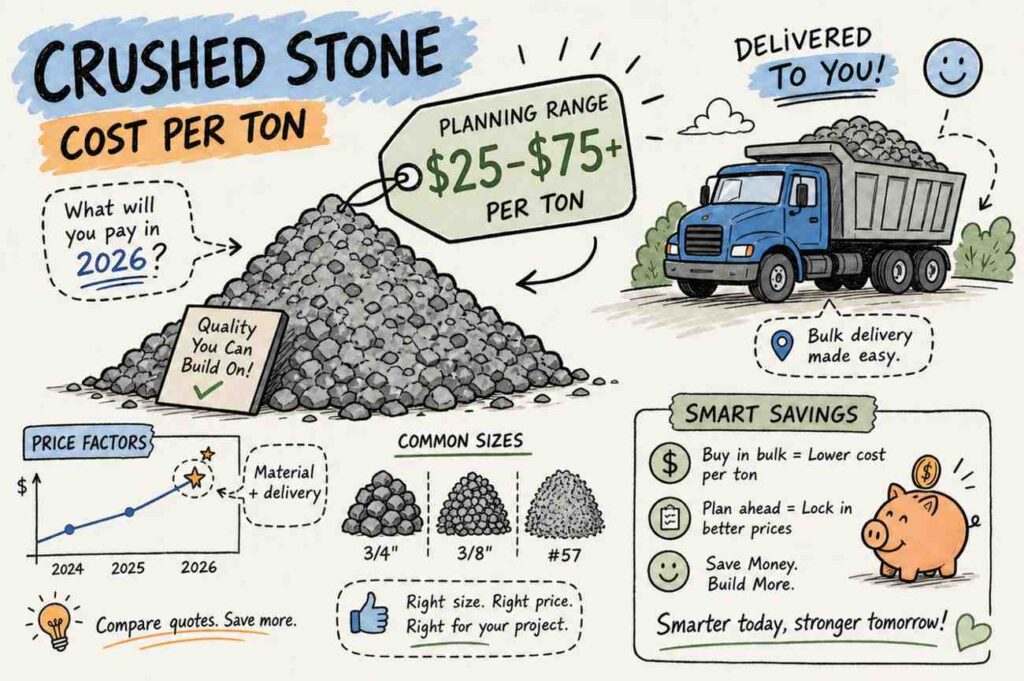
The national range for crushed stone sits between $10 and $50 per ton as a rough starting point, but that spread is too wide to be useful on its own. The real number depends heavily on what kind of stone you’re buying. Here’s where the four most common types land when looking at crushed stone prices in 2026:
- Limestone: $30-$55 per ton
- Crushed granite: $25-$50 per ton
- Pea gravel: $28-$45 per ton
- River rock: $33–$75+ per ton
Limestone is often one of the more affordable options in regions with nearby limestone quarries, and while gravel costs and crushed stone prices have generally risen over the past decade as extraction and production costs increased, local availability and haul distance still move the price higher or lower. Demand tied to highway and bridge construction and other infrastructure projects also helps keep aggregate consumption high and influences pricing. Granite is abundant too, but crushing it requires more energy, which nudges the price up. River rock carries a premium because it’s often sorted, washed, and sold for decorative purposes rather than bulk structural use. By comparison, crushed concrete often runs about $11 to $53 per ton, and concrete recyclers commonly sell that recycled aggregate below virgin decorative materials. Basic structural materials such as road base usually cost less than specialty landscaping stone. (Price ranges are based on supplier surveys and regional aggregate market data current as of early 2026.)
How stone size and grade move the number
Within each stone type, grade and sizing shift the price further. Limestone is a good example. Crushed limestone fines run $30-$40 per ton, #57 limestone, the half-inch to one-inch workhorse used in driveways and drainage beds, runs $35-$50 per ton, and larger decorative sizes push toward $40-$60 per ton. The crushing, sorting, and washing involved in producing finer or more uniform grades adds cost at the quarry before the stone ever reaches you.
For your project, this matters in a practical way. Driveway base layers often use crusher run or another specified dense-graded base, while French drains typically use clean, washed #57 stone or a similar free-draining aggregate. Crusher run is often the cheapest option per ton and compacts beautifully. Decorative applications like garden borders or exposed aggregate patios may use pea gravel or river rock, which often cost more per ton because they are selected and processed for appearance. Knowing the right grade going in gives you a real price target before any supplier conversation starts.
Regional crushed stone cost per ton in 2026
Regional price breakdown at a glance
Where you live matters almost as much as what you’re buying. The crushed rock price per ton varies significantly by region. In 2026, Northern states run $40-$80 per ton, Southern states run $35-$60 per ton, and Western states show the widest range at $30-$100 per ton depending on location. The Midwest often lands on the lower end of the national range, thanks to a dense network of active quarries driving competition.
Texas and Florida have extensive quarry networks that create genuinely competitive local markets, keeping Southern pricing lower. California’s strict environmental regulations, including CEQA review requirements and tight air quality controls, add real overhead to quarry operations and push delivered prices to the high end of the Western range, commonly $34-$101 per ton. By contrast, areas near the Great Lakes benefit from water transport options that reduce hauling costs and help moderate prices in those Northern markets. Regional pricing can also spike during peak construction seasons or after severe weather, when local demand and supply conditions tighten.
Why quarry distance is the single biggest price lever
Crushed stone is a heavy material, so transportation costs often become the biggest driver in the delivered price. The same #57 limestone that costs $38 per ton from a quarry 10 miles away can run $65 per ton if it has to cross a mountain range or ship across state lines. Fuel, driver time, and road wear don’t disappear, they just get added to your invoice.
Before you assume any price, find out where the nearest active quarry or aggregate yard is located relative to your job site. A quick call or search for local suppliers—especially the exact query ‘crushed stone quarry near me’—gives you a solid benchmark. Most states also list certified aggregate suppliers on their DOT websites. Proximity to the source almost always means a lower rate, and nearby aggregate suppliers can often deliver directly to the project site or let you self-haul if the savings justify it.
Delivered crushed stone cost: fees, truckload minimums, and the charges buyers miss
Flat fee vs. per-mile pricing structures
Delivery costs come in two common structures. The first is a flat rate per ton, typically $10-$25 per ton for standard service within the supplier’s delivery zone. The second is per-mile pricing, where some suppliers charge around $10 per mile beyond a base radius of roughly 5 miles. For example, on a 5-ton delivery, if your job site is 20 miles from the supplier’s yard and the first 5 miles are included, the remaining 15 miles could add about $150 in mileage charges.
Some regions use entirely different models. Some suppliers use flat trip fees by delivery zone instead of per-mile pricing. In higher-cost or longer-distance delivery zones, delivery fees can run from a few hundred dollars to nearly $1,000 depending on location, access, load size, and supplier policy. Always ask whether your quote uses a flat trip fee, per-mile rate, or per-ton delivery charge before comparing suppliers. That’s a completely different calculation than per-mile pricing. Always ask your supplier explicitly how they structure delivery before comparing quotes, because two numbers that look similar can include very different delivery assumptions.
Full truckload pricing and minimum order thresholds
As a rough planning example, a delivered truckload can run around $1,200-$2,400 in some markets for trips within roughly 50 miles, while minimum delivery orders may start around 5 tons or 10 cubic yards depending on the supplier. Actual charges vary by material, truck capacity, haul distance, access, and local supplier policy. For larger projects, a full truckload can be one of the most cost-efficient options because fuller loads spread delivery costs across more material, and some suppliers also offer bulk or volume pricing. For smaller projects, some suppliers offer free delivery above the 5-ton threshold within a short radius.
If your project falls below the minimum, the self-haul option is worth pricing out. Renting a dump truck costs roughly $450 per day from major rental companies, which is a significant upfront cost. For very small loads, hauling with a pickup truck rated for the weight can work well. Smaller quantities usually carry a higher per-ton delivered price than larger orders, so buying gravel is often less economical at low quantity. Knowing exactly how many tons you need before you call is what lets you choose the right delivery option instead of defaulting to whatever the supplier suggests. For quick estimates on delivery and price impacts, some suppliers publish price sheet calculators that let you model trip fees and per-ton charges.
From square feet to tons: running the numbers before you call
The formula that actually works
Converting your project area to tons takes three steps, and accurate measurements help determine the amount needed. Multiply length (feet) by width (feet) by depth (feet) to get cubic feet, divide by 27 to get cubic yards, then multiply by the appropriate density conversion factor for your material. For many common crushed stone and driveway gravel products, that factor often falls around 1.4 to 1.5 tons per cubic yard. Broader crushed stone and dense base materials may range from about 1.3 to 1.7 tons per cubic yard depending on material density, moisture, and gradation.
Here’s a concrete example. A 10 ft by 40 ft driveway section at 2 inches deep works out like this: 10 × 40 × (2/12) ÷ 27 = 2.5 cubic yards. Multiply by 1.4 and you get 3.5 tons of #57 stone. That 3.5-ton estimate is the number you would use when asking a supplier for a ton-based quote. For comparison, a 20-foot by 10-foot driveway at a 3-inch depth equals about 1.85 cubic yards before converting volume to tons. Different stone densities produce different tonnage results, and that gap is one of the most common reasons people over-order or run short mid-project. Understanding the price per cubic yard of crushed stone alongside the per-ton rate also helps you cross-check supplier quotes when they switch between units. If you want a quick conversion tool for cubic yards to tons, a simple cubic yards to tons converter can verify your math. When estimating how much gravel to order, adding 10-15% extra material can be a practical planning allowance for site conditions, placement variation, and waste, but it should not be treated as a universal compaction factor.
Using a calculator to get it right before ordering
If you’d rather skip the arithmetic, the Crushed Stone Calculator helps estimate quantity, weight, and optional material cost before ordering. You enter your project shape (rectangular, circular, or triangular), dimensions, depth, and material type, and the tool outputs cubic yards and estimated tons with a built-in waste factor. If you enter your supplier’s price per ton, it also calculates an estimated material cost. It accounts for selected material density differences between limestone, granite, pea gravel, river rock, and other common materials, giving you a supplier-ready estimate to discuss before ordering.
Use it before you call. Get your number locked in, then contact a supplier’s team for pricing information with a specific tonnage rather than a vague description of the project, that shifts the conversation immediately. As a quick sanity check for material around 1.35 tons per cubic yard, one ton covers roughly 120 square feet at 2 inches deep, 80 square feet at 3 inches, or 60 square feet at 4 inches. Denser materials cover less area per ton, so use the calculator’s material-specific density for the final estimate. For materials near 1.35 tons per cubic yard, a calculator result close to those benchmarks is a useful sanity check.
Material cost vs. what you’ll actually pay for a finished project
What labor adds to the installed price
Material cost and installed cost are two different numbers, and conflating them leads to budget problems. Current 2026 cost guides vary, with some putting gravel driveway installation around $1-$4 per square foot and others reporting about $4-$10 per square foot for professionally installed projects. Site preparation, excavation, drainage, gravel depth and type, labor, equipment, and location account for much of that spread. On professionally installed projects, labor can account for around half of the total cost in some estimates, with installation labor commonly ranging around $30-$100 per hour per worker. Material-only or DIY costs can be much lower, so a low gravel price per ton does not translate directly into the same low installed cost. Residential and commercial construction activity also affects crushed stone consumption and can move contractor-facing material pricing. For broader market references on typical gravel project costs and installed pricing, see a general gravel prices guide.
For DIY projects, the material cost benchmark is what matters most. For anyone hiring out, knowing both numbers lets you evaluate a contractor’s quote intelligently. A quote that seems high on the total might reflect reasonable labor rates plus market-rate material; a quote that seems low might signal cheap material that won’t hold up.
Project cost benchmarks for common applications like pea gravel
Some practical benchmarks for 2026: a basic gravel driveway installation may run around $120-$255 per 100 square feet in lower-cost or minimally prepared conditions, while more involved professional installations can cost substantially more; base layers for patios, walkways, and similar material-only uses like gravel mix, fill, or erosion control cost $20-$40 per cubic yard; and decorative landscaping gravel runs $0.40-$3 per square foot for material only depending on stone type. These ranges reflect real project costs across the US market and give you a starting point for budget planning.
Stone selection plays a direct role in where you land within those ranges. Using crusher run for a compacted base layer instead of pea gravel can reduce material cost while providing a more suitable compacted base for many driveway, patio, and walkway applications. Properly processed steel slag, a byproduct of steel production, is sometimes used as aggregate in granular base applications where local specifications allow it. Where crushed stone is used as concrete aggregate, it should meet the applicable project specifications and aggregate standards, such as ASTM C33/C33M in the United States. Crusher run compacts firmly and binds together under load, making it well suited to many compacted base applications, but because it contains fines, it is not a free-draining aggregate. Paying for river rock’s rounded finish under a patio slab that no one will see is money that doesn’t need to be spent.
How to pay less for crushed stone in 2026
Self-haul vs delivery: when it’s worth the effort
If delivery adds $10-$25 per ton on a 5-ton order, that’s $50-$125 in fees. A dump truck rental runs around $450 per day, which makes self-haul cost-effective only in specific situations. For orders under about 5 tons, self-hauling may be worth considering when the quarry is close, but each pickup load must stay within the vehicle’s rated payload and axle limits, so multiple trips may be required. For loads around 5-8 tons, a single trip in a suitably rated rented dump truck may still beat delivery in some cases, depending on rental cost, fuel, haul distance, and local delivery rates.
For larger projects, the math often flips. Multiple self-haul trips can add rental time and fuel costs quickly. Around 5-8 tons is a useful comparison point rather than a fixed tipping point; above that, delivery often becomes more attractive when the supplier can move the load in one trip. Compare the delivered quote with rental, fuel, travel time, and truck capacity before deciding.
Order size, timing, and supplier comparison
A few tactics consistently reduce the final bill. Order at or above the supplier’s minimum threshold to unlock free or discounted delivery. Time your order for late fall or early spring when demand drops and some quarries offer better pricing to keep trucks moving. And get at least three local quotes before committing, the same material can vary 20-30% between suppliers in the same county, which is real money on any order over 5 tons.
When you call, ask specifically about bulk pricing and truckload rates. Standard online quotes rarely show the best available price. A direct question about what the rate looks like at 10 tons versus 5 tons almost always opens a conversation that a web form won’t.
Choose the right drainage stone for the job
Using the cheapest stone that meets the structural requirements for your application isn’t cutting corners, it’s the correct decision. Crusher run often costs less than river rock and is generally better suited to compacted base applications under driveways, patios, or walkways. Drainage stone should be clean, free-draining, and low in fines; the exact size and stone type should match the drainage application and local specifications. For compacted paver bases or leveling work, use the base and bedding materials specified for the paving system, typically a properly graded aggregate base with an approved bedding material rather than free-draining drainage stone. Matching material to function prevents paying for properties, like visual texture or sorting uniformity, that your project doesn’t need.
Your total project cost is a product of price per ton multiplied by tonnage. Getting the tonnage right through an accurate estimate, and selecting the appropriate material grade, is where the real savings come from. Every ton of over-ordered premium stone that you didn’t need is money that walked out your gate on a dump truck. Some suppliers also sell certain rock by the piece rather than by weight, so confirm the unit before comparing quotes. For a deeper look at current per-ton pricing and load factors you can reference a detailed gravel cost per ton guide that outlines common pricing drivers and regional differences.
Putting it all together before you call a supplier
If you started reading this with three confusing quotes and no framework to evaluate them, you now have one. According to the U.S. Geological Survey, U.S. crushed stone production was about 1.5 billion metric tons in 2025. USGS expected infrastructure funding and major investments in manufacturing, energy, and data-center facilities to support continued aggregate demand in 2026. Stone type and regional quarry density set your baseline per-ton price. Delivery fees and minimum order thresholds are major variables, and some suppliers may offer better terms depending on order size, distance, and local policy. Calculating your tonnage accurately before calling is the single move that separates an informed buyer from someone guessing on the phone.
Head to Crushed Stone Calculator, plug in your dimensions, pick your material, and nail down your crushed stone cost per ton in 2026 before you contact a single supplier. If you’d like to know more about the site and how the estimates are put together, see our About Us page, or browse our Crushed Stone Guides, Crushed Stone Calculator for detailed walkthroughs and examples. Note: product availability, units, and specs can vary by yard. Walk into that conversation with a supplier-ready estimate, a clear material grade, and a better idea of what delivery should reasonably cost in your area, and check whether related aggregates like sand are priced separately. That’s when the quotes start making sense.
Pingback: Understanding Limestone Pricing: A Comprehensive Guide for Buyers
Pingback: Understanding the Price for Gravel: What to Expect and Consider
Pingback: Understanding the Benefits of SB2 Gravel for Your Landscaping Needs
Pingback: 1 Inch Minus Gravel: Uses, Benefits, Installation Tips, and How Much You Need
Pingback: Understanding Crusher Stone Price: A Guide for Buyers and Contractors
Pingback: 3/4 Crushed Stone Price Per Ton & Yard (2026)
Pingback: What Is 22A Gravel? Uses, Sizes, Cost & How Much You Need
Pingback: Pea Gravel Prices in 2026: Per Ton, Per Yard & Installed