Table of Contents
When choosing between limestone vs granite gravel for your next project, the decision often trips people up because both materials look nearly identical in a pile. You’re standing at a supplier counter or scrolling through a quarry’s price sheet, and the choice comes down to two options: limestone or granite. Both are crushed, both are angular, and both are sold by the ton. That similarity is exactly what makes the choice feel harder than it needs to be.
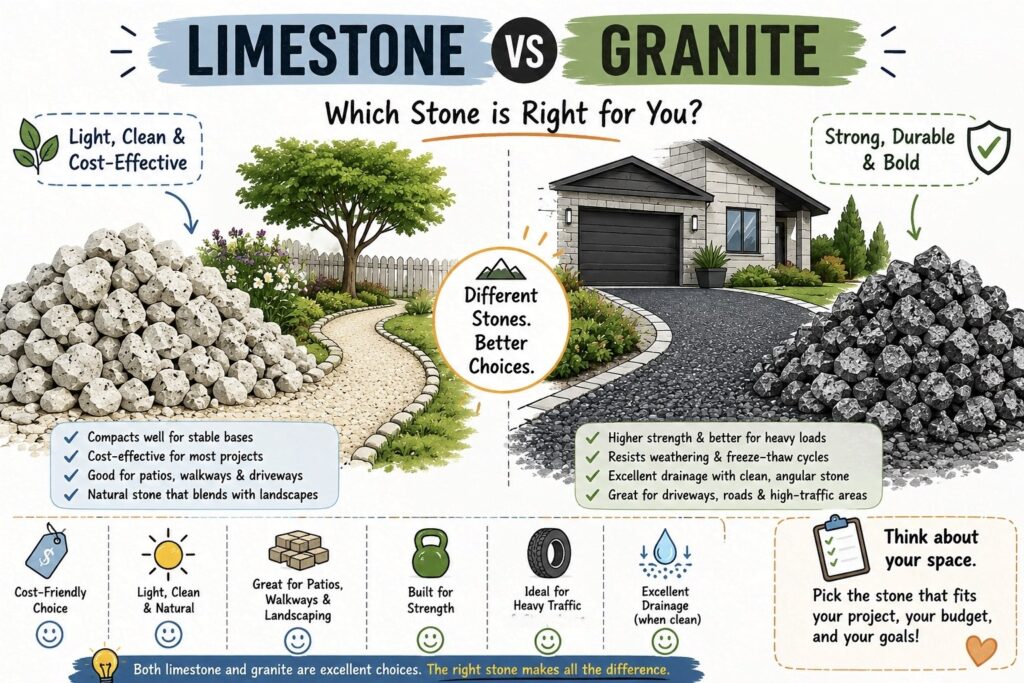
The truth is, these two materials perform differently in ways that matter for your specific project. One compacts into an exceptionally tight base for less money. The other handles harsh conditions better and won’t mess with your garden soil chemistry. Once you know which stone fits your project, you can drop your dimensions into the Crushed Stone Calculator to get a supplier-ready tonnage estimate. But the material choice comes first.
This guide covers the four factors that drive the decision: performance, cost, project fit, and installation depth. By the end, you’ll have a clear answer, not a list of maybes.
Crushed Limestone vs Crushed Granite: What Separates Limestone and Granite at the Material Level
Limestone is calcium carbonate, a sedimentary rock that forms from compressed marine deposits. It sits around 3 on the Mohs hardness scale, making it noticeably softer than granite, and it runs roughly 95-105 pounds per cubic foot dry. Granite, on the other hand, is an igneous rock fused from quartz, feldspar, and mica. It lands at 6-7 on the Mohs scale and weighs in at 100-110 pounds per cubic foot dry. That density difference matters when you’re ordering: a cubic yard of granite weighs more than a cubic yard of limestone, so you’re buying more weight per cubic yard without necessarily getting more volume.
Visually, limestone tends to show up gray-white and weathers to a lighter, slightly dusty finish over time. Its fines gradually produce a semi-cemented surface, which is part of why it packs so well. Granite holds its color longer, whether that’s gray, pink, or speckled, and it doesn’t produce the chalky dust that limestone can. For most base course and driveway work, appearance is secondary to performance. But for a garden path or a visible landscape feature, that color difference is worth factoring in.
Limestone vs granite gravel: compaction, load-bearing, and drainage
Compaction and load-bearing of crushed limestone
Both materials are angular, and angular stone compacts well. The distinction shows up under sustained load. Granite’s hardness means particles resist breaking down under pressure, which makes it the stronger choice for heavy vehicles, steep driveways, or high-traffic situations. Limestone, particularly dense-graded mixes like 610 limestone, compacts into a remarkably tight base that approaches concrete-like rigidity. It’s the dominant base course aggregate across much of the American Midwest and South, driven largely by regional geology and quarry distribution rather than marketing preference.
For light-to-moderate residential traffic, limestone compacts cleanly and costs less. For heavy loads, commercial use, or demanding terrain, granite holds up longer without the particle breakdown that can loosen a surface over time. In practice, particle breakdown on a limestone driveway shows up as loose, shifting surface material and small depressions that develop under tire tracks over several seasons.
Drainage and freeze-thaw performance of crushed granite
Drainage behavior splits along a different line. Clean, open-graded stone of either type drains well. The difference appears when fines are present. Limestone fines contain calcium carbonate, which cements together over time and reduces permeability. Granite fines stay chemically inert and don’t bind the same way. For French drains and drainage-critical applications, use clean, washed, open-graded stone with minimal fines, whether limestone or granite. Granite has an advantage in chemical inertness and long-term durability, but a clean #57 limestone can still work well when local suppliers provide a properly washed drainage stone.
In freeze-thaw climates, granite has a clear edge. Its lower porosity means less water absorption, which translates to less expansion-driven cracking when temperatures cycle below freezing. Limestone performs adequately when properly installed and maintained, but it degrades faster in regions with repeated deep freeze cycles. If you’re in New England, the Upper Midwest, or anywhere that sees hard winters, factor climate into your material choice, not just your base depth.
What crushed limestone vs crushed granite cost in 2026
Crushed limestone runs $30-$38 per ton nationally, or roughly $35-$54 per cubic yard. In high-volume markets like the Midwest and Southeast where limestone quarries are abundant, prices can drop to $20 per ton or below for bulk orders. Smaller quantities push higher, sometimes past $60 per ton. See a national reference for gravel prices to compare local variance and get a sense of market ranges.
Crushed granite is less uniformly priced across the country. In many markets, it costs more than comparable limestone grades because granite is harder to quarry and process, and its higher density can increase the delivered weight for the same project volume. Common crushed granite may fall around the mid-to-higher end of local crushed stone pricing, while premium decorative or specialty granite products can push into the $75–$100+ per ton range.
In granite-rich regions, local quarry availability can narrow or even reverse the price gap, so always compare local quotes before assuming granite will cost more. Delivery typically adds a variable fee, often in the $50–$150 range for local orders and more for longer hauls, so get a delivery quote before finalizing your budget.
Regional availability is what actually drives the price gap in practice. In limestone-rich areas (the Midwest, Southeast, and Texas), limestone wins on cost by a wide margin. In granite country (New England, the Appalachian range, parts of California), granite can match limestone pricing at local suppliers. Always get local quotes rather than leaning on national averages. Once you have a price per ton from your supplier, plug it into the cost estimate field in the How Much Crushed Stone for a Driveway tool to get your total project material cost with waste factor already built in.
Choosing between limestone vs granite gravel for driveways and paths
For a new gravel driveway, use limestone for the base course. It’s cost-effective, compacts well, and handles the structural load. Crushed stone for driveways typically calls for a quality base, and dense-graded limestone delivers exactly that. For the surface layer, either #57 limestone or crushed granite driveway gravel works well. In freeze-prone climates, lean toward granite on the top layer since it holds its surface better through repeated freeze-thaw stress. If you’re resurfacing an existing driveway, either material works for a 2-inch top dressing. Match what’s already down when you can.
For walkways, garden paths, and visible landscaping areas, appearance and soil chemistry both matter, and crushed stone can also serve as ground cover in landscaping projects. #57 granite looks cleaner and holds color longer, making it the better pick where aesthetics count; for example, it’s often used in low maintenance spaces near a pool where a tidy, durable finish matters. Crushed limestone in fine grades works well for compacted path surfaces, but consider the pH effect on any nearby plantings. The soil chemistry section below covers that in detail. For more project-specific tips and step-by-step advice on layout and layer construction, check out our Driveway Guides.
For base courses under patios, pavers, and concrete slabs, dense-graded limestone such as 610 or 3/4″-and-under mixes is a common choice in many regions where limestone is locally available. It’s cost-effective and produces a stable, load-bearing base that serves residential applications well. Granite works equally well and is the preferred choice in areas with significant freeze-thaw cycling or high structural loads, but a limestone base is the more economical option for most residential jobs.
Stone grades, sizes, and installation depths
#57 stone, running 3/4″ to 1″, is the most versatile grade for both materials. You’ll use it as a driveway surface, drainage stone, French drain fill, and path material. It’s angular, self-draining, and widely available in both limestone gravel and granite gravel forms. #3/#4 stone (1.5″- 2.5″) handles base layer work for new driveways and structural applications.
It provides the structural backbone before a finer top layer goes down. Crusher run and 610-style dense-graded mixes blend stone and fines to compact into a firm, stable surface. In limestone-rich regions, these products are often limestone-based, while other regions may sell similar dense-grade material made from granite, traprock, or other local stone. For a general primer on crushed stone types and uses, see this crushed stone overview.
Here are the installation depths that apply to both materials, including a crushed limestone driveway:
- New gravel driveway: 4-6″ compacted base (#3/#4) plus 3-4″ surface layer (#57), totaling 6-10″ minimum
- Driveway resurfacing: 2″ of #57 over an existing compacted base
- Walkways and garden paths: 4″ minimum of #57 or #8 (3/8″) stone
- Base course under patio or pavers: 4–6″ of dense-graded aggregate, crusher run, road base, or similar compactable crushed stone; larger #3 or #4 stone is better treated as an optional lower support layer when extra drainage or weak soil requires it.
Always compact each layer before adding the next. Don’t dump the full depth at once and expect it to settle correctly on its own. On clay-heavy or weak soils, lay landscape fabric at the subgrade first to limit weeds and prevent base contamination from working up into your stone over time. When installing the stone, spread it evenly in thin layers before compaction. For driveways with poor drainage, an open-graded granite base under a compacted limestone surface layer gives you permeability below and stability above. That combination works well in low spots and flat terrain.
Soil effects, plant impact, and long-term maintenance
Limestone gravel slowly raises soil pH as rainwater carries calcium carbonate and other minerals into surrounding ground. Over multiple growing seasons, this effect accumulates. For most lawns and general planting areas, a modest pH increase is harmless or even beneficial. Near acid-loving plants like azaleas, blueberries, and rhododendrons, consistent limestone runoff becomes a genuine problem.
The soil can shift from the low-pH conditions these plants need toward a neutral or mildly alkaline range that limits their nutrient uptake. Granite is the correct choice in these areas. It stays chemically inert and doesn’t alter soil pH over time, making it the default recommendation for any gravel installation adjacent to ornamental beds or food gardens. For more on liming and soil pH management, consult this Purdue Extension guide on liming soils
Both materials need periodic topping up, generally every 2-3 years for best results under normal driveway use, though well-installed driveways with good drainage can stretch closer to 5 years between top-ups as water moves through the layers and eventually infiltrates the ground. Granite surfaces tend to hold their grade longer under heavy traffic because particles break down more slowly. Limestone driveways in freeze-thaw regions may need light regrading after winter as surface fines shift. A 1-2″ top dressing of fresh #57 restores the surface cleanly. Both materials, properly maintained, can deliver 15-25 years of service under residential traffic. The lifespan difference between the two is less about material and more about installation quality, drainage, and how much maintenance you put in.
Making the final call
The decision comes down to two scenarios for most residential projects. Limestone wins on cost and compaction for base course work, moderate-traffic driveways, and budget-friendly paving around the house, especially where a patio-style finish makes sense. Granite wins on freeze-thaw resistance, long-term surface stability under heavy use, pH neutrality for landscaping near sensitive plants, and resistance to weathering, erosion, and crushing forces.
Neither material is wrong. They’re different tools that suit different conditions, and now you know which conditions favor each one. When you weigh limestone vs granite gravel side by side like this, the right choice for your site usually becomes obvious. Once you’ve made your material choice, the next step is estimating how much to order. Use the Crushed Stone Calculator and plug in your project dimensions. The tool supports limestone and granite with selected density values, converts your results into cubic yards and estimated tons, and applies a waste factor to help reduce the chance of running short on delivery day. Both the decision and the math are covered.
Pingback: Driveway Stone Types Compared: Size, Cost & Performance
Pingback: Understanding Crushed Rock Price: Factors and Trends You Need to Know
Pingback: Understanding the Cost of Crushed Stone Per Ton: A Comprehensive Guide
Pingback: Understanding Class Five Gravel: The Best Choice for Your Project
Pingback: Understanding 2 Gravel: Types, Uses, and Key Properties
Pingback: Understanding Gravel 1: Uses, Benefits, and Characteristics
Pingback: Clean Stone Guide: Uses, Sizes, Drainage, Driveways & Cost
Pingback: Gravel Sizes Guide: Choose the Right Stone for Any Project
Pingback: Essential Guide to Rock Sizing for Landscaping and Construction
Pingback: Understanding the Price for Gravel: What to Expect and Consider
Pingback: The Best Uses and Benefits of 5/8 Minus Gravel for Your Projects
Pingback: Understanding the Benefits of SB2 Gravel for Your Landscaping Needs
Pingback: How Much Does a Yard of Gravel Weigh? Essential Facts and Calculations
Pingback: Essential Aggregate Gravel Size Chart for Your Construction Needs
Pingback: Essential Guide to Choosing the Right 57 Rock for Your Project