Table of Contents
Many gravel driveways fail prematurely, not because of bad stone, but because of bad planning. Wrong depths, skipped layers, and guessed quantities lead to ruts, pooling water, and a surface that looks tired before it’s had a chance to settle. This gravel driveway installation guide walks you through the full process: layout and permits, material selection, estimating how much to order, and laying each layer correctly. Follow these steps and you’ll have a better chance of building a driveway that drains well, holds up under normal use, and stays easier to maintain over time.
The good news is that this isn’t a complicated project. It rewards careful preparation far more than it rewards muscle or expensive equipment. Get the planning right and the physical work becomes straightforward. Skip it and you’ll be regrading every spring.
Plan Before You Dig Excavating for a Gravel Driveway: Layout, Drainage, and Permits
Excavating for a gravel driveway starts with site planning focused on drainage and stability, because the dig depth and base design determine whether you create a functional driveway or one that settles, ruts, and holds water. Many residential gravel driveways use about 8 to 12 inches of total excavation below finished grade, while weak soil, poor drainage, freeze-thaw climates, or heavier vehicle use may require a deeper base. The right depth depends on soil strength, drainage, traffic load, and local practice. Before adding stone, remove topsoil, organic material, and any soft spots. If you’re a U.S. homeowner, DIY installer, landscaper, or small contractor planning the job, start with a simple sketch on paper and mark the length, width, and any curves or widening areas near the garage or parking pad. A standard single-lane driveway runs 10 to 12 feet wide; a two-car width is 20 to 24 feet. Then mark the layout on the ground with stakes, string, and paint so the excavation limits are clear before digging. Pinning down these numbers early is critical, because every calculation you do later flows from them: stone volume, material cost, equipment rental time, drainage details, and layer thicknesses for the sub-base, middle layer, and top dressing.
Before breaking ground, check with your local building department about permit requirements for excavation work. Many counties require a permit if you’re connecting to a public road or installing a new culvert. Contact local utility services first so underground utilities are marked before any excavation begins. Permit fees are often modest for simple residential driveway work, and some areas may charge planning-level fees in the $50 to $200 range, but rules and costs vary by city, county, driveway entrance, culvert work, and public-road connection. The inspection process can also help catch drainage or access issues before they become expensive problems. Requirements vary significantly by state and county, so don’t assume the neighbor’s project didn’t need one just because yours won’t.
Walk your site after a rain and note where water moves and where it pools. Proper drainage is what keeps a gravel driveway durable, stable, and cheaper to maintain over time. If your driveway runs downhill toward the house or a low point, you need a drainage plan built in from the start, not added as an afterthought, and runoff should be directed away from the building to avoid water pooling on the driveway. Many gravel driveways use a slight crown or cross slope to move water away from the surface; steeper terrain calls for the additional solutions covered later in this guide, including grading, culverts, and other drainage fixes. From there, this guide walks through excavation depth, stone layers, quantity estimates, compaction, equipment choices, common mistakes, and maintenance so the driveway lasts.
The three-layer system: which stone goes where
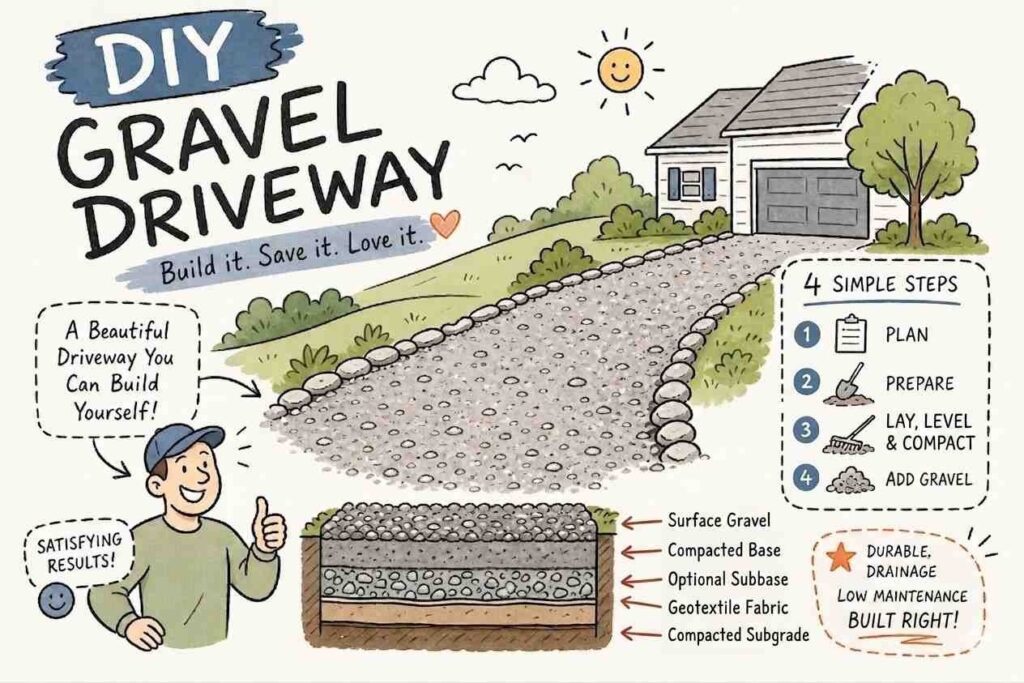
A properly built crushed stone driveway is a layered system, not a single dump of gravel. Each layer has a specific job, and skipping one creates a weak point that traffic and water will find over time.
Sub-base: using crushed stone for stability
The sub-base is the lower support layer used when the soil is weak, drainage is poor, or the driveway will carry heavier loads. For many light residential driveways on stable soil, a compacted dense base and surface layer may be enough. Where extra support is needed, use a gravel base of larger angular crushed stone such as #3 or #4 stone below the dense base layer to create a stable foundation under the surface layers and support long term stability and structural integrity.
For light residential use, many driveway systems start around 6 to 8 inches below finished grade. Sandy soils may need only 8 to 10 inches of excavation, while most gravel driveway installations still fall in the 8 to 12 inch range. In more demanding cases, deeper excavation may be needed based on local soil and contractor or supplier guidance.
In soft, clay-heavy, or waterlogged soils, consider geotextile fabric between the native soil and the base stone before adding aggregate. Woven geotextile is often used where strength and separation are the priority, while non-woven fabric can be useful where filtration and fines retention matter more. Remove all grass, roots, and topsoil before base installation to help prevent settling. The subgrade should be firm, stable, and compacted thoroughly before any gravel is laid. For engineered driveways, heavy-use areas, or contractor-built projects, compaction may be tested against a project specification such as 95% relative compaction, but typical DIY driveway work should follow local contractor, supplier, or equipment-rental guidance.
Middle layer
Not every driveway needs a middle layer, but high-traffic driveways or deeper layered systems can benefit from one. This layer bridges the larger lower stone and the finer surface material, helping fill gaps, lock the lower stone in place, and create a more even surface for the top layer.
Depending on the local stone sizes available, this layer may use intermediate angular crushed stone such as #4 stone or a transition layer such as #57 stone where that material fits the local design, supplier recommendation, and available gradation. The goal is not one universal size, but a stable bridge between the lower support stone and the wearing course, with each layer placed at its intended thickness to improve durability and stability.
Wearing course
The top layer, commonly around 2 inches, is the wearing course: what you and your vehicles interact with every day. #57 crushed stone around 3/4 inch is a widely used all-around surface choice because it drains well, looks clean, and stays more stable than rounded stone when placed over a properly compacted base. In some regions, decomposed granite or crushed limestone is used as an alternate surface material, but angular stone is still the better pick for stability on most driveways. Crusher run can work well as a budget surface option or on slopes where binding fines help reduce shifting, but it may be dustier and less decorative than clean stone; that dust is often managed by lightly wetting the surface during installation.
Gravel types include crushed stone, river rock, and pea gravel. Pea gravel looks attractive but migrates too easily for most working driveways, and river rock has a similar issue because rounded rocks tend to move more than angular options under traffic, especially when conditions stay wet. Stick with angular material for a driveway that sees regular vehicle traffic. For a deeper look at recommended materials and help choosing the right stone for your site, see the Best gravel for driveways: Types, Layers, and Costs Guide. Also, if you want a visual reference for sizes and uses, this gravel size chart is a helpful resource.
Gravel driveway installation guide: calculating how much to order
The math is straightforward once you understand it. Multiply your driveway’s length in feet by its width in feet by the layer depth in feet, then divide by 27 to convert cubic feet to cubic yards. To find weight in tons, multiply cubic yards by the stone’s density, which runs 1.4 to 1.7 tons per cubic yard depending on material type. A 100-foot by 12-foot driveway with a 6-inch base layer works out to roughly 22 cubic yards and 31 to 37 tons of stone for that layer alone. Run this calculation separately for each layer, then add the totals together.
If running three separate layer calculations sounds tedious, this is exactly what How Much Crushed Stone for a Driveway: Layers and Cost is built for. Enter your driveway dimensions, select your stone type, and the tool handles the cubic yard conversion, weight in tons, and estimated material cost in seconds. It also applies a customizable waste factor, so you’re not placing a supplier order on a number that ignores spillage and compaction. Use it before you call a supplier and you’ll show up to that conversation with a supplier-ready estimate you can trust. For a quick reference on calculating gravel quantities, see this calculating gravel guide.
Always order 10 to 15% more material than your base calculation shows to account for compaction, spreading losses, and edge topping. Running short means a second delivery charge, which typically costs more than the overage stone itself. Build that buffer in from the start.
On pricing: as of 2026, common driveway gravel and crushed stone prices vary widely by region, quarry distance, material type, and order size. For planning, many bulk gravel products fall around $20 to $75 per ton, while common crushed stone often lands closer to $25 to $50 per ton before delivery. Gravel driveways are generally cheaper and more cost-effective than asphalt or concrete, with brick and other materials usually costing more for initial installation. #57 stone may be cheaper in quarry-heavy regions and higher in urban or coastal markets. Crusher run or local road base is often one of the more affordable structural base options, but supplier prices vary. These are material-only planning ranges and do not include delivery, fuel surcharges, minimum order fees, or spreading charges.
Excavation depth and layer installation: doing the work right
Many residential gravel driveways use about 8 to 12 inches of total excavation below finished grade, while weak soil, poor drainage, freeze-thaw climates, or heavier vehicle use may require a deeper base. The right depth depends on soil strength, drainage, traffic load, and local practice. Grading the subgrade is essential to establish proper drainage before any stone is placed.
Mark your layout with stakes and string lines before any digging starts. Keep the subgrade as even as possible and remove all organic material, roots, and soft spots before placing any stone. Correct any low spots during subgrade prep so they do not collect water and turn into potholes later. Organic material under a driveway compresses over time and creates the exact conditions that cause settling and ruts. For more detailed guidance on excavation depth and best practices, see this excavation depth guide.
Place the sub-base stone first and spread it to an even depth. Compact in maximum 4-inch lifts using a plate compactor or vibratory roller. Compaction is critical to prevent ruts and potholes, and rolling each lift to full density matters even more where heavy vehicles will use the driveway. Compacting thicker lifts creates uneven density, one of the most common installation mistakes, and causes settling that shows up months later. Add the middle layer if you’re using one, compact again, then spread and compact the surface layer.
Hand tamping is not sufficient to achieve uniform density, especially in the base. For a typical residential driveway, plan on renting a plate compactor (roughly $60 to $120 per day at most equipment yards). For larger projects, a skid steer or mini-excavator speeds up excavation and stone spreading considerably. Hand tools, rakes, shovels, a line level, and marking stakes, cover the rest.
Proper drainage solutions that keep water from destroying your work
The single most effective drainage technique is crowning the driveway: building the center slightly higher than the edges so water naturally sheds to the sides rather than pooling. Aim for a slight crown, and start that crown shape in the subgrade, not just the finished surface, to help prevent erosion and pooling. A crown of 1 to 2 inches across a 12-foot width is enough. Combine this with a consistent longitudinal slope of at least 1% (about 1 inch of drop per 10 feet of run) to keep water moving rather than sitting.
Where natural grading isn’t enough, install a swale along one or both sides of the driveway. A swale is a shallow channel that collects and redirects runoff before it undermines the driveway edge. For high water volume or steep slopes, a French drain handles overflow; use french drains where runoff volume is too high for surface swales alone. Some driveway drainage trenches are roughly 6 to 12 inches wide and 18 to 24 inches deep, but trench size, pipe size, fabric, stone depth, slope, and outlet location depend on the drainage design and site conditions. Use clean, free-draining stone around the pipe where specified, and make sure the system carries water to a safe discharge point.
On steep driveways, water bars cut across the surface at intervals interrupt downhill flow and prevent gravel from washing away during heavy rain. For additional drainage product options and installation ideas, this drainage solutions overview is practical and visual.
Poor drainage is the root cause of most gravel driveway failures. Water softens the foundation, washes out fines, and feeds the freeze-thaw cycle that breaks apart even well-compacted bases. Soils or base materials with excellent drainage help maintain a more durable driveway under wet conditions. Building drainage into the design from the start is one of the best ways to extend driveway life and reduce future maintenance.
Stabilization grids and maintenance to prevent common failures
For areas that see repeated turning, braking, or heavy loads, plastic honeycomb stabilization grids filled with gravel significantly reduce surface migration. Made from HDPE, the grids lock stone into individual cells that prevent lateral movement and downward displacement. Installation follows the same base preparation as a standard driveway: compact the subgrade, level the base, lay the grid panels using interlocking connections, fill each cell with clean 3/4-inch angular gravel, and compact the filled surface. Where site conditions warrant it, a heavy-duty geotextile fabric under the system can also help deter weed growth. Premium cellular grid systems cost more up front than a basic gravel surface, but they may reduce future maintenance in high-traffic or high-maintenance areas when installed correctly. They’re especially useful at entry points and turnaround areas where tires stress the surface most and bare gravel would scatter within a season.
Even a well-built gravel driveway loses material over time through displacement and compaction. Homeowners should plan on periodic top-dressing (often every few years) with fresh gravel and sometimes more gravel in worn areas or after minor settling. Rake or blade the surface smooth before adding new material so you’re not burying ruts under fresh stone. Inspect and regrade each spring after frost heave has settled and before the ground dries out completely.
Three failures account for most of what goes wrong: ruts from under-compacted base layers, edge crumbling from inadequate shoulder support, and washouts from poor drainage. All three are preventable. Protect driveway edges with edging, shoulder stone, or proper grading because edge spread increases maintenance and can shorten driveway life. Compact thoroughly in proper lifts and design your drainage plan before the first stone goes in. Fixing these problems after installation costs far more in time and material than preventing them during the build.
Build it right and you won’t revisit it for years
A gravel driveway done right is one of the most durable and cost-effective surfaces you can put on a residential property. The key is treating the planning and base work as seriously as the surface you can see. This gravel driveway installation guide covers every stage, dimensions, materials, calculations, drainage, and compaction, because each one affects the others. Get them right in sequence and the finished product takes care of itself.
Before you call a supplier, use the Crushed Stone Guides, Crushed Stone Calculator to pin down your material order. Enter your dimensions, pick your stone type, and you’ll get cubic yards, estimated tons, and cost with a built-in waste factor for spillage, compaction, and uneven ground. It’s free and takes about 30 seconds, which is a fair trade for walking into that supplier conversation with confidence instead of guesswork.
Nail the prep work, layer by layer, and this is a driveway you build once.
Pingback: French Drain Gravel: Right Type, Size & How Much to Order
Pingback: Gravel base for pavers: materials, depth, and installation
Pingback: Which Crushed Stone Size Is Best for a Long Gravel Driveway
Pingback: Understanding Class Five Gravel: The Best Choice for Your Project
Pingback: The Benefits of Using 22A Gravel for Your Landscaping Projects
Pingback: Pea Gravel Prices in 2026: Per Ton, Per Yard & Installed