Table of Contents
How much crushed stone do i need for a 2 car driveway? The answer starts with three inputs: your dimensions, your depth, and your stone type. You’ve measured your driveway, you know the square footage, and now you need to call a quarry and tell them how many tons to deliver. That last step is where most homeowners get stuck. Square footage doesn’t convert cleanly to tons without knowing your depth and your stone type, and those two variables move the final number more than most people expect.
This article walks through a real 20×40 ft driveway from start to finish, showing the exact math at both 4-inch and 6-inch depths so you can call your supplier with a confident number. This is exactly the kind of estimate our Crushed Stone Calculator runs quickly, but if you want to understand what’s behind that number, keep reading. We’ll cover dimensions, depth decisions, stone selection, the tonnage math, and the waste buffer you should always add.
What size is a standard two-car driveway?
Before running any numbers, it helps to confirm your project fits a recognizable footprint. A standard two-car driveway in the US runs 20 to 24 feet wide. Twenty feet is the practical minimum for two cars parked side by side with workable clearance. Twenty-four feet adds comfort, especially if you have larger vehicles or tight garage door openings.
Length varies more widely. A driveway running straight from the street to a garage commonly starts at around 20 feet and can extend to 40 feet or more depending on lot depth and setback requirements. Common planning sizes include 20×20 ft, 20×22 ft, 24×24 ft, and 20×24 ft. Check your lot layout and local setback rules to confirm your actual run.
For this article, the working example is 20×40 ft, or 800 square feet. It’s a practical single-run driveway with a straight path to a two-car garage, which keeps the geometry clean and the math clean as well. If your driveway is a different size, the same formula applies, just swap in your own dimensions at each step.
How deep should crushed stone be for a driveway?
Depth is the variable most people guess wrong on, and getting it wrong means either a base that fails under load or a material order that’s way off. For a standard residential driveway carrying passenger vehicles, 4 inches of compacted crushed stone is the minimum. That’s the right starting point for a driveway with a firm, well-drained subgrade in a stable climate.
Six inches is the correct call when your soil is soft or poorly drained, when you’re in a northern freeze-thaw climate where frost heave is a real concern, or when the subgrade has poor load-bearing capacity. If you’re unsure about your soil, go with 6 inches. The extra material cost is small compared to fixing a failing driveway base later.
Most residential gravel driveways use a two-layer approach: a coarser base layer for strength and compaction, topped by a finer wearing surface for appearance and traction. The base layer is where the bulk of your material goes. The depth numbers in this article refer to the base layer, which is typically crusher run or a comparable compactable aggregate. A surface layer of 2 inches of #57 stone or similar material can be added on top for a finished look, but that’s a separate calculation once your base is set. For a deeper look at layers and material quantities, see our How Much Crushed Stone for a Driveway: Layers and Cost guide.
For manufacturer’s and contractor recommendations about how deep to place each material, consult a resource on proper gravel depth before you finalize your plan.
How much crushed stone for a 2-car driveway: picking the right stone type
Once you’ve locked in your depth, stone type is the next variable that affects your order. It determines density, and density is what converts cubic yards into tons on your purchase order. Two materials cover most residential driveway projects.
Crusher run (also called crusher fines, road base, or processed gravel) is the most common base material for residential driveways. It’s a blend of crushed stone and fine particles that compacts into a hard, interlocked surface. It resists rutting, doesn’t shift under load, and bonds well over time. Density varies by source, moisture content, and compaction level, a commonly used planning figure is 1.5 tons per cubic yard, though the practical range runs roughly 1.3, 1.5 t/yd³. Confirm the density with your supplier before finalizing a large order. That planning figure is what the calculations below use.
#57 stone is angular, clean, and drains freely. It’s typically used as a surface layer because it provides good traction and sheds water well. It doesn’t compact as tightly as crusher run, so it isn’t the right choice as a standalone base on soft subgrade. Its density runs slightly lower, around 1.4 tons per cubic yard. If you’re calculating a surface-only layer of #57, adjust your density accordingly. For an overview of common sizes and where each grade is used, see this crushed stone grades guide.
For a full base calculation on the 20×40 ft driveway, 1.5 tons per cubic yard is the standard planning number. That keeps the estimate conservative without overstating your order.
Tonnage and depth: how much crushed stone for a 2-car driveway
Here’s the math for the full calculation.
Step 1: Convert your dimensions to cubic yards
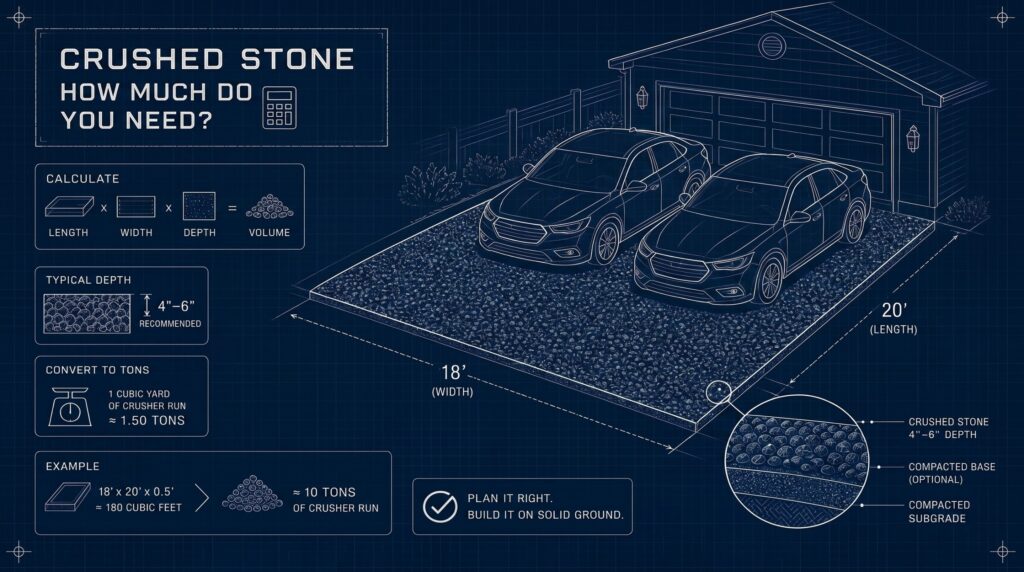
The formula is: (Length × Width × Depth in feet) ÷ 27 = cubic yards. The 27 converts cubic feet to cubic yards, since one cubic yard equals 27 cubic feet. Convert your depth from inches to feet by dividing by 12. Four inches becomes 0.333 feet. Six inches becomes 0.5 feet.
For 20×40 ft at 4-inch depth:
20 × 40 × 0.333 = 266.67 cubic feet
266.67 ÷ 27 = 9.88 cubic yards
Step 2: Convert cubic yards to tons
Apply the crusher run planning density of 1.5 tons per cubic yard:
9.87 yd³ × 1.5 = 14.8 tons
That’s your baseline number before the waste buffer. Just under 15 tons of crusher run at a 4-inch depth across 800 square feet. If you’d rather check the conversions with a tool, try a cubic yards calculator to verify your volume figures.
Cubic yards of crushed stone and tons of crushed rock, quick conversion
Run the same math with a 6-inch depth:
20 × 40 × 0.5 = 400 cubic feet
400 ÷ 27 = 14.8 cubic yards
14.8 × 1.5 = 22.2 tons
That’s a difference of more than 7 tons between a 4-inch and 6-inch base on the same driveway footprint, and a significant cost difference when priced per ton. Choosing your depth before calling the supplier isn’t optional; it’s the variable that defines your entire material order.
Why you should always order 10% more than your base number
The math gives you a theoretical volume based on flat, even dimensions. Real-world installation doesn’t work that way. Crushed stone compresses during compaction, spreads unevenly at the edges, and some material always gets displaced at the perimeter or lost in low spots in the subgrade. Ordering exactly to your calculated number will leave you short on almost every job.
The standard buffer for a clean, regular driveway like this is 10%. On a 14.8-ton baseline, that’s roughly 1.5 extra tons. The cost of that cushion is a fraction of what a second delivery trip will run you, especially if you’re working with a busy quarry during peak season.
If your subgrade is rough or uneven, or your driveway edges aren’t perfectly straight, push that buffer to 15%. The additional cushion covers the extra fill required at low spots and the material that shifts during spreading and grading. For the 20×40 ft driveway with a solid subgrade, 10% is the right call.
- 4-inch depth, adjusted: 14.8 tons + 1.5 tons = ~16.3 tons to order
- 6-inch depth, adjusted: 22.2 tons + 2.2 tons = ~24.4 tons to order
- Many suppliers accept half-ton increments, check with yours when placing the order
Get your exact number with Crushed Stone Calculator
The 20×40 ft example works well as a teaching tool, but your driveway may be 18×35 ft, or it may taper near the garage, or you might be doing a circular turnaround on one end. Manual math handles straight rectangles cleanly. Irregular shapes and multiple sections are where it gets tedious fast.
Crushed Stone Calculator lets you enter your exact dimensions, select your stone type from a list of preloaded materials (including crusher run/road base, crushed stone, pea gravel, and more) set your depth, and apply a waste factor. The tool outputs cubic yards, estimated tons, and an optional cost estimate based on your local price per ton. Everything lands on a single page with no manual math required on your end.
If your driveway differs from the sample layout used here, just plug in your actual length and width. Common two-car sizes like 20×20 ft or 24×24 ft are straightforward entries. If your edges aren’t perfectly straight or you’re working with a tapered shape, set the waste factor to 15% instead of 10% and the tool adjusts the final order quantity automatically. For additional walkthroughs and related articles, browse our Crushed Stone Guides.
Pulling it all together
Still asking how much crushed stone you need for a 2-car driveway? Here’s the short answer: a 20×40 ft two-car driveway at 4 inches deep needs roughly 16.3 tons of crusher run including a 10% waste buffer. At 6 inches, that number climbs to about 24.4 tons. Depth is the single biggest lever in this calculation, which is why nailing that decision before you order matters more than anything else.
The decision framework is clear: use 4 inches if your subgrade is firm and well-drained, use 6 inches if your soil is soft, poorly drained, or if you’re in a freeze-thaw region. Choose crusher run for the compacting base layer, add #57 stone on top if you want a cleaner finish and better surface drainage, and always pad your order by at least 10%. For additional perspective on standard driveway widths and planning, this concrete driveway width guide can help you decide what width fits your needs.
If your dimensions are different from the example here, run your exact numbers through Crushed Stone Calculator. Enter your length, width, depth, and stone type, and the tool handles the cubic yard conversion, density adjustment, and waste factor for you. You’ll have a solid order quantity ready before you pick up the phone.