Table of Contents
You measure your driveway, run a quick calculation, and land on 10 cubic yards of crushed stone. Then you call your supplier and they quote by the ton. Suddenly you’re not sure if you need 10 tons, 13 tons, or something else entirely. Cubic yards measure the volume of gravel or crushed stone, while tons measure its weight, so converting between them requires the material’s density: tons = cubic yards × (weight per cubic yard ÷ 2,000).
That volume-versus-weight disconnect trips up a surprising number of homeowners, property owners, landscapers, small contractors, and DIYers who haven’t ordered bulk aggregate before. If you’ve ever stared at two different numbers and wondered which one to give your supplier, here’s cubic yards vs tons for gravel explained simply, so you can convert accurately and order with confidence.
A tool like the Gravel Calculator will show you cubic yards and tons at the same time so you never have to reconcile the two on your own. That matters because many suppliers sell by weight while most project layouts are measured by space, and getting the conversion wrong can leave you short, over budget, or paying for extra delivery. Below, you’ll see how cubic yards and tons differ, the conversion formula with worked examples, typical weight ranges for common gravel types, how moisture and stone shape affect density, how to measure your project and add a waste factor, and when to use the calculator to check your numbers before you order.
Volume vs. weight: why gravel has two different numbers
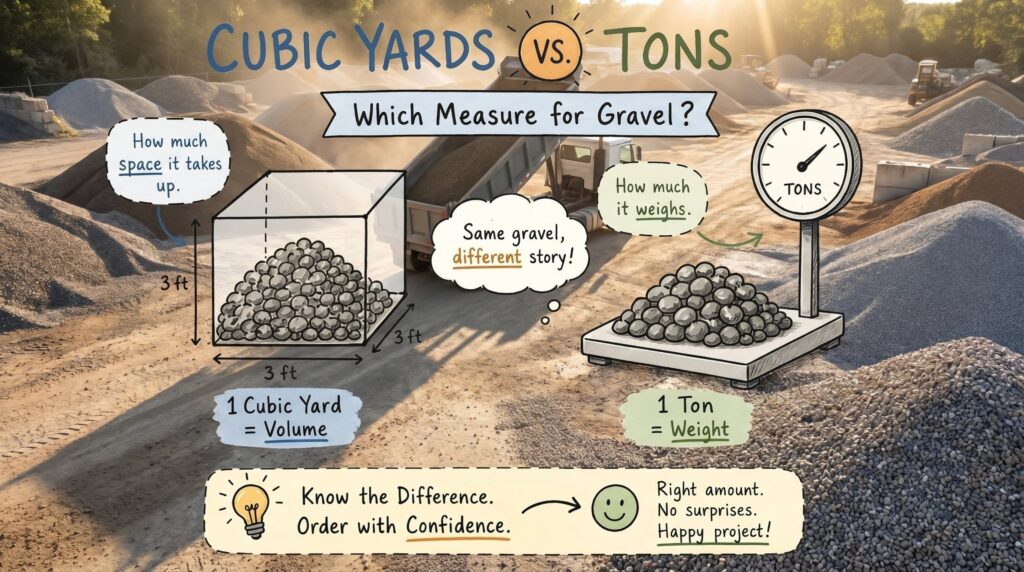
The confusion starts because cubic yards and tons measure completely different things. A cubic yard measures volume, how much three-dimensional space a material occupies. A ton measures mass, how heavy that material is. Neither number tells you anything about the other without one additional piece of information: the material’s density.
What a cubic yard actually measures
Picture a box that’s 3 feet long, 3 feet wide, and 3 feet tall. That box holds exactly one cubic yard, which equals 27 cubic feet. The measurement is pure geometry. It doesn’t matter whether the box is full of feathers, water, or crushed granite, the volume is the same.
What a ton actually measures
A US ton is 2,000 pounds. It measures weight, not space. Suppliers commonly quote gravel by the ton because they load trucks onto a scale. Weight is their most precise and consistent measurement method. When a quarry says “$18 per ton,” they’re selling you pounds, not space.
Why you need to know both
Project guides calculate volume based on area and depth. Suppliers invoice by weight. Without a density conversion, you’re trying to match two incompatible numbers. The gravel’s bulk density is the bridge between them, and it varies meaningfully from one material to the next.
The pickup truck test: visualizing a cubic yard of gravel
Abstract math is harder to work with than a physical image. Before running any numbers, it helps to have a clear mental picture of what you’re actually ordering. One cubic yard of gravel weighs roughly 2,800 pounds (1.4 tons) on average, already past the one-ton mark, and a relatively modest amount of material for most residential projects.
What one cubic yard looks like in real life
One cubic yard is a 3-by-3-by-3-foot cube of material. Spread flat at 4 inches deep, that same cubic yard covers approximately 81 square feet, roughly a 9-by-9-foot area. That visual gives you an immediate gut-check on whether your calculated order sounds right.
How a standard pickup truck stacks up
Pickup bed capacities vary by make and model, so treat these figures as a rough guide rather than hard specs. A typical short-bed pickup can hold somewhere in the range of half a cubic yard of gravel before the bed is full; a long-bed truck may get you closer to a full cubic yard, though some models handle more. So when a contractor quotes you 10 cubic yards, you’re roughly talking about the equivalent of 10 long-bed pickup loads, though actual truckload sizes vary, so it’s worth confirming with your supplier what their delivery volumes look like. That mental image still makes a large driveway order feel concrete and verifiable.
Why this image makes ordering less intimidating
Once you can picture a cubic yard in your driveway, scaling up to a full project order stops being abstract arithmetic. You’re stacking real truckloads, not juggling invisible unit conversions. That confidence carries directly into your supplier conversation.
Cubic yards to tons for gravel: the simple conversion
To convert cubic yards, the conversion formula has exactly one step beyond basic multiplication. Once you have it, you can run any cubic yards to tons estimate in about 30 seconds, though the tons conversion depends on material density.
Where the formula comes from
Volume multiplied by density equals weight. For gravel, density is expressed in pounds per cubic yard. Divide that weight by 2,000 to get US tons. Written out: Tons = Cubic Yards × (Weight per cubic yard ÷ 2,000). The only variable you need to look up is the specific weight of your material.
Cubic yards vs tons for gravel, worked examples
Take a 10-cubic-yard order of average crushed stone, which weighs approximately 2,800 pounds per cubic yard. Multiply: 10 × 2,800 = 28,000 pounds. Divide by 2,000: 28,000 ÷ 2,000 = 14.0 tons. This example shows how cubic yards to tons works in practice. That’s the number you give your supplier when they ask how many tons you need.
The rule of thumb for quick estimates
For most common gravel types used in residential projects, multiplying cubic yards by 1.4 gets you close enough for a first call with a supplier. Keep in mind these figures are approximations that serve as a first-pass estimate, since approximate densities for common materials vary by region and material type; the realistic range runs from about 1.30 tons per cubic yard for lighter pea gravel up to roughly 1.55 tons per cubic yard for heavier traprock (basalt), and some sources use 1.5 as a general default. Use the exact density when you’re finalizing a budget or ordering a large quantity where a small percentage error means real money.
How much common gravel types actually weigh
Not all gravel weighs the same, and the differences are significant enough to affect your order. Even across different materials, material density varies, so the weight per cubic yard can change a lot. Particle size, stone shape, and moisture content all influence the bulk density of a material, and moisture and compaction can also change how much that material weighs. A rounded river rock has more air pockets between stones than tightly graded angular crushed stone, which changes how the weight adds up per yard.
A quick reference for popular gravel types
Use this as your go-to quick reference chart when working through a conversion:
- Pea gravel: about 2,400–2,800 lb/yd³, or roughly 1.2–1.4 tons per cubic yard
- Crushed limestone: about 2,900 lb/yd³, or roughly 1.45 tons per cubic yard
- #57 stone: about 2,400–2,700 lb/yd³, or roughly 1.2–1.35 tons per cubic yard
- River rock: about 2,600–3,000 lb/yd³, or roughly 1.3–1.5 tons per cubic yard
- Crushed granite: about 3,000 lb/yd³, or roughly 1.5 tons per cubic yard
- Sand: about 1.3 to 1.5 tons per cubic yard
- Topsoil: about 1.0 to 1.35 tons per cubic yard
- Concrete: about 2.0 tons per cubic yard
- Mulch: a cubic yard of mulch is much lighter than stone and varies by type and moisture
Why moisture and stone shape shift the numbers
Wet gravel can weigh 10 to 20 percent more than dry in typical conditions, and compacted gravel or soil can weigh even more per cubic yard than loose material. If your supplier loads material following a rainstorm, the tonnage per yard goes up. Rounded stones like river rock also pack differently than angular crushed stone, and compaction reduces air gaps between particles, fits more material into the same space, and makes the mix denser and heavier per cubic yard. Compacted soil can be around 1.3 tons per cubic yard, depending on moisture and mix, so check local specs to ensure your estimate is realistic.
Which gravel type to use for which project
Crusher run is commonly used where a dense, compactable driveway base is needed. #57 stone is cleaner and drains better, but it does not compact into the same tight base because it contains fewer fines. The right choice depends on whether your project needs dense support, drainage, or a layered base design. Pea gravel works for walkways and drainage applications where water needs to pass through freely. River rock handles decorative borders and erosion control on slopes. Knowing the density difference between these materials matters when you’re estimating tonnage, using a river rock density figure to order crusher run will give you a meaningfully wrong answer.
For recommended layer depths on driveways and other surfaced areas, check guidance on how deep gravel should be for a driveway, or review our driveway gravel guides for project-specific installation tips.
Calculating how many tons of gravel your project actually needs
Now that the conversion formula is clear, the next step is calculating the volume your project requires. Every driveway, patio, and walkway starts with the same basic math: length times width times depth, then a division by 27 to convert cubic feet into cubic yards.
The volume formula every DIYer needs
The core formula is: (Length × Width × Depth in feet) ÷ 27 = cubic yards. Convert your depth from inches to feet first by dividing by 12. A 4-inch depth becomes 0.333 feet. A 3-inch depth becomes 0.25 feet. This single formula handles driveways, patios, and walkways without modification.
Two worked examples with real dimensions
For a 20-by-40-foot driveway at 4 inches deep: 20 × 40 × 0.333 = 266.4 cubic feet. Divide by 27 and you get approximately 9.9 cubic yards. At 2,800 lb/yd³ (1.40 tons/yd³), that’s about 13.9 tons of crushed stone. For a 12-by-16-foot patio base at 3 inches deep: 12 × 16 × 0.25 = 48 cubic feet. Divide by 27 for approximately 1.78 cubic yards, which works out to roughly 2.5 tons. The same method applies to other materials too—for example, 2 cubic yards of wet sand at 3,200 lb/yd³ comes to about 3.2 tons. Both numbers give you exactly what you need for a supplier call.
If you’d rather use an online tool to avoid manual conversion, try a cubic yards calculator to double-check your work quickly.
Why you should always add a waste factor before calling your supplier
Add 10 percent to your calculated quantity for clean rectangular projects on flat ground. Bump that to 15 to 20 percent for irregular shapes, sloped terrain, or sites with an uneven subgrade. Stone settles during compaction, some material gets displaced at the edges, and delivery piles don’t spread perfectly. Running short and waiting on a second delivery almost always costs more in time and fees than a modest overage would have.
Stop guessing: see cubic yards and tons at the same time
All the math in this article works. But when you’re standing in your driveway with a tape measure and a phone call to make in ten minutes, doing the conversion manually leaves room for errors. Crushed Stone Calculator runs all of this automatically and displays both cubic yards and tons on the same screen, so there’s no mental math required and no risk of handing your supplier the wrong unit.
Why having both numbers on one screen changes everything
Most homeowners bounce between a project guide showing cubic yards and a supplier quote in tons, trying to reconcile two figures that were never designed to match directly. When both numbers appear side by side from one set of dimensions, that friction disappears. You know your volume for planning and your tonnage for ordering, without a separate conversion step in between.
What the tons calculator accounts for that a spreadsheet won’t
Crushed Stone Calculator includes density presets for common stone types, so you’re not guessing at the weight per cubic yard. The Gravel Calculator also lets you use a custom density when you have a supplier-specific value, which can make the estimate more accurate. Exact values still depend on the specific material, moisture level, compaction, and supplier source.
The Gravel Calculator includes density presets for common gravel types, lets you add a waste factor, and includes an optional cost estimator; enter your supplier’s price per US ton and get a project cost estimate back. To compare current market rates when setting your supplier budgets, see a summary of gravel prices. The output covers cubic yards, cubic feet, US tons, pounds, metric tons, and kilograms, all from one set of project dimensions.
Run your numbers before you call the quarry
Enter your length, width, and depth. Select your gravel type. The same tool can answer common questions about cubic yards to tons for gravel and other bulk materials. The calculator returns your volume in cubic yards and your weight in tons before you’ve dialed a single number. You arrive at the supplier conversation ready to place a confident order rather than working from a rough estimate you’re not quite sure about.
Cubic yards measure space. Tons measure weight. Converting between them takes one key number: the density of your specific gravel. With the formula, the weight reference table, and the Gravel Calculator, ordering gravel becomes a straightforward task instead of a stressful guessing game.
Run your project dimensions through the Gravel Calculator before you call a supplier, and you will have both cubic yards and tons ready for the quote. For additional tips and project articles, visit our Blog.
Pingback: How Much Does a Yard of Gravel Weigh? Essential Facts and Calculations