Table of Contents
Which crushed stone size is best for a long gravel driveway? The short answer: a compacted #3 stone base topped with #57 stone or crusher run. But the full answer depends on your traffic load, climate, and how the layers are built, because distance amplifies every mistake.
A 200-foot gravel driveway is not simply a longer version of a 30-foot apron pad. A single-layer stone pour that holds up fine near the garage will rut, wash out, and scatter by the time you reach the road. Most long driveway failures trace back to two problems: using the wrong stone size for the job and skipping the layered build that makes a gravel surface hold up over years of use.
The framework that works is a two-layer system: a compacted base that handles load and drainage, topped by a surface layer that takes daily tire contact. Both layers require specific stone sizes chosen for specific reasons. Before you pick the right stone, though, you need to know how much of each layer you’re actually dealing with. On a long driveway, the tonnage involved surprises almost everyone who hasn’t run the numbers first. Crushed Stone Calculator lets you estimate each layer separately so you have real quantities before you call a supplier, not an uncomfortable surprise after the first truck shows up.
Why a long driveway demands a layered stone system
The single-dump approach breaks down on longer runs for reasons that compound with distance. Load stress accumulates as tires travel the full length of the driveway repeatedly. Water channels along the grade rather than shedding quickly from a short surface. Tires track the same line over and over, concentrating wear in narrow bands instead of distributing it across a wider pad. Each of those forces becomes more damaging the longer the driveway runs.
A layered system works because each layer handles a different force. The base layer distributes load into the subgrade and moves water downward and away. A mid-layer or binder, where used, ties the coarse base to the finer surface. The topcoat takes tire contact, provides surface stability, and determines how the driveway looks and drives. On a long run, skipping the base and going straight to topcoat leaves no foundation to resist soft spots or seasonal heaving.
The failure pattern without a proper base is predictable. Tire ruts form first near the street end or at the gate, where traffic concentrates for turns and stops. Gravel migrates outward toward the edges rather than staying under tire paths. Washout channels form along the crown line after rain. That sequence is the reason to build the system correctly once rather than resurface repeatedly.
Which crushed stone size is best for a long gravel driveway, base vs. topcoat
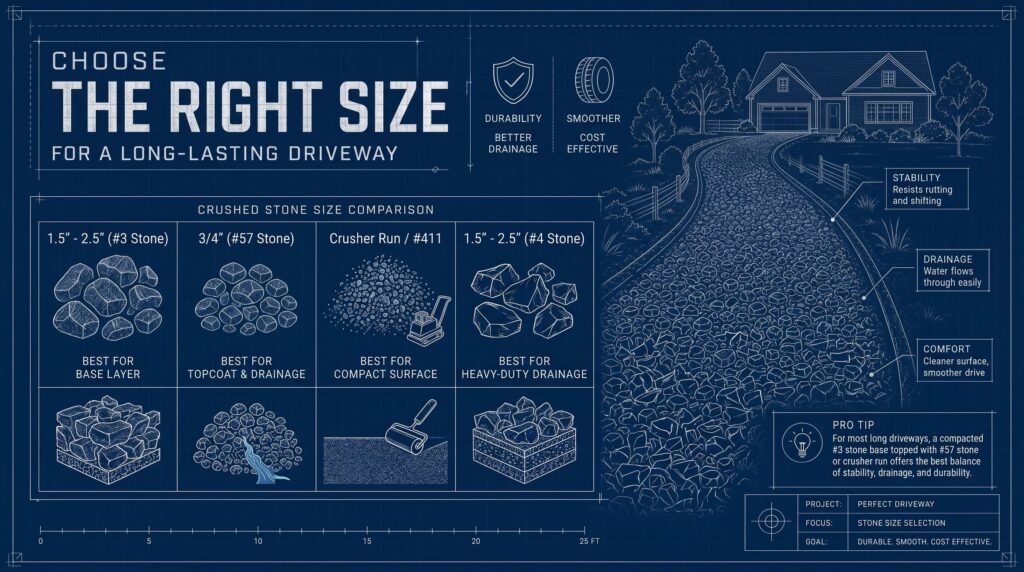
The right driveway gravel size is actually two answers: one for the base and one for the surface, with each layer doing a distinct job. Getting both right is what separates a driveway that lasts a decade from one that needs attention every season. Here’s how the most common stone sizes stack up in each position.
The base layer: why #3 crushed stone earns its place
#3 crushed stone, which runs roughly 1½ inches to 2½ inches in size, belongs at the bottom because its angular shape creates interlock under compaction while still allowing water to drain downward rather than pool. Angular edges are what make this work. Rounded stone of the same size rolls under load instead of locking, which means it shifts instead of holds. For a residential driveway carrying passenger vehicles, plan on 4 to 6 inches of compacted #3 stone as the base. If the driveway handles heavier delivery trucks or farm equipment regularly, push that to 6 to 8 inches compacted. To estimate this layer in the calculator, select #3 Stone (Coarse Base) at 1.30 tons/yd³ from the material dropdown.
The open gradation of #3 stone is also critical in freeze-thaw climates. A base layer that drains freely does not trap water that turns to ice and heaves the surface. In northern US states, that free-draining base layer does more useful work per dollar than any topcoat upgrade you can make.
The top layer: #57 stone, #411, and crusher run compared
#57 stone, a clean angular aggregate around 3/4 inch in size, is the most common topcoat choice for long gravel driveways. It drains well, compacts to a stable driving surface, and resists displacement better than fine or rounded gravel. For most homeowners with passenger vehicle traffic, #57 on top of a compacted #3 base is the standard combination that holds up.
#411 is a hybrid material that blends crushed stone with fines and stone dust. It compacts tighter than #57 alone, which creates a firmer, less loose-feeling surface. It’s a good choice when you want a surface that feels more solid underfoot and under tire, particularly on long runs where a looser surface can feel inconsistent from end to end. To estimate #411 quantities, select #411 Stone (Crushed + Fines) at 1.45 tons/yd³ in the calculator.
Crusher run, a mixture of crushed stone and rock dust from the full range of crusher output, is the right call when maximum compaction is the priority. At high-traffic points such as entries, sharp turns, and turnaround areas, crusher run on the surface locks down and resists the scattering that #57 can produce under repeated braking and turning. If the driveway carries trucks or equipment on a regular schedule, crusher run on the surface layer provides the stability to handle it. For more on using crusher run as a sturdy base and surface option, see the crusher run project base overview.
How drainage, compaction, climate, and traffic shape your size decision
Drainage and freeze-thaw climates
In wet climates or regions with hard freeze-thaw cycles, open-graded stone in the base layer is non-negotiable. Fine-heavy materials like stone dust or dense-graded road base trap moisture. That trapped moisture freezes, expands, and lifts the surface, then thaws and leaves the base weaker and more susceptible to rutting. The cycle repeats every winter and accelerates base breakdown. Angular #3 or #57 stone in the base keeps voids open so water drains through rather than collecting where it can do structural damage.
The physical sequence of freeze-thaw damage matters here. Water enters the base, freezes and expands to create internal pressure, forms ice lenses that push the surface upward, then melts and leaves an unstable, saturated base just as vehicles apply load in spring. A free-draining base layer interrupts that cycle at the first step.
Traffic load and surface stability
Heavier or more frequent traffic pushes you toward tighter, well-graded mixes on the surface. #57 is the right call for typical passenger vehicle use on most residential driveways. When the driveway carries trucks, delivery vehicles, or farm equipment regularly, crusher run on the surface provides the stability needed without the surface scattering that coarser single-size stone produces.
One rule applies regardless of traffic level: angular stone in both layers outperforms rounded pea gravel. Pea gravel rolls under load, migrates to edges, and provides almost no structural interlocking. It is not a functional driveway material for a long run that sees real use. For a deeper explainer on crushed stone gradations and how different grades perform, consult an understanding crushed stone grades guide.
Estimating total tonnage for a multi-layer long driveway
Why long driveways surprise people with tonnage
Tonnage is consistently the most misjudged variable in long driveway projects, especially when quantities are estimated by eye rather than by the numbers. At a 4-inch base depth, 1,000 square feet of driveway needs roughly 12.35 cubic yards — about 16.1 tons using #3 Stone (1.30 tons/yd³), 17.3 tons using #57 Stone (1.40 tons/yd³), or 18.5 tons using Crusher Run (1.50 tons/yd³). A 300-foot driveway at 12 feet wide is 3,600 square feet. A 4-inch base layer for that area runs about 44.4 cubic yards — roughly 58 to 67 tons depending on your material. If you build a 6-inch base instead, that rises to about 66.7 cubic yards and approximately 100 tons at crusher run density.
The topcoat adds another 2 to 3 inches across the same area. A 4-inch base with topcoat totals approximately 89 to 105 tons for a driveway that size. A 6-inch base with topcoat pushes the total to 133 to 150 tons. Each layer is calculated separately, which is why totals add up faster than most people expect.
How Crushed Stone Calculator handles multi-layer estimates
Crushed Stone Calculator is built for exactly this kind of two-layer project. The process is straightforward: run one calculation for the base layer by entering width, length, and depth for the #3 stone, then run a second calculation for the topcoat using the same dimensions with your chosen depth. Select ‘#57 Stone (Clean Crushed)’ for a #57 surface layer, ‘#411 Stone (Crushed + Fines)’ for #411, or ‘Crusher Run / Road Base’ for crusher run.
The tool outputs cubic yards and estimated US tons for each layer separately, which is what you need to place two distinct material orders. For a quick online alternative, try an online crushed stone calculator, and for step-by-step quantity examples see How Much Crushed Stone for a Driveway: Layers and Cost.
On any long driveway with a grade change or irregular shape, apply a 15% waste factor rather than the default 10%. Irregular shapes, curved runs, and any slope with fill areas create material loss that a flat-footprint calculation won’t capture. A short-order situation mid-project on a 300-foot driveway is not a minor inconvenience, it’s a scheduling and cost problem that’s worth a few extra tons of buffer to avoid. Delivered prices for #57 stone run roughly $50 to $75 per ton in 2026, and crusher run typically runs $40 to $70 per ton delivered — confirm current pricing with your local supplier as prices vary by region, so knowing your quantities accurately before the first order saves real money.
Installation steps that make the layers actually hold
Choosing the right stone sizes and ordering the right quantities gets you to the job site ready. Installation technique determines whether those materials perform for years or start failing in the first season. For a complete layer-by-layer walkthrough and practical installation tips, consult the Gravel Driveway Installation Guide: DIY Layers, Depth & Cost.
Compact in lifts, not one thick dump
No lift thicker than 3 to 4 inches before compaction. This is the core principle behind every successful base installation. Spreading the full base depth at once and then running a plate compactor over the surface creates a firm crust over a loose, unstable layer underneath, the compactor doesn’t reach deep enough to consolidate material below the top few inches. Each lift needs to be lightly wetted, not saturated, then hit with multiple compactor passes in crossing directions before the next lift goes down. Moisture helps the fines lock and the angular faces seat against each other.
On a long driveway, this process takes more time than most homeowners budget for. A 300-foot base at 6 inches compacted means two 3-inch lifts across the entire run, with each lift fully compacted before the next goes down. Plan the schedule and equipment rental around that reality, not around the idea that gravel is just spread and driven on.
Crown, slope, and edge containment
Build a slight center rise, called a crown, so water sheds to both sides of the driveway rather than running down the middle. On a long driveway, this is one of the highest-value structural decisions you can make from the start. Even a modest grade without a crown will direct water down the centerline, eroding the surface layer, cutting channels, and eventually working into the base. Build the crown into the compacted base layer so every subsequent lift follows the same profile.
Edge containment is equally important and often overlooked. Without a berm, edging, or defined shoulder, gravel migrates outward over time, particularly at curves where lateral tire force pushes material off the surface. A well-defined edge keeps the stone where the tires are and reduces how quickly the surface thins out between replenishments.
Maintenance that protects the investment over time
A well-built layered driveway is not maintenance-free, but it’s low-maintenance in a predictable way. Knowing what to watch for makes the upkeep manageable rather than reactive.
When to replenish the topcoat
Most residential #57 or crusher run topcoats with typical passenger vehicle traffic need replenishment every 5 to 7 years with basic maintenance. Driveways that regularly carry trucks, delivery vehicles, or heavy equipment may need attention every 2 to 3 years. The signal is visible base stone showing through the surface layer. At that point, vehicles are beginning to contact the base directly rather than riding on the topcoat, which breaks down the base structure faster than surface wear alone. Replenishing before the base is exposed keeps the layered system intact and extends the intervals between any base repairs.
Spot repairs and regrading
Fill ruts early, before water channels into them and widens the damage. A rut that’s an inch deep is a simple fill-and-compact job. A rut that’s collected water for two seasons is a base repair. An annual pass with a box blade, landscape rake, or gravel rake to restore the crown and redistribute material adds only a few hours of work and keeps the surface profile doing its drainage job. A well-compacted base reduces how often the surface needs regrading because there’s a stable platform underneath that resists deformation rather than following it.
Getting the sizing and the system right from the start
To answer which crushed stone size is best for a long gravel driveway: use #3 for the base and #57 or crusher run for the surface, and treat them as a system, not separate decisions. A #3 crushed stone base gives you load distribution and drainage. A #57 or #411 topcoat gives you a driveable, stable surface that holds up across the full length of the run. For high-traffic points or driveways that carry heavier vehicles, crusher run on top delivers the compaction and surface stability that single-size stone can’t match. For additional tips on selecting and buying materials, review a guide to buying crushed stone and gravel.
The longer the driveway, the more each part of that system matters. Skipping the base, using rounded stone, or going with a single layer saves time upfront and costs significantly more in repairs and resurfacing within a few years. Before you place any material order, run your numbers through Crushed Stone Calculator for both layers separately. Enter your actual dimensions, set a 15% waste factor for any driveway with curves or grade changes, and get the cubic yards and tonnage for each layer before you call a quarry or landscape supplier. For further comparisons of material types and costs, see Best gravel for driveways: Types, Layers, and Costs Guide.
Getting the best crushed stone size for your long driveway right, and knowing your quantities before the first delivery arrives, is the difference between a driveway that holds for a decade and one that needs attention before it ever fully settles.
Pingback: The Best Uses for Crushed Limestone in Construction and Landscaping
Pingback: Understanding the Cost of Crushed Stone Per Ton: A Comprehensive Guide
Pingback: Understanding 2 Gravel: Types, Uses, and Key Properties
Pingback: Understanding 67 Stone: Uses, Benefits, and Key Characteristics
Pingback: 57 Stone Rock: Uses, Sizes, Coverage & How Much You Need
Pingback: Gravel Sizes Guide: Choose the Right Stone for Any Project
Pingback: Understanding Crusher Stone Price: A Guide for Buyers and Contractors
Pingback: 3/4 Crushed Stone Price Per Ton & Yard (2026)