Table of Contents
When you’re trying to get cubic yards vs tons explained before a supplier call, the confusion usually hits at the same moment: you’ve measured your project area, punched the numbers in, and got a clean result in cubic yards. Then the quarry quotes you in tons. Suddenly you’re doing mental math while trying to sound like you’ve done this before. This moment trips up homeowners and contractors alike, and the reason is simple: cubic yards and tons measure two completely different things.
One is volume, the other is weight, and you can’t convert between them without one extra piece of information — the material’s density. This guide gives you the formula, the density values for common materials, and a practical cheat sheet so you can place a supplier order with a number you actually trust.
By the end of this article, you’ll understand why the conversion isn’t a fixed multiplier, which materials break the popular 1.4 rule of thumb, and how tools like Crushed Stone Calculator handle common cubic-yards-to-tons conversions automatically so you’re not doing unit math on a job site.
Cubic Yards vs Tons Explained—What Each Unit Actually Measures
Dense-graded base materials such as 304 stone, 411 stone, and crusher run usually weigh more per cubic yard than clean gravel because fines fill the air spaces and compact tightly. For DIY homeowners, property owners, landscapers, small contractors, and outdoor project planners in the United States, understanding this density difference helps turn project volume into a realistic order before calling a supplier.
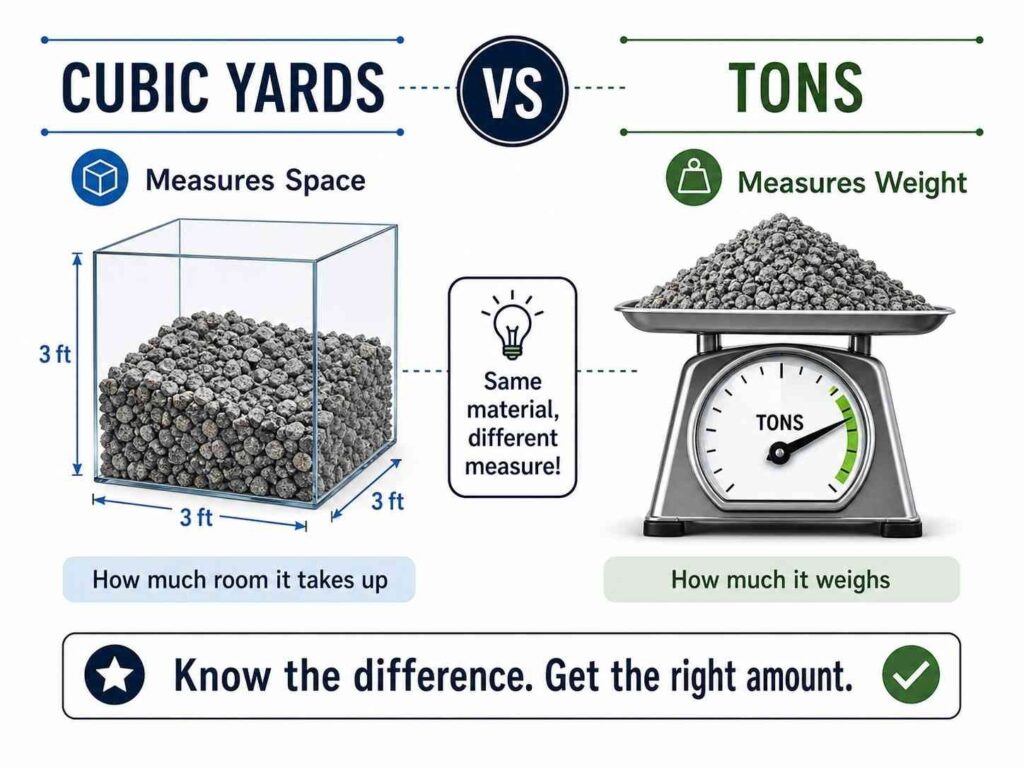
A cubic yard is a box of space: 3 feet wide, 3 feet tall, 3 feet deep, totaling 27 cubic feet. It measures how much room a material occupies, nothing more. A US short ton is 2,000 pounds. It measures weight. Neither unit tells you anything about the other on its own, which is why converting cubic yards to tons requires material density rather than a one-size-fits-all number—especially for dense base materials like 304 stone, 411 stone, and crusher run.
One cubic yard of dry mulch may weigh only several hundred pounds, while one cubic yard of crushed stone can weigh well over 2,500 pounds. Same volume, very different weight. In this guide, you’ll see how volume and weight differ, how density is used to convert cubic yards to tons, the typical weight range for crushed stone materials like 304 stone, how moisture and compaction can change that number, and when a calculator gives you a more precise estimate.
One more distinction worth making: when U.S. quarries and landscape suppliers say “ton,” they mean the US short ton, 2,000 pounds. A metric ton (also called a tonne) is 2,204.6 pounds. A British long ton is 2,240 pounds. For any project in the US, short tons are the standard unit. Getting that conversion right helps you avoid over-ordering or coming up short, so you can budget more accurately and order enough material the first time.
Why Your Project Dimensions and Your Supplier’s Quote Use Different Units
Project calculations naturally produce cubic yards. You measure length, width, and depth in feet, multiply them together, and divide by 27. That’s how material quantity calculations work, and it matches how you physically think about filling a space with material. A trench, a driveway bed, a patio base — all of these are spaces you’re filling, so volume is the natural starting point.
Suppliers work from the other direction. Some quarries and aggregate companies sell by the ton because they have certified scales on their trucks and loading equipment. Weighing a load is more precise than measuring volume, especially for materials where moisture content changes the weight significantly between a dry summer and a wet fall delivery. Pricing by the cubic yard is common for mulch and topsoil; ton-based pricing is more typical for stone and aggregate, though this varies by supplier and region. The unit you receive depends on the material, the supplier, and where you’re located.
This gap is where ordering mistakes happen. Under-order because you assumed a cubic yard and a ton were close enough, and you’re calling back for a second delivery and paying another haul fee. Over-order because you used the wrong multiplier, and you’re left moving excess material. Getting the conversion right the first time helps avoid both problems.
The Formula That Converts Volume Into Weight
Density is the bridge between cubic yards and tons. It tells you how much one cubic yard of a specific material weighs, and without it any conversion is a guess. With it, the math is a single calculation:
US Short Tons = Cubic Yards × 27 × Density (lbs/ft³) ÷ 2,000
If you already know the weight per cubic yard for your material, you can simplify to: US Short Tons = Cubic Yards × (lbs per cubic yard ÷ 2,000)
For example, if you need 5 cubic yards of #57 crushed stone and use a common estimating value of 1.4 tons per cubic yard, the order weight is: 5 × 1.4 = 7.0 US tons.
If your supplier gives density in pounds per cubic foot instead, use the full formula. At 105 lbs/ft³: 5 × 27 × 105 ÷ 2,000 = 7.1 US tons.
You may have heard the shortcut: multiply cubic yards by 1.4 to estimate tons. Use 1.4 tons per cubic yard as a quick sanity check for many common gravels and crushed stones, not as a final order number. When you need a more accurate cubic-yards-to-tons conversion, use material-specific density.
Density Reference: How Much Does One Cubic Yard Actually Weigh?
The table below covers the most common project materials and their typical weight ranges.
| Material | Approx. lbs/ft³ | Approx. lbs per Cubic Yard | Tons per Cubic Yard (CY to tons) |
|---|---|---|---|
| Crushed limestone | 100–115 | 2,700–3,105 | 1.35–1.55 |
| Crushed granite | 105–125 | 2,835–3,375 | 1.42–1.69 |
| Standard 3/4-inch gravel | 95–110 | 2,565–2,970 | 1.28–1.49 |
| Crusher run / dense grade base | 110–130 | 2,970–3,510 | 1.49–1.76 |
| Dry sand | 90–105 | 2,430–2,835 | 1.22–1.42 |
| Wet sand | 110–130 | 2,970–3,510 | 1.49–1.76 |
| Loose topsoil | 75–95 | 2,025–2,565 | 1.01–1.28 |
| Dry mulch | 15–30 | 405–810 | 0.20–0.41 |
| Fresh concrete | 135–150 | 3,645–4,050 | 1.82–2.03 |
These are planning ranges only. Actual bulk density can vary by quarry, material gradation, moisture, and compaction, so always confirm the supplier’s tons-per-cubic-yard value before placing a large order. For broader engineering reference values, see these dirt and mud density tables.
Crushed stone, loose gravel, and gravel
Standard 3/4-inch crushed stone and gravel typically run between 1.28 and 1.55 tons per cubic yard, depending on stone type, gradation, and moisture. Crushed limestone often falls around 1.35–1.55 tons per cubic yard, while crushed granite may run slightly heavier at roughly 1.42–1.69 tons per cubic yard.
Dense-graded base course products like crusher run, 304 stone, or 411 stone are a different story. They can reach around 1.49–1.76 tons per cubic yard because the fines fill the air voids and the material packs tightly. These are the orders where accurate density matters most, since the quantities tend to be large and the cost difference between a correct and incorrect estimate adds up fast.
Sand, topsoil, and mulch
Mulch is the material most likely to wreck an estimate that relies on the 1.4 rule of thumb. At roughly 0.20–0.41 tons per cubic yard, it is one of the lightest common landscape materials by a wide margin. Applying the 1.4 multiplier to a mulch order can overestimate the weight by several times, especially when comparing price-per-ton quotes against price-per-yard quotes.
Dry sand commonly falls around 1.22–1.42 tons per cubic yard. Loose topsoil is usually lighter, roughly 1.01–1.28 tons per cubic yard. Both are manageable with material-specific density values rather than a blanket multiplier.
Concrete mixes, stone dust, and heavier materials
If you’re estimating material around a concrete project, start with a realistic number: fresh concrete lands around 1.82–2.03 tons per cubic yard, and wet sand can reach roughly 1.49–1.76 tons per cubic yard or higher depending on moisture. A general aggregate multiplier will not always get you there. The difference between 1.3 and 1.55 tons per cubic yard might seem small in a quick mental estimate, but on a 20-cubic-yard order, it becomes about a 5-ton difference.
How Moisture, Compaction, and Particle Size Shift the Weight
A cubic yard of dry fill dirt may weigh around 2,000 pounds, while wet material can be much heavier and may reach 3,000 pounds or more. That’s not a rounding error; it’s a material planning variable. For sand and soil, moisture adds real, measurable weight. For clean crushed stone, surface moisture usually has a smaller effect, but it can still contribute to variation between loads. For a focused reference on fill dirt weights, see this fill dirt weight per cubic yard guide.
Compaction increases density by reducing air voids between particles. Loose gravel shoveled into a pile weighs less per cubic yard than the same material vibrated and packed into a base layer. Compacted base materials like 304 or 411 stone can run around 1.75 tons per cubic yard because the fines fill the gaps and the angular particles lock together. Crusher run should be spread in 4 to 6-inch lifts for maximum density. If your supplier’s density value is based on compacted material but your estimate uses loose density, you may under-order and need a second delivery.
Particle size plays a role too. Coarser gravel has more air space between pieces and therefore lower bulk density. Finer-graded materials and screenings pack denser for the same volume. For many DIY and contractor projects, using the standard density values for your material type and adding a 10% waste factor is a common starting point. For uneven areas, slopes, soft soil, or irregular edges, a larger buffer may be needed. On soft or muddy ground, a geotextile or landscape fabric layer can help separate the stone from the soil and reduce sinking. That buffer helps cover settling, cut edges at borders, and small losses that happen during installation.
How Crushed Stone Calculator Handles the Conversion Automatically
Crushed Stone Calculator uses density values for common materials such as limestone, granite, pea gravel, river rock, stone dust, traprock, sandstone, marble, and quartzite. When you select a material and enter your project dimensions, the tool applies the selected material density automatically. For dense base materials, options such as Crusher Run / Road Base or #411 Stone can help estimate compactable base layers, while supplier-specific materials like 304 stone should be checked against your supplier’s tons-per-cubic-yard value. You don’t need to look up pounds per cubic foot or run the formula manually for common estimates. Results come back in cubic yards and estimated weight in US tons, so you can see both units at once. Learn more about the purpose behind the tool on our About Us page.
The output is built around what you actually need before a supplier call. You get total volume, estimated weight in tons, and an optional cost estimate based on your price per ton or per yard. You walk away with a practical estimate you can use before calling the quarry or supplier. The calculator also lets you add a waste factor so your final estimate can include a material buffer for spillage, settling, uneven areas, or small installation losses.
For dense base materials such as crusher run, supplier density can vary by gradation, moisture, and how tightly the material packs. If your supplier provides a specific tons-per-cubic-yard value, use that number for the most accurate order estimate. For standard projects, the calculator gives you a clear planning estimate, and the formula covered above is your fallback when you need to verify a custom material density.
Putting It Together Before You Call the Supplier
Getting cubic yards vs tons explained comes down to one key insight: these units aren’t interchangeable, but converting between them is straightforward once you have the right density value. Measure your project in feet, calculate the cubic yardage, and for base projects plan to lay the material over prepared ground in compacted lifts before final grading, then find the density for your material and apply the formula. For most crushed stone orders, the 1.4 multiplier gets you close. For compacted base materials, lighter soils, or anything involving moisture, use the material-specific values from this guide. For dense base materials such as 304 stone, 411 stone, and crusher run, spread the material in compacted lifts and confirm the supplier’s tons-per-cubic-yard value before ordering. These materials are useful for driveway bases and other load-bearing areas, but their final weight can vary by gradation, moisture, and compaction.
The cleanest path for any aggregate or gravel project is to let a tool with density values already loaded handle the CY to tons conversion for you. Crushed Stone Calculator gives you both the cubic yard and tonnage in one step, along with a cost estimate you can use to compare supplier quotes side by side. If you’re planning a driveway project specifically, check our Driveway Guides, Crushed Stone Calculator for material and depth recommendations tailored to driveways. Whatever the project, getting the unit conversion right the first time means one fewer problem on delivery day. Start with your dimensions, pick your material, and get a supplier-ready estimate you can use before placing your order.
Pingback: Waste Factor for Stone Projects: How Much Extra to Order
Pingback: Cubic Yards vs Tons for Gravel: Simply Explained
Pingback: Understanding the Weight of Limestone Per Cubic Foot for Your Projects