Table of Contents
Knowing the weight of limestone per cubic foot is the first step to ordering the right quantity for any driveway, patio base, or landscaping project. Below you’ll find the numbers you need, the formulas to apply them, and practical tips to avoid costly mistakes.
Quick Answer: How Much Does Limestone Weigh per Cubic Foot?
Solid limestone generally weighs about 162 to 165 pounds per cubic foot. Crushed limestone is lighter because of the air gaps between particles, and a cubic foot of limestone in crushed form weighs around 96 to 150 lbs depending on the grade, moisture content, and how tightly it’s packed. For most driveway and landscaping stone, 110–125 lb/ft³ is a reliable planning range.
Limestone’s weight varies due to factors such as porosity and mineral composition, which is why you see a range rather than a single number. If your crushed limestone averages 120 lb/ft³, then 10 cubic feet weighs about 1,200 lb.
- Solid limestone block: ~160–170 lb/ft³ (use 165 lb/ft³ for quick estimates)
- Crushed limestone aggregate: ~95–150 lb/ft³ (110–125 lb/ft³ is common for driveways)
- Moisture, compaction, and stone grade shift the number within those ranges
The rest of this article shows how to convert cubic feet, square feet, and cubic yards into weight and tons so you can plan your next project with confidence.
What Is Limestone and Why Its Weight per Cubic Foot Matters
Limestone is a sedimentary rock primarily composed of calcium carbonate, typically formed from the shells of ancient marine organisms. Colors range from white and light gray to yellowish-red hues caused by iron or manganese oxides, with darker tones appearing when organic matter is present.
Solid building limestone used for blocks, steps, and slabs is dense and heavy per cubic foot. Crushed limestone aggregate has air gaps between pieces, so it weighs less per unit of volume. Crushed limestone is used for driveways and paths, while clean crushed limestone is used for drainage applications like drainage beds and French drains. Beyond aggregates, limestone plays a role in cement production, agriculture to neutralize acidic soils, and across the broader construction industry.
Why does the weight per cubic foot matter in practice?
- Transportation logistics are affected by the high weight of limestone materials, so you need accurate load estimates before scheduling delivery.
- Limestone is sold by weight or by volume depending on the supplier, making density the bridge between your project dimensions and a price quoted per ton or per cubic yard.
- Planning labor, trailers, and lifting equipment for heavy blocks or retaining walls depends on knowing how much limestone you’re moving.
Typical Limestone Weight per Cubic Foot: Solid vs Crushed
Limestone weight per cubic foot depends entirely on whether you’re working with solid stone or crushed aggregate. The average density of limestone is 1.55–2.75 g/cm³, and that wide range reflects the difference between a porous slab and a dense quarried block.
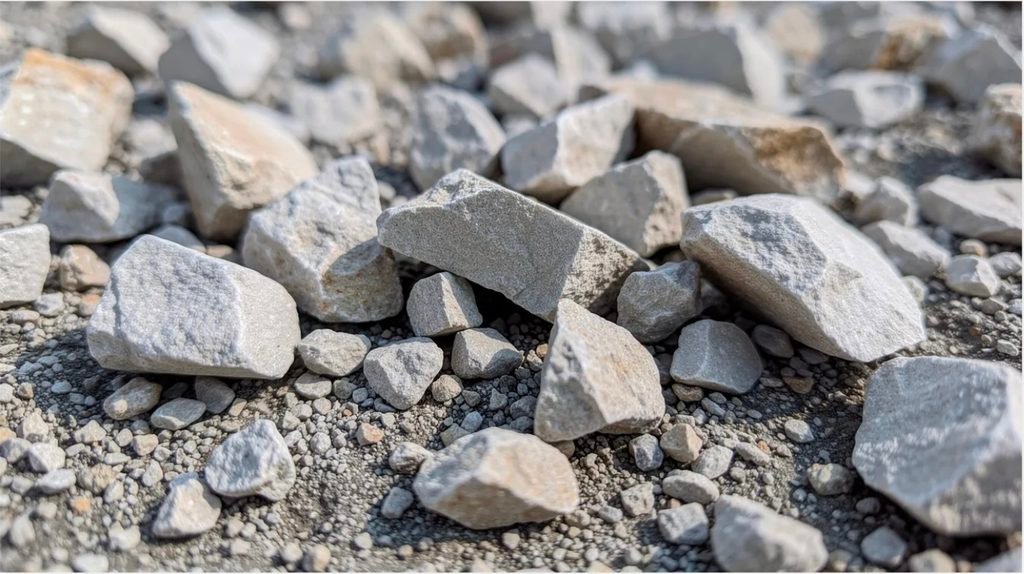
Solid limestone is categorized into low-density, medium-density, and high-density classifications:
- Low-density limestone ranges from 110 to 135 pounds per cubic foot.
- Medium-density limestone ranges from 135 to 160 pounds per cubic foot.
- High-density limestone exceeds 160 pounds per cubic foot, reaching up to 172 pounds.
Most solid limestone used in construction falls in the medium to high-density range, which is why 160 to 170 pounds per cubic foot is the practical planning figure. The low-density classification covers porous, highly weathered stone that is rarely specified for structural work, so don’t use those lower numbers for a solid limestone order.
For crushed material, the bulk density of loose crushed limestone is significantly less than solid limestone. Solid blocks of limestone are denser than crushed limestone due to the lack of air pockets. Crushed limestone compacts well due to its angular shape, and crusher run limestone is a dense-graded aggregate that packs tighter than clean stone. Weight estimations for limestone differ based on moisture content and particle size-damp material fresh off the truck can weigh 5–15% more than dry stone.
Quick comparison: 1 cubic foot of solid block at 165 lb/ft³ weighs roughly 165 lb, while 1 cubic foot of crushed limestone at 120 lb/ft³ weighs about 120 lb. Suppliers may quote density in lb/ft³ or tons per cubic yard, so understanding both units keeps you from misreading a quote.
From Cubic Foot to Cubic Yard: Converting Limestone Volume and Weight
Most homeowners measure a project area in square feet and depth in inches, but suppliers price limestone in tons or cubic yards. Conversions are the missing link.
- 1 cubic yard = 27 cubic feet
- 1 cubic foot ≈ 0.037 cubic yards
Using crushed limestone at 120 lb/ft³ as an example, weight per cubic yard = 27 × 120 = 3,240 lb ≈ 1.62 US tons. Loose crushed limestone runs closer to 1.4 tons per cubic yard at lighter densities around 104 lb/ft³, so always confirm which density your supplier is quoting. Solid limestone is heavier: at 162 lb/ft³, one cubic yard of solid limestone weighs approximately 4,374 pounds, or about 2.2 US tons. Overall, a cubic yard of limestone weighs roughly 1.4 to 2.2 tons depending on whether it is crushed or solid.
Reversing the math: if a supplier quotes 1.5 tons per cubic yard, that’s 3,000 lb ÷ 27 ≈ 111 lb/ft³-a useful check when comparing gravel driveway cost per ton across vendors.
How to Calculate How Much Limestone You Need (Step by Step)
You can calculate how much limestone any project requires with a simple formula or skip the math entirely using a limestone calculator. Here’s the manual method.
To calculate limestone volume, use length × width × depth. Then, the weight of limestone needed equals volume needed times density.
Worked example-crushed limestone driveway:
- Measure length and width: 40 ft long × 12 ft wide
- Depth: 4 inches → 4 ÷ 12 = 0.33 ft
- Volume = 40 × 12 × 0.33 ≈ 158.4 cubic feet
- At 120 lb/ft³ density → 158.4 × 120 ≈ 19,008 lb ≈ 9.5 tons
- Convert to cubic yards: 158.4 ÷ 27 ≈ 5.87 yd³
Compacted crushed limestone provides stability as a sub-base for driveways and foundations, but compaction increases the volume needed for limestone orders. A 10% waste factor is standard in construction projects to cover settling, spillage, and uneven ground. Structural load-bearing calculations must also consider the high weight of solid limestone when designing base layers for heavy vehicle traffic or parking areas.
Rather than running these numbers by hand, the Crushed Stone Calculator lets you enter dimensions, material type, and waste allowance to get volume, weight, and estimated cost instantly. You can also use the Stone Weight Calculator or Gravel Calculator for related materials like sand, granite, or mixed gravel.
Coverage: How Much Area Does a Ton or Cubic Foot of Limestone Cover?
Beyond weight, the question most people really want answered is: how many square feet will this limestone cover at a given depth?
The relationship is straightforward: Area (ft²) = Volume (ft³) ÷ Depth (ft).
At a typical density of 120 lb/ft³, 1 US ton of crushed limestone equals about 16.7 ft³ of material. A US ton of limestone covers roughly 50 square feet at 4 inches deep, though this drops closer to 45 square feet once the material is compacted. Here are estimates at common depths:
- 4 inches deep (0.33 ft): ~50 sq ft per ton
- 2 inches deep (0.167 ft): ~100 sq ft per ton
- 1 inch deep (0.083 ft): ~200 sq ft per ton
For small projects, 1 cubic foot of limestone spread 1 inch deep covers about 12 square feet. Thicker layers for walkways, pavers, or a gravel base for pavers obviously cover fewer square feet per cubic foot.
Actual limestone cover varies with particle size, compaction, and surface irregularities. Fine dust fills gaps better than #57 clean stone, so always round up your estimate and include a waste buffer in the limestone calculator.
Using a Limestone Calculator to Turn Cubic Feet into Tons (and Cost)
Manual formulas work, but an online limestone calculator is faster and eliminates errors when you need to plan a crushed limestone driveway, patio fill, or drainage bed quickly.
How to use the tool:
- Choose your material type (for example, crushed limestone, concrete aggregate, or a specific grade) so the correct limestone weight per cubic foot is applied.
- Enter project dimensions-length and width in feet or inches, depth in inches.
- Optionally add a waste factor (10% is a solid minimum) to account for compaction and spillage.
- Optionally enter the price per ton or per cubic yard to get an estimated cost. Limestone typically costs $40 to $70 per cubic yard as of 2026, depending on grade and region, though delivery and minimum order fees vary by supplier.
The calculator outputs total volume in cubic feet and cubic yards, total limestone weight in pounds and US tons, and your estimated cost. Crushed Stone Calculator is a free, no-signup tool designed for DIY homeowners and small contractors who need a quick estimate before they order limestone.
Practical Tips When You Order Limestone by Weight
Understanding weight per cubic foot keeps you from under-ordering material or overloading a truck. Here are the most important things to get right:
- Confirm whether your supplier prices per ton or per cubic yard, and ask what density they assume for their crushed stone product.
- Ask for the specific limestone grade-each has a different bulk density and behavior. Dense-graded mix packs tighter than clean stone used for drainage.
- Use your calculator estimate in tons as the basis for quotes, then round up to cover uneven ground and settling.
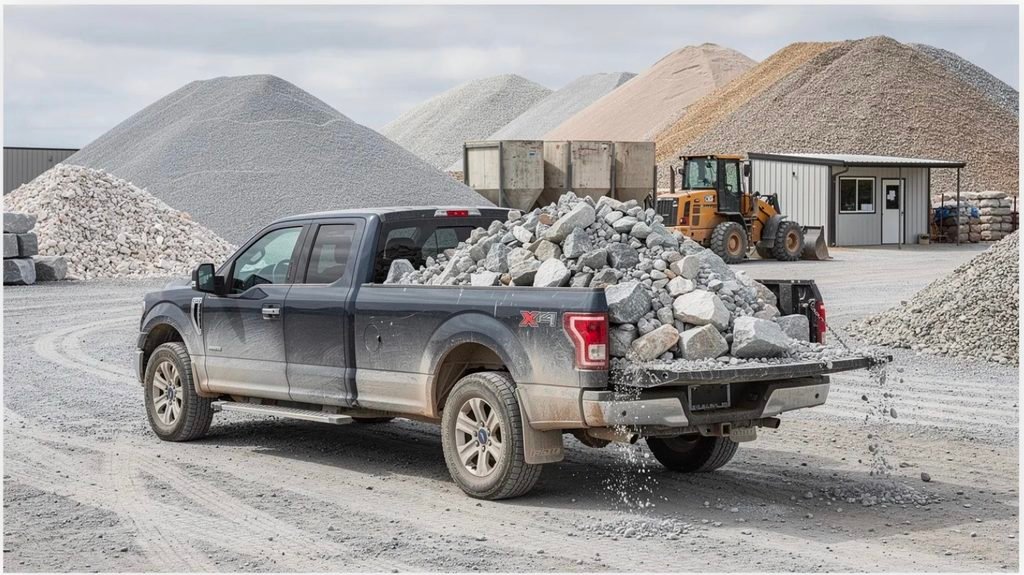
- Never rely only on cubic yards when loading a pickup or trailer. Multiply volume by limestone weight per cubic foot to get total load in pounds. For a pickup, stay within the payload and GVWR on the door label. When towing, the trailer’s own GVWR and the hitch rating both apply, and roughly 10 to 15 percent of the load weight should sit on the tongue. A single cubic yard of crushed limestone runs about 2,800 to 3,200 lb, which is enough to overload a small trailer on its own.
- For a gravel driveway or parking area handling regular vehicle traffic, plan for 4–6 inches of compacted base material. Compacting in layers improves stability for deeper bases-use a plate compactor and work in lifts no more than 3 inches deep per single pass.
- For shallow landscaping cover (1–2 inches), prioritize visual appearance and weed suppression over structural depth. A soft, fine grade works well here.
Before committing to a large delivery, plug your measurements into the Crushed Stone Calculator to get volume, weight, and price together so you can plan your quantity with confidence and avoid surprises at the gate.