Table of Contents
Most French drain gravel installations fail for a simple reason: the homeowner grabbed whatever gravel was available at the local landscaping yard without checking whether it actually performs underground. Within two or three seasons, fine sediment migrates into the perforated pipe, the perforations clog, and the “drain” becomes a buried wet spot. The stone you choose, the size you specify, and the quantity you order all determine whether your system is still working in 2046 or calling for a full re-dig by next spring.
This guide covers the four decisions that matter most: which gravel type performs reliably underground, how to match stone size to your trench and soil conditions, how to calculate the tonnage you need before calling a supplier, and how to sequence the installation so the gravel envelope does its job for decades. Before you place that quarry call, run your trench dimensions through the free calculator at CrushedStoneCalculator.com to get a confident ton count you can hand directly to a stone yard.
What French drain gravel actually does underground
The job of the stone envelope
Drainage rock isn’t just fill material. It creates a permeable channel that intercepts groundwater and redirects it toward a perforated pipe. The gravel column functions as both a reservoir and a filter: it slows incoming water enough that the pipe can accept it, while the stone’s irregular surfaces trap fine soil particles on the outside of the envelope rather than letting them migrate in. Understanding the distinction between “fill” and “functional drainage stone” is what separates a drain that lasts from one that doesn’t.
How void space moves water
The key concept is void ratio: the air gaps between individual stone particles are what actually carry the water, not the stones themselves. Angular, irregular particles stack in ways that leave consistent, interconnected gaps throughout the gravel column. Rounded stones, by contrast, have smooth surfaces that allow them to shift and pack tightly under soil pressure, gradually collapsing those gaps over time. The geometry of each individual particle determines drainage capacity, which is why two materials of the same nominal size can perform completely differently once they’re buried.
Why angular crushed stone outperforms rounded pea gravel
The problem with smooth, rounded stone
Pea gravel is the most common wrong choice for residential French drains, and the failure mechanism is straightforward. Smooth, rounded surfaces don’t trap fine sediment on the outside of the gravel envelope; instead, they allow it to pass straight through and settle into the perforated pipe. After a year or two of seasonal water movement, those perforations fill in and the system stops draining. Rounded particles also repack under soil pressure over time, which reduces the void space the drain depends on from the start.
Why #57 stone is the industry standard for French drain gravel
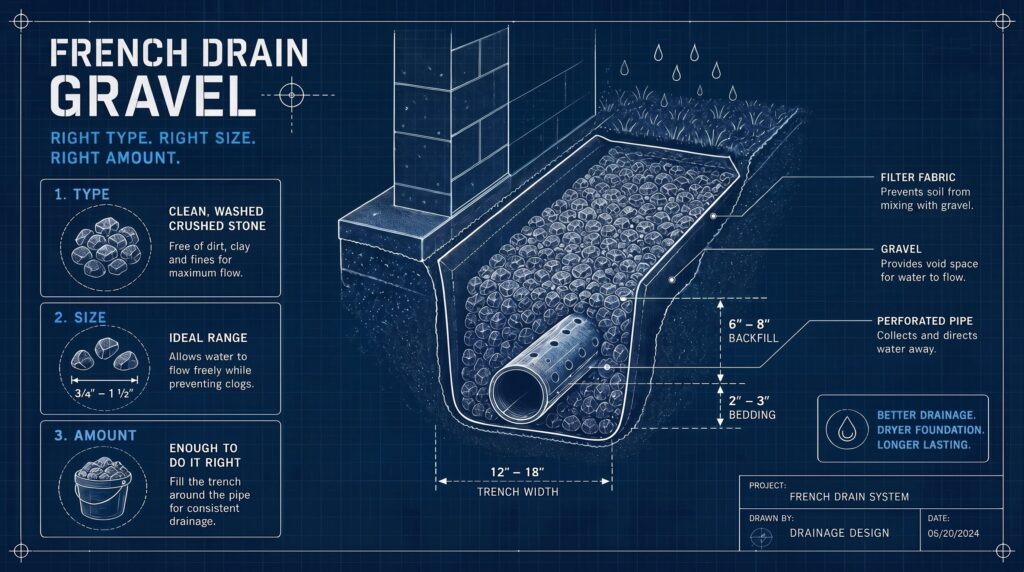
#57 crushed stone is the most widely specified drainage rock for residential French drains. It’s angular, washed, and screened to a 3/4-inch nominal size, which hits the sweet spot between adequate void space and effective debris filtration. “Washed and screened” matters: the production process removes the fine particles that would otherwise migrate into the pipe on their own, before the surrounding soil ever gets involved.
#67 stone is a slightly smaller, more uniform alternative that also drains well but packs a bit tighter than #57, making it a secondary choice for most applications. When a supplier’s spec sheet references “clean crushed stone” or “permeable drainage stone,” the spec sheet is generally describing material in this same washed, angular category.
Choosing the right drain rock size for your soil and trench
Standard sizing for most residential installs
For the majority of residential yard drainage projects in mixed or loamy soils, 3/4-inch clean angular stone (#57) is the correct starting point. This size is widely available from US stone suppliers, fits naturally around a standard 4-inch perforated pipe, and produces the void ratio needed to handle typical residential water volumes without excessive settling. If a supplier offers something labeled “drainage rock” without a specific gradation number, ask whether it’s angular and washed before ordering. That single question rules out a lot of inadequate material. (See our Gravel Driveway Installation Guide: DIY Layers, Depth & Cost for similar layer and depth recommendations on residential aggregate installations.)
When soil type changes the sizing equation
Heavy clay soil complicates the picture because clay particles are finer and migrate more aggressively than sandy loam. In clay-heavy conditions, the filter fabric surrounding the gravel envelope does more of the filtration work, and some installers step up to 1-inch to 1.5-inch stone to preserve void space even if small amounts of fine material work past the fabric edge. Sandy or loose soils present the opposite consideration: smaller angular stone can help stabilize trench walls and prevent sidewall collapse during installation. Trench depth also plays a role, since shallow trenches under 12 inches have less margin for error and benefit from tightly graded angular stone that resists lateral shifting over time.
How much French drain gravel your project actually needs
Calculating volume from trench dimensions
The formula for volume per linear foot is straightforward: trench width in inches multiplied by trench depth in inches, divided by 144, equals cubic feet per linear foot of trench. A few real examples make this concrete. An 18-inch-wide by 12-inch-deep trench produces 1.5 cubic feet per linear foot, so a 100-foot drain needs 150 cubic feet, or about 5.6 cubic yards. A 24-inch by 18-inch trench produces 3.0 cubic feet per linear foot, putting a 100-foot run at 300 cubic feet, or roughly 11.1 cubic yards. These are your starting volumes; the waste factor covered below is what turns them into a real supplier order.
Converting cubic yards to US tons (and why it matters when ordering)
Most US quarries and landscape supply yards quote aggregate by the ton, not by the cubic yard, and the conversion depends on material density. Angular crushed stone used for drainage typically weighs 1.4 to 1.5 tons per cubic yard, so the 5.6-yard example above works out to roughly 7.8 to 8.4 US tons. This is where many homeowners stall: they’ve calculated volume but don’t know how to translate it into an order.
The free Crushed Stone Calculator at CrushedStoneCalculator.com handles this conversion automatically, applying material density presets for drainage stone types and outputting results directly in US tons so you can place a confident, specific order on the first call. You can also cross-check quick estimates using an online gravel calculator if you want a second opinion before you call the yard.
Building in a realistic waste factor
Always order more than your calculated volume. Irregular trench edges, pipe bedding adjustments, and minor overexcavation all consume material that doesn’t show up in a straightforward length-times-width-times-depth formula. A 10% overage is a solid baseline for a straight trench run; plan for 15% on curved or L-shaped layouts where irregular geometry creates more fill zones. The Crushed Stone Calculator includes this buffer automatically, but if you’re running the math by hand, add that percentage before you finalize the order. Coming up short on aggregate mid-project is a time-consuming and costly problem to solve.
Installing the gravel correctly around your drain pipe
The pipe-bedding sequence: what goes where
The gravel envelope is a three-layer assembly, and each layer has a specific function. Start with 2 to 3 inches of drainage stone on the trench floor as pipe bedding; this base layer keeps the pipe level and supported, not resting directly on compacted subsoil. Pack at least 2 inches of stone on each side of the pipe to provide lateral support, then cover with 6 to 8 inches of drainage stone above the top of the pipe. That top coverage is what gives the gravel column enough volume to intercept water approaching from above before it reaches the pipe perforations, the actual mechanism doing the drainage work. For a step-by-step manufacturer’s perspective, see this French drain installation guide.
Wrapping the gravel in filter fabric
The filter fabric installation is the single step most likely to determine whether your drain lasts 5 years or 25. Use a needle-punched nonwoven polypropylene geotextile in the 4 to 8 oz weight range; 6 oz is a solid all-around choice for most residential soils, while 8 oz fabric is worth specifying in very silty or fine-grained conditions where sediment migration is a bigger concern.
Install the fabric before placing any gravel: lay it into the open trench so it extends up both trench walls with enough overlap to fold over the top when you’re done. Once the gravel and pipe are in place, fold the fabric edges over the top of the stone column and hold them flat before backfilling. This wraps the entire drainage stone envelope and keeps surrounding soil from migrating into the aggregate layer over the full life of the system.
When a gravel-free French drain system is worth considering
How modern gravel-free systems work
Gravel-free alternatives like Poly-Rock and prefabricated corrugated drainage modules replace the aggregate envelope with engineered plastic structures that create equivalent void space without the bulk and weight of stone. These products install faster because there’s no aggregate to haul and place in the trench, which is a real advantage in tight access situations or heavily landscaped yards where bringing in several tons of crushed stone would cause more damage than the drain itself solves.
The honest cost and capacity trade-off
Gravel-free systems carry higher material costs than bulk crushed stone, though faster installation can offset some of that expense on larger or labor-intensive projects. For drainage capacity, properly specified gravel-free systems match a traditional aggregate-filled drain in most residential applications; longevity is comparable when sizing and slope are correct. The traditional gravel French drain remains the most proven and cost-effective choice for most homeowners. Gravel-free systems earn their place primarily when aggregate delivery is genuinely impractical or site access is severely limited, not as a routine upgrade.
Getting the material right from the start
The core decision framework is short: choose angular washed crushed stone in the 3/4-inch to 1.5-inch range, size the gravel envelope to your full trench dimensions rather than just the pipe, and calculate your tonnage before calling the supplier so you order the right amount on the first trip. Getting that quantity right is the step most DIYers skip, and it’s the one that leads to mid-project supply runs or excess material sitting in the driveway. For industry gradation guidance and specification notes, consult published gravel drainage specifications.
Running your trench length, width, and depth through the free Crushed Stone Calculator at CrushedStoneCalculator.com takes about two minutes. Select the Rectangular shape, enter your trench length as Length, trench width as Width, and trench depth as Depth — then choose Crushed Stone or Limestone as your material type (not Pea Gravel, which is not suitable for drainage). It applies the correct density for drainage stone, adds a built-in waste factor, and outputs a US ton count you can read directly to a quarry or landscape supply yard over the phone. That’s the number that keeps your project on track without a second delivery.
Choosing the right French drain gravel and ordering the correct tonnage are the two decisions everything else depends on. Once those are locked in, the rest comes down to execution: proper pipe bedding, consistent gravel coverage above the pipe, and filter fabric wrapped correctly around the entire stone envelope before backfill. That last detail, the fabric wrap, is what separates a drain that performs for five years from one that’s still draining freely in twenty-five.
For related articles and additional how‑to resources, visit our Blog.
Pingback: No. 57 Stone Guide: Sizing, Uses, Price & How Much You Need
Pingback: Understanding Crusher Stone Price: A Guide for Buyers and Contractors
Pingback: The Benefits of Using 22A Gravel for Your Landscaping Projects
Pingback: Understanding the Benefits of SB2 Gravel for Your Landscaping Needs
Pingback: Top Benefits of Using Washed Gravel in Construction and Landscaping