Table of Contents
Planning a crusher run patio feels straightforward until you start researching base materials. Forums disagree. Big-box store employees give vague answers. One source swears by sand, another insists on gravel, and a third throws out terms like “dense grade aggregate” without explaining what that means. The confusion is real, but the answer for most DIY patios is less complicated than it seems.
Crusher run, also called crush and run, DGA (dense grade aggregate), or quarry process depending on your region, is a widely used, highly compactable, load-bearing base material commonly sold by local quarries. It’s not glamorous, but it works. This guide covers the right depth for your patio type, the correct compaction method, how crusher run compares to #57 stone, what it costs in 2026, and how to estimate tonnage accurately. Before you call a supplier for a quote, you can get a reliable tonnage figure quickly using the free Crushed Stone Calculator , which includes a crusher run density preset built right in.
Why crusher run works so well as a patio base
What’s actually inside crusher run
Crusher run is not a single-size stone. It’s a well-graded mix of angular crushed stone up to 1 to 1.5 inches combined with quarry fines and stone dust, all produced in one pass through a crusher. The industry uses different names for this material depending on the region: DGA in the Mid-Atlantic, quarry process in New England, road base in parts of the South and Midwest.
The material typically meets a 3/4-inch minus or 1.5-inch minus gradation, meaning all particles fall at or below that top size with a full range of smaller sizes included down to fine dust. That mixed gradation is intentional, not an accident, the spec exists because of how the material behaves under compaction, which is the real reason it works so well under a patio.
How stone-plus-fines creates a self-locking base
When you compact crusher run, the fines fill the voids between the larger angular pieces. The angular shape of the crushed stone means each particle locks against its neighbors instead of rolling like a round pea gravel would. Drive a plate compactor over it and the air gets pushed out, leaving a dense, slab-like layer that distributes load evenly. That’s exactly what a crusher run patio base needs underneath the finished surface, whether you’re laying concrete pavers, natural flagstone, or a loose gravel finish. Because #57 stone contains no fines, it doesn’t compact into a rigid mass the same way, a distinction covered in detail in the comparison section below.
Crusher Run Patio Depth: How Deep to Compact?
Paver patio: the 4 to 6 inch base rule
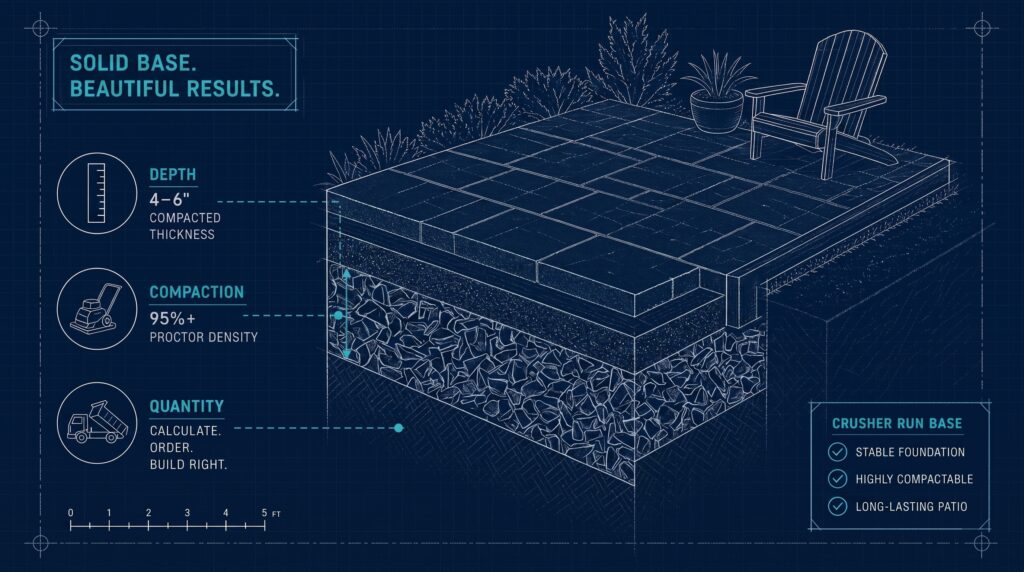
For any patio finished with pavers or flagstone, plan for 4 to 6 inches of compacted crusher-run base as the structural layer. On top of that, add a 1 inch bedding course of crusher dust or coarse sand for final leveling before the pavers go down. That bedding layer is not part of the structural base; it’s the setting bed that lets you fine-tune the surface elevation before locking everything in place.
On clay-heavy soil, or for larger and heavier patios, push the compacted crusher-run base to 8 to 12 inches total. The depth changes, but the method stays the same: install it in lifts, not all at once.
Loose gravel patio: shallower and simpler
A loose crusher run or gravel patio skips the bedding layer entirely. Excavate and compact the subgrade, lay landscape fabric to separate the stone from the native soil, and finish with 2 to 4 inches of crusher run on top. Because there are no pavers to level, you don’t need the precision of a sand or dust bedding course. The material just needs to be settled and reasonably uniform in depth.
Installing in lifts, not all at once
Never dump the full depth and compact in one pass. Work in 2 to 3 inch lifts, compacting each lift completely before adding the next. Skipping this step is the single most common cause of a soft, unstable patio base. A standard residential plate compactor cannot fully densify lifts thicker than 3 inches, which leaves weak spots in the middle of the layer. Installing in multiple lifts and compacting each one produces a far more stable base than placing the full depth and compacting once.
Crusher Run Patio: Compaction and Equipment
The right equipment for the job
A plate compactor is the standard tool for granular materials like crusher run. For most residential patios, a forward-plate compactor is sufficient. A jumping jack rammer works better in trenches or for cohesive clay soils, but it’s overkill for an open patio footprint. Rent a plate compactor from any equipment yard for a day; it makes an enormous difference compared to hand tamping, which simply doesn’t generate enough force to achieve real compaction.
Pass count, overlap, and the 95 percent density target
Make multiple passes over each lift, overlapping each pass by about 50 percent to avoid leaving soft strips between runs. The engineering standard for base compaction is 95 percent relative density. In the field, a practical indicator that you’re approaching that target: the surface stops sinking visibly under the machine. Some experienced installers also listen for the compactor to return a higher-pitched sound rather than a dull thud as the lift densifies. For verification on critical projects, an in-place density test or plate bearing test provides an objective confirmation. That density target is what separates a stable crusher-run patio project from one that settles unevenly after the first winter.
What causes the “jello wobble” and how to avoid it
A bouncy, springy base almost always traces back to the same culprits: compacting too thick a lift, compacting over soft or wet subgrade, or skipping passes in the middle of the slab area. The subgrade is the most overlooked factor. If the native soil underneath hasn’t been compacted first, no amount of work on the crusher-run layer will fix the problem. Compact the subgrade before you place any base material, and work in thin lifts from the bottom up.
Crusher run vs. #57 stone: which base is right for your patio?
Stability and load-bearing: crusher run’s advantage
Because #57 stone is a clean, single-size aggregate with no fines, it doesn’t compact into a rigid mass the way crusher run does. It has high void content, which means particles can shift more easily under load. For a crusher run patio base where stability is the priority, a well-compacted compactable gravel like crusher run consistently outperforms #57 stone as a direct structural layer.
The drainage and frost-heave trade-off
Here is where #57 stone gains ground. The same fines that make crusher run compact so well also slow water movement through the material. In cold climates with heavy freeze-thaw cycles, trapped water in a crusher-run base can contribute to heaving if drainage isn’t designed into the system. #57 stone drains freely because of its open void structure, which reduces that risk. If you’re building in a wet climate with cold winters and poor natural drainage, a layer of #57 stone beneath the crusher-run compaction course is worth the added step and material cost.
Which one to choose
For most DIY patios in moderate climates on decent soil: use crusher run. It’s easier to compact, widely available, and more affordable than engineered alternatives. In cold, wet regions with clay soil and frost depths over 24 inches, design a drainage layer of #57 stone below a thinner crusher-run compaction course, or consider an engineered paver base product designed specifically for freeze-thaw performance. The decision comes down to your climate and your drainage situation, not personal preference.
Estimating how many tons of crusher run you need
Why crusher run is sold by the ton, not by the yard
Quarries and landscape supply yards typically sell crusher run by weight because it’s consistent and straightforward to measure at a scale. The problem is that most people measure their project in square feet and inches. Converting cubic volume to tons requires the material’s bulk density, and crusher run is denser than most people expect.
Crusher run bulk density used for estimating purposes is approximately 3,000 pounds per cubic yard (1.50 tons per cubic yard), or roughly 111 pounds per cubic foot. Loose density before compaction runs lower — treat all figures as working estimates and confirm with your supplier. At the standard estimating density of 1.50 tons per cubic yard, one ton of crusher run covers approximately 54 square feet at 4 inches deep. Use the Crushed Stone Calculator for your exact project dimensions.
Using the Crushed Stone Calculator for accurate results
This is where the free Crushed Stone Calculator earns its keep. Enter your patio dimensions, set your target depth, and select crusher run from the material dropdown. The calculator applies a crusher run density preset to convert cubic yards directly to US tons, giving you a reliable order quantity to bring to your supplier. It also includes an adjustable waste factor, with 10 to 15 percent recommended for irregular patio shapes or uneven subgrades. Running this calculation before you call the quarry means you order the right amount the first time, not two tons short or two tons over.
What crusher run costs for a patio project in 2026
Material price range and what to expect by region
In 2026, crusher run material runs roughly $17 to $40 per ton from a bulk supplier or quarry. The low end reflects bulk limestone-based crusher run in areas near active quarries with strong regional supply. Prices push higher in markets where delivery distances stretch long or where demand consistently exceeds local supply. On a delivered basis, the practical regional ranges look like this:
- Near quarries or rural areas: $25 to $40 per ton delivered
- Suburban markets: $30 to $50 per ton delivered
- Urban or remote areas: $40 to $60 per ton delivered
Delivery charges and how to reduce your per-ton cost
Delivery adds $100 to $500 per load depending on distance and load size. Some suppliers offer free delivery above certain thresholds, commonly around 15 tons, though policies vary, so check with your local supplier directly. If your project needs less than five tons, coordinate with a neighbor who also has a stone project in the works, or pick up in a rented dump trailer to avoid paying a full delivery charge on a small load. Your effective delivered cost for a small residential patio often lands between $35 and $75 per ton once hauling is factored in. For typical project planning and a practical primer on using crusher run as a base, see this crusher run project base overview.
Putting it all together before you order
A DIY base choice like a crusher run patio earns its reputation as the default DIY base choice because of its compactability, wide availability, and straightforward installation process. The method holds across most project types: excavate to the right depth, compact the subgrade, install crusher run in 2 to 3 inch lifts at 4 to 6 inches total compacted thickness, compact each lift to 95 percent density, and add a 1 inch bedding course before pavers go down. Do not exceed 1 inch — a thicker setting bed creates too much compressible material under the pavers, which leads to rocking and uneven settlement over time.
#57 stone has a real role in drainage-heavy builds and cold-climate systems, but it doesn’t replace a compacted crusher-run base for structural stability under a finished patio surface. For most homeowners in most climates, crusher run is the right call: it’s affordable, forgiving to install, and it performs.
For your crusher run patio project, run a quick tonnage estimate with the free Crushed Stone Calculator before you place that supplier call. Enter your dimensions and target depth, and the calculator handles the density conversion for you. A few minutes of math now is the simplest way to avoid a second delivery charge later.
Pingback: Crusher Run vs 57 Stone for Driveway Base: Which Wins?