Table of Contents
The most common mistake homeowners make when planning a gravel driveway is calling a supplier and ordering whatever material is cheapest or most readily available. That approach often leads to ruts forming after the first hard winter, washout channels cutting through the surface after heavy rain, or a driving surface that shifts every time a vehicle turns around. Choosing the right driveway stone types matters, picking the wrong one costs you money twice: once when you buy it, and again when you fix it.
Every driveway stone type covered here serves a specific purpose. The right choice depends on traffic load, drainage needs, and whether you’re building a base layer, a surface course, or both. Stone type also changes how much material you need to order, since density varies significantly across materials. A cubic yard of crushed granite weighs more than a cubic yard of pea gravel, and that difference shows up directly in your tonnage and your cost estimate. The Crushed Stone Calculator accounts for this with material-specific density presets so you can create a more realistic planning estimate before you order.
Crusher run and #411: the compacting stones that build a solid base
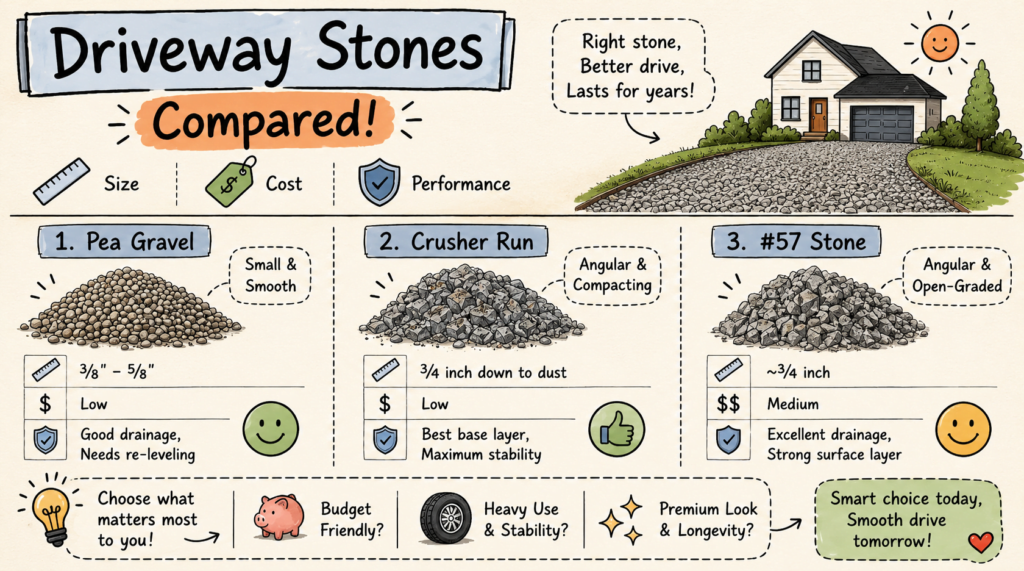
Crusher run is a blend of crushed angular stone mixed with stone dust and fines. That combination is what makes it valuable: the fines fill the gaps between larger pieces and lock everything together under compaction. The result is a dense, semi-rigid layer that resists rutting and doesn’t migrate under tire pressure. Sizing typically runs from 3/4 inch down to dust, which is why it compacts so tightly compared to clean, single-size stone.
#411 is essentially #57 stone blended with stone dust screenings, placing it between crusher run and clean open-graded stone in terms of drainage performance. It compacts well but allows slightly more water movement than pure crusher run. For driveways in moderate-rainfall areas where you want a stable base without completely sacrificing drainage, #411 hits a useful middle ground. When crusher run compacts, it sheds water more slowly than clean open-graded stone; #411 may retain some permeability while still locking together under compaction.
Crusher run is the right call for the base layer of any driveway that sees regular vehicle traffic, clay-heavy soil, or areas prone to washout. In freeze-thaw climates, plan on a compacted base of at least 6 inches, built in 2 to 3 inch lifts. #411 works well as either a base material or a driving surface layer in drier climates. Neither of these driveway stone types suits drainage-specific applications like French drain fill, where open-graded material is required.
#57 stone and crushed granite: drainage first, durability second
#57 stone is clean crushed stone sized at roughly 3/4 inch with minimal fines. That open, uniform sizing creates consistent voids throughout the layer, which means water moves through it quickly rather than pooling on the surface. It is widely used for drainage applications, and it can also work as a driveway surface or drainage layer above a compacted base where clean, open-graded stone fits the design. The angular shape gives it more stability than rounded stone of similar size, and its hydraulic conductivity is significantly higher than dense-graded materials. For a concise explanation of what #57 stone is and common uses, see what #57 stone is used for.
Crushed granite brings exceptional hardness compared to most driveway aggregate options. It comes in multiple sizes and has a distinctive gray-to-silver appearance that looks sharper than standard limestone. For high-traffic driveways, commercial access roads, or areas where the surface layer takes serious abuse, granite holds its form longer than most alternatives. The tradeoff is cost, which often runs higher than limestone in many markets, particularly in regions without local quarry access — though prices vary and granite can be competitive near quarry sources.
In a properly built gravel driveway, #57 stone often serves as the middle structural layer, placed above a crusher run base and below a finer driving surface. One common residential setup in freeze-thaw areas uses a compacted dense-graded base, such as crusher run, with a thinner surface or drainage layer above it depending on local material options, slope, and drainage needs.
For a detailed size comparison that helps you decide between similar crushed sizes, consult this 57 vs 67 crushed stone comparison. Crushed granite can function as either the structural layer or the top course, depending on whether it’s ordered in coarse base grade or finer surface grade. Neither stone should be placed directly on bare soil without a compacted base underneath.
Crushed limestone, a top driveway stone type for residential use
Crushed limestone is angular, light gray to off-white in color, and available in a wide range of grades from coarse base material down to screenings. Most suppliers carry it in sizes that mirror the standard numbered stone grades, produced specifically from limestone. Its appearance is clean but not decorative, which works fine for functional driveways where performance takes priority over curb appeal.
The drainage and compaction performance of limestone depends heavily on which grade you order. A clean #57 limestone grade drains openly and handles water movement well. A crusher-run equivalent with limestone fines compacts tightly and builds a strong, stable base. This flexibility makes limestone one of the few driveway gravel types that can serve as either a base material or a surface course depending on how it’s graded, without needing to switch stone suppliers between layers.
Limestone’s main advantage is regional availability and price. In most parts of the US, it’s one of the most affordable options per ton, and it’s widely stocked at local quarries and landscape suppliers. Where it underperforms is in highly acidic soil conditions, where it can break down faster than granite or harder crushed stone for driveways. For most residential builds in neutral soil conditions, crushed limestone delivers strong value at every layer. If you want a deeper comparison of performance and cost between the two, read Limestone vs Granite Gravel: Cost, Strength & Best Uses.
Pea gravel, one of the driveway stone types: honest pros and cons
Pea gravel is small, smooth, rounded stone ranging from about 3/8 to 5/8 inch. The smooth surface and natural earth tones make it one of the most visually appealing options for residential driveways and walkways. It comes in a range of colors depending on the source material, from warm brown and tan mixes to cooler gray and white blends. River rock offers a similar natural appearance, but it is not stable for vehicle traffic. For homeowners who want a softer, more decorative look than standard crushed stone, pea gravel is a common decorative choice.
The same smooth, rounded shape that makes pea gravel look good is exactly what causes problems on a working driveway. Rounded stones don’t interlock. Under tire pressure, they roll and displace rather than compact into a stable surface. On any slope, they migrate downhill. In high-rainfall areas, runoff pushes them around during storm events, leaving ruts, bare patches, and material scattered across the lawn or into the street.
Pea gravel works best on flat driveways with light vehicle use, particularly when combined with solid edge restraints that prevent lateral migration. A compacted crusher run base underneath keeps vertical displacement in check. For anything with regular heavy vehicle traffic, steep grade changes, or soft clay soil underneath, a more angular driveway stone type will outperform it significantly. Use pea gravel as decorative gravel where aesthetics matter more than structural performance.
What each driveway stone type costs per ton in 2026
Crusher run often sits toward the affordable end of the driveway stone market. As a practical 2026 planning range, crusher run or road-base gravel commonly falls around $20 to $40 per ton before delivery in many U.S. markets. In areas close to quarries or for bulk pickup, lower prices around $10 to $15 per ton may be possible, while suburban, urban, or remote deliveries can cost more. #411 stone typically falls in the $25 to $40 per ton range, depending on regional availability and whether it’s sold as a separate product or blended limestone base. These two materials cover the majority of base-layer needs at the lowest cost per ton.
Crushed limestone averages $30 to $40 per ton nationally, though pricing varies widely by region and grade. Crushed granite typically ranges from $25 to $50 per ton but can reach $60 or more in areas without local quarry access. Pea gravel runs $10 to $50 per ton depending on color, blend, and regional availability, with decorative mixes at the higher end. River rock sits at the premium end at $40 to $75 per ton, primarily because of decorative demand rather than structural performance. Premium decorative stones, such as marble chips, are usually chosen for appearance rather than structural driveway performance and can cost much more than standard driveway aggregate.
Delivery fees apply across all materials and can run $50 to $200 depending on distance and load size. On a delivered basis, expect $25 to $40 per ton near quarries, $30 to $50 in suburban markets, and $40 to $60 in urban or remote areas. For most residential projects, material cost and delivery together determine the real budget. The most cost-effective approach for a full driveway build is to use crusher run or #411 for the base layer and reserve the premium stone for the top course only, which reduces total tonnage of the expensive material without sacrificing performance.
Getting your tonnage right before you order
Volume and weight don’t translate the same way across driveway stone types, so estimating how much gravel you need starts with matching the right density to the material. Crushed granite has a density of roughly 1.40 to 1.55 tons per cubic yard, while pea gravel runs about 1.25 to 1.35 tons per cubic yard, and crusher run sits around 1.50 tons per cubic yard. If you calculate tonnage based on the wrong density, you either order short and pay for a second delivery, or you pay for stone you don’t need. On a standard two-car driveway, the density difference between materials can shift your total tonnage by 15 percent or more.
Beyond getting tonnage right, two installation elements protect your material investment. A proper geotextile fabric over the prepared subgrade can help keep stone from migrating into soft soil while still allowing drainage, especially in clay-heavy or wet conditions. Edge restraints along both sides of the driveway prevent lateral spreading and keep the material in the lane where it belongs. Without those two elements, even the best stone selection will require frequent regrading and top-ups to maintain a clean surface. For tips on compacting and stabilizing open-graded stone in the surface course, see this guide on how to compact and stabilize #57 stone.
The Crushed Stone Calculator includes built-in material presets for crusher run, limestone, granite, pea gravel, river rock, and more, each tied to typical bulk density estimates. Enter your driveway dimensions and target depth, select the stone type, and the calculator returns cubic yards and estimated tons in seconds.
It also includes an adjustable waste factor and a price-per-ton input so you can build a rough material budget before you call. For most full driveway orders, bulk gravel is usually the practical option because the calculator helps you estimate delivered quantities before you contact suppliers. If you’re deciding between two gravel sizes and grades, run both through the calculator and you’ll see exactly what the tonnage and cost difference looks like on paper. For an in-depth reference on crushed stone grades, that resource is a helpful companion when choosing sizes.
Choosing the right driveway stone types starts with knowing what you’re building
Crusher run and #411 give you the compacted stability that heavy traffic and soft soils demand. #57 stone and crushed granite handle drainage and structural loads without trapping water in the base. Crushed limestone delivers reliable all-around performance at a price point that’s hard to beat in most US markets. Pea gravel earns its place on flat, low-traffic driveways where appearance matters and edge restraints keep it in check.
Matching the right driveway stone types to your specific site conditions will save you money on materials and cut down on long-term maintenance. Once you’ve identified the right material, make sure you order the right amount. Use the Crushed Stone Calculator before you call a supplier. You’ll show up to that conversation knowing your dimensions, your stone type, and your estimated tonnage instead of guessing at the yard and hoping the driver brings enough. For additional reading and step-by-step planning, see our Driveway Guides, Crushed Stone Calculator.
Frequently asked questions about driveway stone types
Which driveway stone types are best for steep driveways?
Angular, compacting materials like crusher run or #411 perform best on steep grades because angular gravel interlocks well. The right gravel for steep driveways also needs to resist washout and stay in place under turning tires. Their fines lock together under compaction, resisting the downhill creep that rounded or single-size stones experience. Avoid pea gravel on any slope because it can migrate downhill under both vehicle traffic and rainwater runoff.
What is the best driveway aggregate for freeze-thaw climates?
Crusher run is a common base choice in freeze-thaw regions because it compacts tightly when installed in proper lifts over a prepared subgrade. A compacted base of at least 6 inches, laid in 2 to 3 inch lifts, gives the driveway enough depth to resist frost heave, and good drainage helps reduce damage from repeated freeze-thaw cycles. A clean stone layer such as #57 can improve drainage above or within the driveway structure where the design calls for open-graded material.
How do gravel sizes and grades affect driveway performance?
Coarser, open-graded stone like #57 drains freely but doesn’t compact into a firm surface on its own, so performance changes with the type of gravel as well as the size. Finer, dense-graded material like crusher run compacts tightly but restricts drainage, while finer gravel is often used to create a smoother top layer over coarser stone below. Most well-built driveways use both: a compacted dense-graded base with an open-graded or mid-grade surface course on top. For a practical explanation of how different crushed stone sizes are used, check the crushed stone grades guide.
Can I use the Crushed Stone Calculator to compare driveway stone types?
Yes. Enter your driveway dimensions and depth, then switch between stone types using the material preset menu. The calculator adjusts density automatically for each material — switch between stone types to compare tonnage and cost estimates one at a time. If you’d like a broader reference library on selection and installation, also see our Crushed Stone Guides, Crushed Stone Calculator.
Pingback: Crusher Run vs 57 Stone for Driveway Base: Which Wins?
Pingback: Gravel Driveway Cost Per Ton — 2026 Pricing & Tonage Guide