Table of Contents
When you’re on the phone with a landscape supplier and the rep asks, “Do you want crusher run or #57 stone for your driveway base?” most people pause. Both are crushed stone. Both get used under driveways all the time. But choosing between crusher run vs 57 stone for a driveway base matters more than it might seem, these two materials behave completely differently once they’re in the ground, and picking the wrong one leads to ruts, washouts, or a base that shifts with the first hard freeze.
This article breaks down exactly how these two materials compare for driveway base construction: compaction behavior, drainage performance, load-bearing capacity, recommended depths, installation steps, and cost. By the end, you’ll have a clear answer for your specific situation, including when using both materials in layers is the smartest move. Once you’ve nailed down your material choice, calculating exact tonnage is the fast part. The Crushed Stone Calculator includes material-specific density presets for both crusher run and #57 stone so you can get your order quantity right before you pick up the phone.
What actually separates these two materials
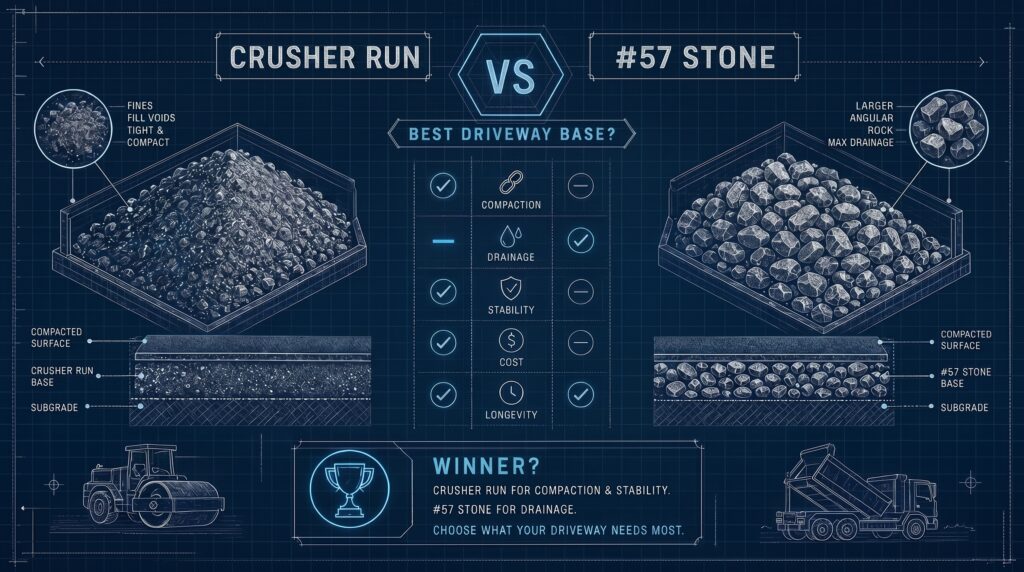
The difference between crusher run and #57 stone comes down to one thing: fines. Everything else, compaction strength, drainage behavior, load capacity, flows directly from whether or not fine particles are present in the mix.
Crusher run: the dense-graded workhorse
Crusher run is a well-graded, dense-graded aggregate. Its particle sizes range from fine dust all the way up to about 1.5 inches, with every size in between. That full range of particles is intentional. The fines fill the void spaces between larger pieces, which is precisely what makes crusher run so effective as a base material. It’s typically made from crushed granite, limestone, or trap rock, and you’ll see it sold under regional names including crush-n-run, road base, or processed gravel depending on where you are in the country.
57 stone: the clean, open-graded aggregate
#57 stone, also called 57 crushed stone or 57 gravel in some regions, is a uniformly graded aggregate with a gradation range of approximately 3/8 inch to 1½ inches per ASTM C33, with a nominal size of about ¾ inch. It’s washed and screened specifically to remove fines, leaving a uniform, open structure with large void spaces between each piece. It’s also crushed from limestone or granite, but processed very differently from crusher run. When aggregate suppliers use the word “clean,” they mean free of fines, not visually clean.
The presence or absence of fines is the single biggest factor driving every performance difference between these two materials. Keep that in mind as you read through the comparisons below.
Crusher run vs 57 stone for driveway base: compaction and load-bearing
When you spread crusher run and run a plate compactor over it, the fines migrate into the voids between larger stones. The result is a dense, interlocked mat that distributes vehicle loads evenly across the subgrade and resists shifting, rutting, and deformation under repeated wheel traffic. Compacted crusher run is commonly reported in the range of roughly 2,900 to 3,100 pounds per cubic yard (approximately 1.45 to 1.55 tons per cubic yard), depending on gradation, source, and compaction technique.
57 stone, with its open, uniform structure, tells a different story. The stones roll against each other rather than locking together. You can compact it somewhat for settling purposes, but it will never achieve the tight, rigid layer that crusher run does. #57 stone’s bulk density for ordering purposes is approximately 2,800 pounds per cubic yard (1.40 tons per cubic yard). Its open structure means it contains more air voids than crusher run, but its delivery density is still meaningfully higher than some loose-state figures suggest.
What this means under passenger vehicles and light trucks
Under a typical residential driveway handling cars, pickups, and light trucks, compacted crusher run forms a base that holds its profile season after season. It resists the ruts that develop when stones shift under repeated wheel loads. #57 stone used as the sole base layer is prone to movement, especially during freeze-thaw cycles or on wet, soft subgrades where lateral support is limited.
For raw compaction and load-bearing strength, crusher run is generally the better driveway base aggregate for most residential scenarios, though sites where drainage is the overriding concern may call for a different approach, as covered below.
Drainage behavior: the one area where #57 stone wins decisively
Because #57 stone has almost no fines, its void spaces are large and connected. Water infiltrates quickly and moves freely through the aggregate layer rather than pooling or sitting against your subgrade. Permeability is high. Compare that to crusher run, where the same fines that make it compact so well also reduce permeability significantly. Crusher run sheds water sideways and off the surface rather than allowing it to pass through vertically.
Neither behavior is wrong. They’re just suited to different problems, the question is which one your site has.
When drainage matters more than compaction
There are specific site conditions where #57 stone’s drainage advantage outweighs its compaction weakness: high water tables, clay-heavy subgrades that hold moisture, sites with significant surface runoff, or driveways where standing water has historically been an issue. In those conditions, trapping water beneath a dense-graded base layer creates frost heave risk and long-term base failure. That’s where a drainage layer of #57 stone, placed strategically beneath crusher run, becomes the right answer.
Using both materials together: the layered base approach
Experienced contractors on wet or clay-heavy sites often use both materials in a layered system. The most common arrangement on poor-draining subgrades places a bottom layer of #57 stone, typically 3 to 4 inches, directly on the subgrade to handle drainage, letting water pass through and away from the compacted layers above.
A top layer of crusher run, 4 to 6 inches compacted, sits on top and provides the load-bearing strength and surface stability. That said, layer order can vary depending on site conditions and design intent: some engineered approaches place a drainage layer above the structural base to intercept surface infiltration, so consult local contractor guidance or DOT recommendations if your subgrade is unusually soft or your drainage situation is complex.
Used correctly, the layered approach gives you the best performance characteristic from each material where it’s needed most. For more on designing layered aggregate installations and typical patio/base applications, see the Crusher Run Patio Base: Depth, Compaction & Tonnage Guide.
On very soft or wet subgrades, adding a geotextile fabric between the native soil and your first stone layer is worth the small added cost. It prevents fines from the subgrade from migrating up into your drainage layer over time and clogging it, a practice widely recommended in highway and site construction guidance for separation and filtration on weak subgrades.
When a single-material base is the right call
Not every driveway needs a layered system. In well-drained sandy or loamy soils with good natural permeability, a single compacted crusher run base performs well without a drainage layer underneath. The layered approach earns its place on sites with poor drainage or expansive clay soils. Treat this as a site-specific call, not a universal rule. If your yard drains quickly after rain and you don’t have standing water problems, straightforward compacted crusher run is probably all you need. For a broader comparison of driveway stone types, sizes, and performance, consult our detailed guide.
Base depth, compaction method, and installation steps
Material selection only matters if the installation is done correctly. A shallow or poorly compacted crusher run base will fail just as fast as the wrong material altogether.
Recommended depths for residential driveways
For passenger vehicles and light trucks, plan on a compacted crusher run base of 4 to 6 inches minimum after compaction, not before. If you’re using the layered approach, that means 3 to 4 inches of #57 stone plus 4 to 6 inches of compacted crusher run on top. Soft or wet subgrades may require deeper base sections. These are practical starting points based on typical residential conditions, not engineered specs for your specific soil bearing capacity.
Step-by-step installation process
- Excavate to depth, removing all topsoil and organic material from the driveway footprint.
- Grade and compact the native subgrade, addressing any soft spots before placing stone.
- Install the #57 stone drainage layer if using the layered approach, spread and tamp level.
- Spread crusher run in lifts no deeper than 3 inches per layer before compaction.
- Compact each lift with a plate compactor or vibratory roller, making 2 to 4 overlapping passes until no visible movement remains under the compactor.
- Add additional lifts and compact each one until you reach your target finished depth.
- Grade the finished surface with a slight crown of 1 to 2 percent to direct surface water away from the center of the driveway.
Compaction tips that actually matter
Don’t try to compact more than 3 inches per lift. Thicker lifts look efficient but the compaction energy from a standard plate compactor doesn’t reach the bottom of the layer, leaving a soft zone that causes problems later. Compact when the material is slightly moist but not saturated: bone-dry crusher run compacts less effectively, and saturated material won’t compact at all. Make multiple overlapping passes across the full width of the driveway so you don’t leave strips of loose material at the edges. For practical guidance on plate compactor technique, see this how to use a plate compactor correctly guide, and for broader compaction principles used in pavement work, the basic compaction process for successful pavements is a useful reference.
Cost comparison and calculating how much you need
Both materials are affordable compared to pavement, but there’s a meaningful price difference between them that should factor into your planning.
What these materials cost in 2026
Crusher run typically runs $30 to $60 per ton delivered, making it one of the more affordable driveway base aggregates on the market. #57 stone runs slightly higher at $40 to $80 per ton delivered, reflecting the additional screening and washing required in its production. These figures are approximate national averages for 2026, regional variation is significant, and quarry proximity, local demand, and haul distance all affect the final delivered price, so treat them as planning benchmarks rather than guaranteed quotes.
One pricing nuance worth knowing: because crusher run compacts to a higher density than #57 stone (heavier per cubic yard), you’ll be buying more weight in tons for a given finished volume, so always compare material costs on a per-ton basis using density-specific conversions rather than by volume alone. A rough example: crusher run at approximately 1.50 tons per cubic yard versus #57 stone at approximately 1.40 tons per cubic yard means the per-yard cost gap is narrower than the per-ton price difference suggests. For a quick primer on crushed stone grades and common uses, this guide to crushed stone grades is handy.
How to nail your tonnage before you call the supplier
Once you’ve decided on your material and know your driveway dimensions and target base depth, use the Crushed Stone Calculator to get exact tonnage before placing your order. The calculator includes material-specific density presets for both crusher run and #57 stone, so your tonnage estimate reflects the actual weight of the material you’re buying, not a generic average. That matters because crusher run is heavier per cubic yard than #57 stone, and ordering by the wrong density preset is a common and costly mistake.
The built-in adjustable waste factor is especially useful for irregular driveway shapes or projects with curved edges. A 10 to 15 percent waste buffer on top of your calculated tonnage protects you from coming up short on delivery day. If you’re also considering surface stone types beyond the base, our Best gravel for driveways: Types, Layers, and Costs Guide covers finish stones, maintenance, and aesthetic choices.
The bottom line: crusher run vs 57 stone for driveway base
When you’re weighing crusher run vs 57 stone for a driveway base, the decision comes down to compaction versus drainage. Crusher run is the right call when load-bearing strength and rut resistance are your top priorities, which covers the majority of standard residential driveways. #57 stone earns its place when drainage is the primary concern, or as a sub-base drainage layer beneath crusher run on wet or clay-heavy sites. For many driveways, using both in a layered system delivers the best long-term performance by combining drainage at the bottom with structural strength at the top.
Depth and compaction method matter as much as material selection. Nail the depth for your traffic load, compact in lifts of 3 inches or less, and build in a slight crown so surface water runs off rather than pooling. Those three habits turn either material into a base that lasts.
Once the material decision is made, head over to the Crushed Stone Calculator, punch in your dimensions and depth, select your material preset, and get your tonnage figure before you make that supplier call. No surprises on delivery day, no second trips to the quarry.
FAQ
Q: What is the main difference between crusher run and #57 stone?
A: The single biggest difference is fines: crusher run contains a full range of particle sizes including fines and dust, while #57 stone is a uniformly graded aggregate (gradation range 3/8 inch to 1½ inches per ASTM C33, nominal size ~¾ inch) washed and screened to remove fines. That presence or absence of fines drives compaction, drainage, and load-bearing behavior.
Q: Which is better for a driveway base, crusher run or #57 stone?
A: For a driveway base, crusher run is generally better because the fines fill voids and compact into a dense, interlocked layer that resists ruts and shifting under vehicle loads. #57 stone won’t lock together the same way and is less suitable as the sole load-bearing base under repeated traffic.
Q: Can I use #57 stone as the only base material for my driveway?
A: You can use #57 stone for settling and some base purposes, but it will never achieve the tight, rigid layer that crusher run does because the stones tend to roll against each other. For driveways carrying cars and light trucks, #57 alone risks shifting and deformation unless it’s part of a layered system.
Q: How do crusher run and #57 stone compare for drainage?
A: #57 stone is an open-graded, clean aggregate that drains very well because it’s free of fines, whereas crusher run contains fines that reduce permeability and slow drainage. When suppliers call aggregate “clean,” they mean free of fines, not necessarily visually clean.
Q: Is it a good idea to use both crusher run and #57 stone together?
A: Yes — using both materials in layers is often the smartest approach on wet or clay-heavy sites: #57 stone as the bottom drainage layer (typically 3–4 inches directly on subgrade) to let water pass through freely, with crusher run compacted on top (4–6 inches) to provide load-bearing strength and surface stability. This layered system gives you the best of both materials.
Q: What are typical compacted weights for crusher run and #57 stone?
A: Compacted crusher run is commonly reported in the range of roughly 2,900 to 3,100 pounds per cubic yard (approximately 1.45 to 1.55 tons per cubic yard) depending on gradation, source, and compaction technique. #57 stone weighs approximately 2,800 pounds per cubic yard (1.40 tons per cubic yard). Because it is an open-graded aggregate, it does not compact into a dense layer the way crusher run does — its weight remains relatively consistent whether loose or settled.
Q: How do I figure out how much crusher run or #57 stone to order?
A: Calculating tonnage is straightforward with the Crushed Stone Calculator mentioned in the article, which includes material-specific density presets for both crusher run and #57 stone. Measure your area and desired depth, then use the calculator to get the correct order quantity before contacting your supplier.