Table of Contents
If you’re planning a driveway, drainage project, or landscaping upgrade, chances are you’ve come across the term 57 rock. Here’s what it actually is, how much you need, and when it makes sense over other materials.
What Is 57 Rock? (Quick Overview)
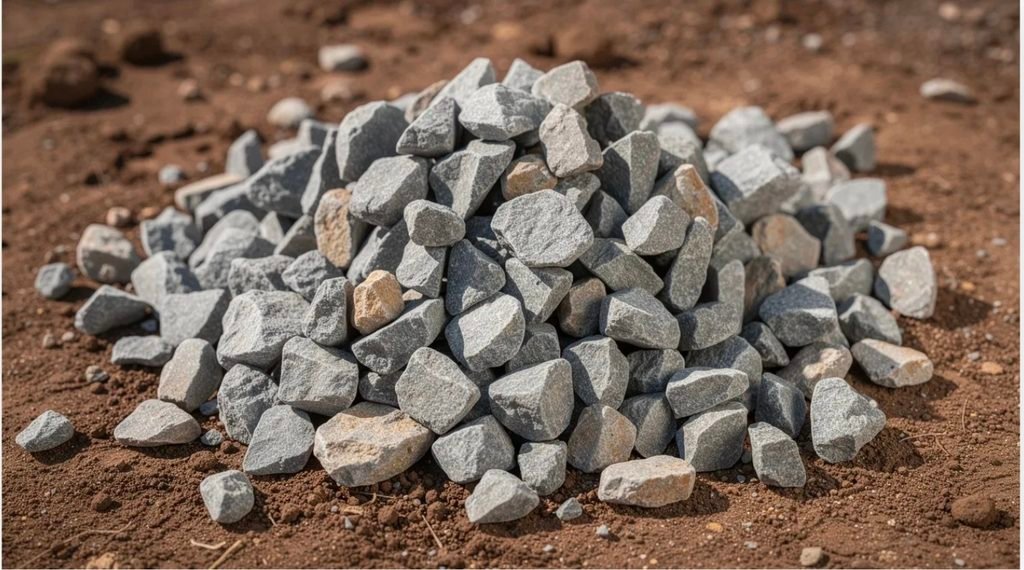
#57 rock is a common coarse aggregate used across U.S. construction and landscaping projects. Suppliers often call it “3/4-inch stone,” but #57 rock contains a mix of particle sizes rather than pieces that are all exactly 3/4 inch. When #57 rock is crushed and angular, the pieces grip each other better than rounded gravel, while the open spaces between them let water drain through.
A few things to note before you order:
- #57 describes a standard aggregate size, not one exact product. The rock type, color, shape, and exact mix of particle sizes can vary by supplier and region. You may see names such as #57 stone, #57 gravel, 57 crushed rock, or 57 lime rock, so confirm the supplier’s product specifications before ordering.
- Clean stone vs. base with fines. #57 stone normally has very little fine material compared with crusher run or road base, which contain smaller particles that help them compact. “Washed” is a separate supplier specification, so if drainage matters, confirm that the #57 stone is clean or washed as required for your project.
- Always verify with your supplier. Sizes, density, and availability differ by location, so confirm specs before you buy.
You can use our crushed stone calculator to estimate cubic yards, tons, and material costs before placing an order.
Typical Size, Material Types, and Density of 57 Rock
A common #57 stone specification includes a mix of larger and smaller pieces, with nearly all of the material passing a 1-inch screen. Exact sizing can vary by local specification and supplier.
Common parent materials and appearance:
- Limestone – often light gray to off-white; common in many parts of the Midwest, South, and Texas. It is one of the most widely used crushed-stone materials in the U.S.
- Granite – often gray or speckled, hard, and durable; common in parts of the Southeast and Northeast. Availability and price vary by local quarry and region.
- Washed gravel or recycled concrete aggregate – available in some markets. Washed natural gravel may be rounded, while recycled concrete aggregate is typically angular. If sold as #57 material, confirm that it meets the #57 size specification required for your project.
Because 57 rock is angular when crushed (especially limestone and granite), the stones interlock better than rounded gravel while still remaining free-draining.
Planning-level density: our calculators use 1.40 US tons per cubic yard for #57 stone. FHWA testing of one AASHTO No. 57 aggregate measured about 1.29–1.47 US tons per cubic yard, showing how bulk weight can change with the material and how densely it is packed. Actual weight also varies by rock type, gradation, moisture, and supplier, so use your supplier’s density when available.
Common Uses for 57 Rock in Landscaping and Construction
57 rock is durable and often cost-effective where it is locally available, which helps make it a popular choice for residential and commercial projects.
Drainage and French drains – Clean #57 stone is commonly used for French drains, curtain drains, pipe bedding, and other drainage work. It may also be used in some septic drain fields, but the stone size and washing requirements must meet the approved system design and local code. Clean #57 stone can have roughly 30–40% open space between the stones, although the exact amount varies with gradation and how the material is placed. These open spaces let water move through the gravel layer and around perforated drainage pipe. It’s also used along foundations to improve drainage in wet areas. Depth, pipe type, and fabric should follow local code.
Retaining walls and structures – Placing 57 rock behind retaining walls reduces hydrostatic pressure by letting water drain away instead of building up. It’s also frequently used for backfilling around drainage and utility pipes, culverts, and under concrete slabs where a free-draining layer is specified.
Driveways, parking areas, and RV pads – 57 rock is commonly used for driveways and parking lots as a top layer over a compacted base such as crusher run. It provides a stable surface for driveways, though it remains a loose aggregate and may migrate on steep slopes without edging. For help choosing the right crushed stone size for a long gravel driveway, see our detailed guide.
Landscaping and decorative uses – It works well in landscape beds, around downspouts, and as a transition between lawn and hardscape. Note that angular stone can be uncomfortable barefoot compared to pea gravel.
Planning a decorative rock or landscape area? Use our Rock Calculator to estimate how much rock you need based on area and depth.
Concrete and asphalt aggregate – #57 stone is also a common coarse aggregate in ready-mix concrete and is used as a base for sidewalks and asphalt roads where mix designs call for that gradation.
Coverage, Depth, and How to Calculate 57 Rock Quantities
Getting the right amount matters. Under-ordering means waiting for a second delivery; over-ordering ties up budget and yard space.
Key coverage rule of thumb: one ton of #57 stone often covers about 100–115 square feet at 2 inches deep, or roughly 65–80 square feet at 3 inches deep.
Step-by-step example (a 40 ft × 10 ft parking strip, 3 inches deep):
- Area = 40 × 10 = 400 sq ft
- Depth in feet = 3 ÷ 12 = 0.25 ft
- Volume = 400 × 0.25 = 100 cu ft → 100 ÷ 27 ≈ 3.7 cubic yards
- Tons = 3.7 × 1.4 (typical density) ≈ 5.2 tons
One cubic yard equals 27 cubic feet – picture a pile roughly 3 ft × 3 ft × 3 ft. The Crushed Stone Calculator on CrushedStoneCalculator.com automates these conversions so you can figure quantities in seconds.
Add 5–10% extra to account for uneven subgrade, grading adjustments, and feathering edges.
Ordering tips:
- 57 rock is commonly purchased in bulk by large customers. A two-yard minimum order is used by some suppliers for local delivery, while others set different minimums or none. Free or discounted delivery may also be available on larger orders, with some suppliers offering it at 15 tons or more.
- Prices for #57 rock vary based on type, weight, and location – some suppliers list bulk material at roughly $30–$75 per ton, while others charge more depending on the material, local market, and delivery. For a complete breakdown, see our crushed stone cost per ton guide.
- Confirm whether your company quotes by ton or cubic yard, and whether the displayed price includes delivery or spreading.
57 Rock vs. Other Aggregates (Driveways, Bases, and Drainage)
Choosing the right aggregate comes down to what your project actually needs. Here’s how 57 rock compares to other materials and common gravels:
| Feature | 57 Rock | Crusher Run / Road Base | Pea Gravel |
|---|---|---|---|
| Fines content | Minimal (clean) | High (compactable mixture) | None |
| Drainage | Excellent | Poor | Good |
| Compaction / stability | Loose | Dense, firm base | Loose, rolls easily |
| Comfort underfoot | Angular, rough | Firm surface | Smooth, comfortable |
| Best for | Drainage, backfill, loose surface | Driveway base, patio base | Walkways, decorative fill |
- vs. Crusher Run – Crusher run contains sand and stone dust that compact into a solid base, making it ideal for the structural layer beneath driveways and sidewalks. 57 rock does not compact the same way. Use both together: crusher run underneath, 57 rock on top for drainage.
- vs. Pea Gravel – Pea gravel is smaller and rounded, more comfortable for walking paths but less stable. Angular 57 rock interlocks better under load.
- vs. Riprap – Riprap (4″+ rock) is meant to protect shorelines and culverts from erosion. It’s far too large for pipe bedding or french drains where 57 rock fits perfectly.
For a different kind of compactable base material, 22A gravel is worth comparing. And for a deeper look at #57 gradation charts and different types of specifications, check our dedicated No. 57 Stone guide.
Before you order, consider: traffic load, desired drainage, slope, local climate, and your overall budget. Use the Crushed Stone Calculator to determine cubic yards, tons, and optional cost, then confirm all specifications and the final price with your local supplier. That last step is the one that keeps every project on track – ready to complete without surprises on delivery day.