Table of Contents
If you’re trying to figure out how much crushed stone for a driveway you actually need, start with three numbers: volume in cubic yards, weight in tons, and an order allowance to account for measurement variation, irregular edges, spreading loss, and other job-site uncertainty. Without all three, most homeowners end up in one of two frustrating spots. They order too little stone, scramble for a second delivery at a higher per-ton rate, and delay the whole project by a week. Or they overbuy and watch several hundred dollars of gravel sit unused at the edge of the driveway. Neither outcome is hard to avoid once you understand the math.
This article walks you through the full process, from raw driveway dimensions to a ready-to-place order. You’ll learn the core formula, how to choose the right depth based on traffic load, how stone type affects your ton estimate, and what current pricing looks like in 2026. If you want to skip the manual math after reading this, the free Crushed Stone Calculator at CrushedStoneCalculator.com handles all of it in seconds. But understanding the math first means you’ll actually trust the result.
How Much Crushed Stone for a Gravel Driveway: The Cubic Yards Formula
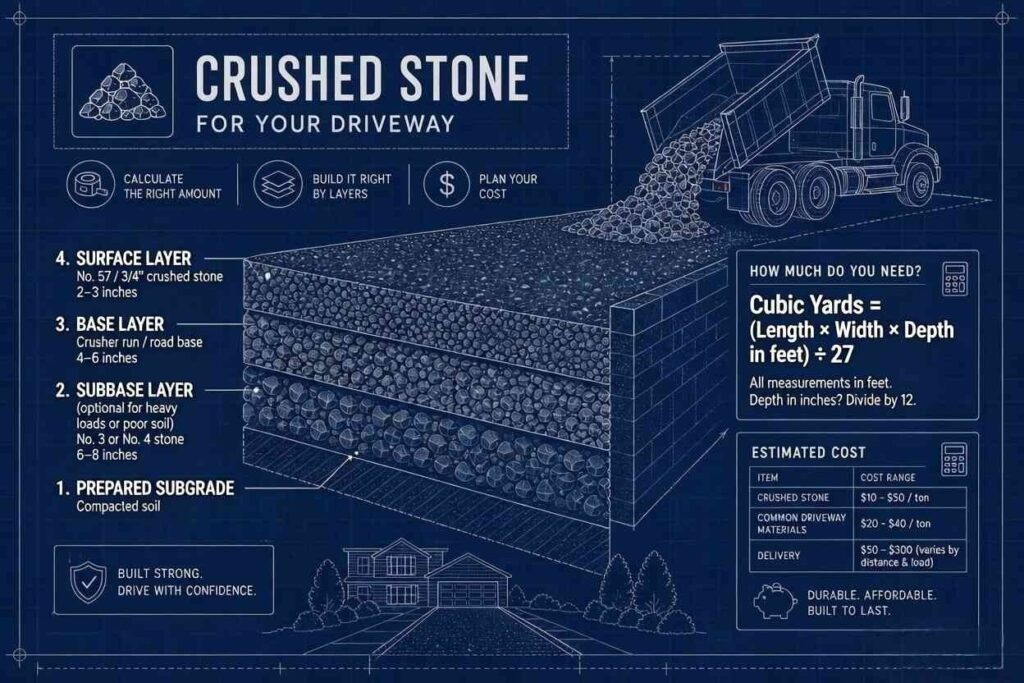
Every crushed stone estimate starts with the same formula: Length × Width × Depth ÷ 27. All three measurements must be in feet before you divide. Since depth is almost always measured in inches in the field, convert it by dividing by 12. The reason you divide by 27 is simple: one cubic yard contains exactly 27 cubic feet (3 ft × 3 ft × 3 ft).
A worked example for a real driveway
Take a driveway that’s 60 feet long, 12 feet wide, with a total stone depth of 6 inches. Convert 6 inches to feet: 6 ÷ 12 = 0.5 ft. Then multiply: 60 × 12 × 0.5 = 360 cubic feet. Divide by 27: 360 ÷ 27 ≈ 13.3 cubic yards.
Now convert to real-world order:
Using #57 stone (typical density ~1.4 tons per cubic yard) → 13.3 × 1.4 ≈ 18.6 tons. Using a 15% order allowance → ~21.4 tons. Rough material cost (at $25–$35 per ton) ≈ $535–$750 before delivery.
Write that number down – you’ll use the full workflow in every step that follows.
Handling driveways that aren’t perfectly rectangular
If your driveway has an L-shape, a widened turnaround, or a flared entrance, break the entire driveway into smaller rectangles, and note that irregular driveways may require measurements from multiple points to maintain accuracy. Calculate cubic yards for each rectangle separately, then add the results together. For circular turnarounds, use the formula: π × r² × depth ÷ 27, where r is the radius in feet. A 10-foot radius circle at 4 inches deep works out to: 3.14 × 100 × 0.33 ÷ 27 ≈ 3.8 cubic yards for that section alone.
Layer depths: recommended gravel depth and how thick should your stone be?
The depth you plug into the formula above for a gravel driveway depends on the build type and the ideal depth needed for the traffic it will handle. Getting this wrong is expensive in either direction. Under-build on a driveway with poor subgrade or heavy freeze-thaw cycles and you’ll be patching ruts after the first hard winter. Overbuild and you’ve spent money on material that wasn’t necessary. Most driveways built from scratch use multiple layers for stability: sub-base, base, and surface. For some new driveways, especially where the subgrade is weak or heavier vehicle loads are expected, the total aggregate depth may reach 12 to 18 inches, but the required depth varies with subgrade conditions, drainage, climate, and expected vehicle loads. Proper planning should also include drainage considerations to prevent water pooling.
Light residential use: cars and light trucks
For a standard single-family driveway with everyday passenger vehicles, a total compacted aggregate depth of about 4 to 6 inches can be a useful planning range where the subgrade is stable and well drained. A practical two-layer setup runs 3 to 4 inches of base course stone compacted first, followed by 2 inches of surface stone on top. This combination handles regular car and light truck traffic without rutting, provided the subgrade is stable and well-drained.
Medium and heavy use: RVs, delivery trucks, and farm equipment
Heavier loads demand more depth. RVs, delivery trucks, farm equipment, and other heavy vehicles may require 8 to 10 inches of compacted stone total. That gravel depth is a common recommended gravel depth range for higher-load driveways. It can vary depending on subgrade conditions and repeated vehicle traffic. Commercial or agricultural traffic that includes heavy equipment pushes the requirement to 10 to 12 inches or more. Under-building for heavy loads doesn’t save money – it accelerates failure and usually means tearing out the surface and starting over within a few years.
Compacted depth vs. loose material: why the numbers differ
The depths above are compacted targets, not the amount you dump on the ground. Compaction varies by material and installation conditions. For rough planning, crusher run may sometimes compact by around 20%, while #57 stone may settle by roughly 8 to 10%, but these figures should not be treated as fixed ratios. For rough planning, if you’re targeting 4 inches of compacted crusher run, you might allow about 5 inches of loose material, although the actual loose depth depends on the specific product and compaction method. For rough planning, about 4.4 inches of loose #57 stone may be used to target roughly 4 inches after settling, but the actual amount can vary by material and installation conditions. When in doubt, ask your supplier for the loose-to-compacted ratio for the specific material you’re ordering. This difference should be considered separately from the order allowance covered below.
Picking the right stone for each layer (and how it changes your quantity)
Stone type matters for two reasons. First, different materials perform very different structural roles depending on where they sit in the driveway cross-section. Second, different stones have different densities, which changes how many tons a given cubic yard weighs. The right stone in the wrong layer is almost as bad as the wrong stone entirely.
Base course stone: crusher run, #3, and #4 crushed stone
The base layer of driveway gravel helps support and distribute vehicle loads while providing a stable foundation for the layers above. Angular, interlocking stone works far better here than round stone, because angular pieces lock together under compaction rather than shifting. Crusher run is a blend of crushed stone and fines that can compact into a dense, stable base, although the exact gradation varies by supplier and region. #3 stone (often around 2 inches, depending on the local specification) works well as a sub-base under crusher run, and #4 stone fills a similar role at a slightly smaller gradation. Recycled concrete can also work here; Recycled Concrete Aggregate (RCA) is a sustainable base-stone alternative. In most cases, angular crushed stone is the preferred base shape because it resists shifting under load and creates a solid foundation.
Surface layer stone: #57, #8, pea gravel, and crusher run top coat
#57 crushed stone, commonly around 3/4 to 1 inch depending on the specification, is a common surface-layer option for gravel driveways. It drains well, provides a reasonably stable driving surface, and looks clean. #8 stone is finer than #57 and can provide a smoother driving surface, while its smaller gradation can help create a more closely packed finish when properly installed. Pea gravel is a rounded stone that tends to scatter under tires, so it is usually less practical for a driveway top course. Crusher run works as a single-material option for budget-conscious projects: its fines compact into a firm, stable surface, though it can get dusty in dry conditions and slightly muddy at the edges after heavy rain.
Why your stone choice feeds back into the calculation
Because gravel weighs differently by material, the same cubic yard does not translate to the same tonnage across products; limestone, granite, traprock, and crusher run all have different densities. This is the key connection between the volume formula above and the tonnage conversion below, since the amount of gravel you need in cubic yards still has to be converted using the specific material. Skipping this step and guessing at density is one of the most common sources of ordering errors. Choosing the right gravel is also part of getting an accurate estimate before ordering.
How Much Crushed Stone for a Driveway: Converting Cubic Yards to Tons
Most quarries and landscape suppliers sell crushed stone by the ton (though some may quote by cubic yard), so unit conversions matter when moving from volume to a supplier order. Weight-based pricing developed because dump trucks have strict weight limits and hauling costs scale with load weight, not volume. The cubic yard figure you calculated needs one more conversion before it becomes a supplier order.
Why density varies by stone type
Density is the key variable when converting cubic yards to tons. Many crushed stone and gravel products fall around 1.3 to 1.7 tons per cubic yard, depending on stone type, gradation, moisture, and supplier. As a common estimating value, #57 stone is often around 1.4 tons per cubic yard, while limestone, granite, traprock, and dense road-base materials may be higher. Always confirm the exact tons-per-cubic-yard figure with your local supplier before placing a large order.
A simple cubic yards to tons conversion
Multiply your figure in cubic yards of gravel by the tons-per-cubic-yard for the stone type you’ve chosen. For example: 15 cubic yards of #57 stone at ~1.4 tons/yd³ equals 21 tons. The same 15 cubic yards of denser road-base material at ~1.6 tons/yd³ equals 24 tons. To see how many cubic yards to use before converting to tons, start with the length width and depth of the area. That difference translates directly into dollars and truckloads, so spending 30 seconds on the density conversion helps you order the gravel you need with less guesswork.
The compaction and waste buffer you need to build in
The formula gives you a clean theoretical number. The job site gives you reality: uneven subgrade, stone spilling past the edge of the driveway, slight variation between loads, and small variations in placement depth before the surface coat goes down. Your raw ton figure needs a buffer to survive contact with the real world.
Ordering about 10% extra gravel can be a practical order allowance for many straightforward residential driveways to account for measurement variation, irregular edges, and spreading loss. If the formula says you need 18 tons, order about 20 tons. Push that buffer higher for driveways with slopes or curved edges. Skipping this step is a common reason driveway projects run short before the job is done. A second delivery is not just inconvenient – it costs more per ton than ordering the full quantity upfront.
Crushed stone costs and what delivery looks like in 2026
With your final tonnage confirmed, the last step is pricing the order. Cost benchmarks shift with fuel prices, regional quarry availability, and demand cycles. Use these figures as a working baseline for 2026, not a quote from any specific supplier.
Material cost per ton in 2026
Crushed stone typically runs between $10 and $50 per ton nationally, with common driveway materials like limestone and crusher run averaging $20–$40 per ton. These figures reflect aggregated national averages and will vary by region and stone type. Granite can run slightly higher in some markets, depending on local availability and hauling distance. Prices are generally lower in quarry-dense regions like the Midwest, and higher in urban or coastal markets where hauling distances add cost.
For a practical two-car driveway in the 500 to 600 square foot range at about 4 inches deep, expect roughly 10 to 12 tons of material, depending on density and waste factor. For the latest comparative figures on local and national gravel prices, check a current pricing guide before you finalize your budget.
Delivery costs, minimums, and truck sizing
Delivery may be charged per load, per mile, or per ton. For nearby deliveries, many homeowners see delivery fees in the $50 to $150+ range, while longer distances or heavier loads can cost more. Many suppliers set a minimum order of 5 to 10 tons, though minimums vary by supplier and region – some express this as a minimum delivery fee rather than a strict tonnage floor. For smaller jobs or tight-access sites, bulk bags can be practical, but bulk delivery is usually more cost-effective for a full driveway order of bulk gravel. Small top-up orders after the fact cost more per ton than the original delivery. For jobs requiring less than a full truckload, renting a dump truck and self-hauling from a local quarry can make more economic sense. Beyond 10 to 15 miles, expect a per-mile surcharge that compounds quickly on longer hauls.
Getting the best price from your local supplier
Call two or three local quarries and request quotes for the same stone specification, using a gravel calculator to confirm pricing quantities before you call. Mention that you’ve already calculated your exact tonnage from the width, depth, and driveway’s length: suppliers respond well to prepared customers because it reduces back-and-forth and signals you won’t dispute the delivery weight. Ask about bulk pricing thresholds, since many suppliers drop the per-ton rate once an order clears 15 or 20 tons. Order slightly above your buffered quantity rather than right at it. The cost difference between 21 tons and 20 is small. The cost of a second delivery trip is not. One of the most common mistakes is asking for pricing with the wrong dimensions or without the extra buffer.
Put the numbers together and place your order with confidence
Now you know how much crushed stone for a driveway to order. The full workflow comes down to this: start with Length × Width × desired depth ÷ 27 to get cubic yards, multiply by your stone’s density factor to convert to tons, then add a 10 to 15% order allowance where appropriate. For a new driveway, a total depth of 12 to 18 inches is commonly recommended. Choose your stone based on layer function, match depth to traffic load and site conditions, and cross-check your total against the 2026 benchmarks above before accepting any supplier quote.
Knowing these numbers before you pick up the phone puts you in control of the conversation. You know the tonnage, the density factor, and why both matter, which means no surprises when the truck shows up.
Read more about our approach on the About Us page, or browse project tips and calculators on the Blog.
If you’d rather skip the manual steps, head to the Crushed Stone Calculator at CrushedStoneCalculator.com. Enter your driveway dimensions, pick your stone type, and the calculator returns cubic yards, tons, and an estimated material cost, making it easier to estimate how much gravel before ordering. Use a tape measure for straight runs and a measuring wheel for longer or irregular sections. It applies material density, supports a custom waste factor, and works for rectangular, circular, and triangular sections, so if you’re wondering how much gravel you need for a project, you can estimate irregular driveways by breaking them into smaller shapes – everything you need to go from measurements to a supplier-ready estimate
Pingback: Gravel Driveway Installation Guide: DIY Layers, Depth & Cost
Pingback: Limestone vs Granite Gravel: Cost, Strength & Best Uses
Pingback: How much crushed stone do i need for a 2 car driveway
Pingback: Which Crushed Stone Size Is Best for a Long Gravel Driveway
Pingback: Gravel Driveway Cost Per Ton — 2026 Pricing & Tonage Guide
Pingback: Gravel Driveway Calculator: Tons, Yards & Cost Guide
Pingback: Understanding the Benefits of SB2 Gravel for Your Landscaping Needs