Table of Contents
Many homeowners end up in one of two situations: they’re halfway through a driveway project and realize they’re short a ton of stone, or they’re left staring at a pile of leftover gravel that’s been sitting in the corner of the yard for two years. Neither outcome is fun, and both are avoidable. Getting your crushed stone quantity right before you place an order comes down to four variables: the area you’re covering, the depth your project requires, the density of the stone you’re using, and a reasonable buffer for waste and compaction.
This guide walks through the full calculation process, from the basic volume formula to converting cubic
yards into tons and bags. It also covers the right depth for common project types, how to apply a waste
factor, and how Crushed Stone Calculator handles all of this automatically once you understand the math
behind it. None of this is complicated. It’s arithmetic with the right inputs.
The formula behind every crushed stone quantity estimate
Length × width × depth: the basic volume calculation
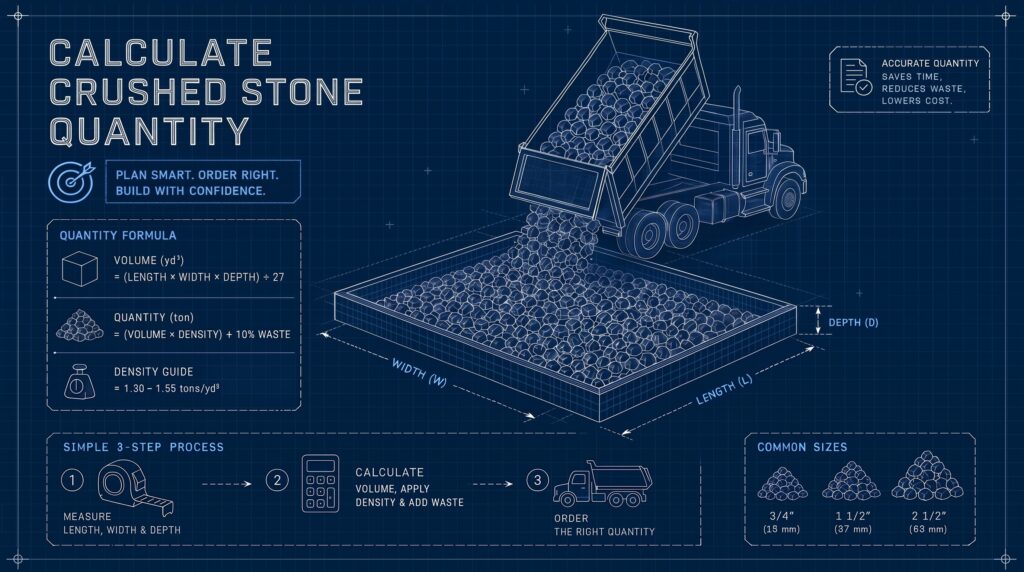
Every aggregate estimate starts with the same formula, regardless of project type. Multiply the length of your area (in feet) by the width (in feet) by the depth (in feet), and you get the total volume in cubic feet. For a 20 ft × 40 ft driveway with 6 inches of stone, that’s 20 × 40 × 0.5, which equals 400 cubic feet. The depth gets converted from 6 inches to 0.5 feet by dividing by 12. That conversion step is where many people slip up.
The formula itself never changes. Whether you’re laying a base for a patio or filling a drainage trench, you’re always calculating length × width × depth. Only the dimensions and the depth recommendation shift depending on what you’re building.
Converting cubic feet to cubic yards (and why it matters)
Stone suppliers quote material in cubic yards or tons, not cubic feet. Once you have your cubic footage, divide by 27 to get cubic yards, since one cubic yard contains 27 cubic feet. Using the driveway example above: 400 cubic feet divided by 27 gives you roughly 14.8 cubic yards. Skipping this conversion and ordering based on cubic feet is a common mistake that leads to dramatic under-ordering.
Write that number down before moving on. Cubic yards is the unit you’ll use to convert to tons, and it’s often the unit your supplier will ask for when you call in an order.
How much crushed stone do you need? Recommended depths by project type
Driveways and load-bearing surfaces
Driveways carry real weight, and not just static loads. Vehicle tires create lateral forces when turning and braking, which push stone outward and downward. For a typical residential gravel driveway, many contractors recommend a layered approach: a 4 to 6 inch compacted base of larger stone (such as No. 4 or 1½-inch stone), topped with a 2 to 3 inch surface layer of finer stone (such as No. 57 or ¾-inch crushed stone).
The larger base stone locks in place under load while the smaller top layer provides a smoother, more stable driving surface. For heavier or more frequent vehicle traffic, increase the base layer to 6 to 8 inches. When in doubt, check with your local contractor or extension service, or consult our Driveway Guides, Crushed Stone Calculator for guidance specific to your soil conditions and traffic load.
Skimping on depth is one of the most reliable ways to end up with ruts and washouts after the first heavy rain. An extra inch of stone at the start costs far less than regrading a failed surface a season later.
Patios, walkways, and paver bases
Foot traffic is a much lighter load than vehicle traffic, which is why 4 to 6 inches of compacted angular stone is the standard for patios and walkways. Angular stone is key here: the irregular edges interlock under compaction and resist shifting in a way that round, smooth stone cannot. For best results, lay the base in lifts of 2 to 3 inches and compact each layer before adding the next; see a crushed stone and gravel guide for stone sizes and typical applications. Paver installations typically finish with 1 inch of stone dust or coarse sand on top of the compacted base, which provides a flat, adjustable setting bed for the pavers.
If your patio design has curves or irregular edges, calculate each section separately and add them together before applying your waste factor.
French drains and drainage channels
Drainage applications work differently from load-bearing projects. The stone in a French drain needs to stay open and permeable, so clean, washed stone like #57 or pea gravel is the right choice rather than crusher run or any material with fines. The volume formula is identical: length × width × depth, then divide by 27. What’s different is that drainage stone is rarely compacted, so the compaction-related waste factor is lower. A 5 to 8% overage is usually sufficient for straightforward trench drainage work.
From cubic yards to tons and bags: the weight conversion
Why stone type and grade change the weight
Many suppliers sell crushed stone by weight, which means your cubic yard number will often need to become a tonnage before you can place an order. Always confirm with your supplier whether they quote by the cubic yard or by the ton, since this varies by region and supplier. The conversion factor depends on the density of the specific stone you’re using. Most crushed stone falls in the range of 1.3 to 1.55 US tons per cubic yard, though the exact density varies by stone type, gradation, moisture content, and compaction level.
Granite typically averages around 1.50 tons per cubic yard, while limestone falls around 1.45 tons per cubic yard. Lighter materials like pea gravel come in at about 1.30 tons per cubic yard. When you don’t know the exact material, using 1.40 tons per cubic yard is a reasonable middle estimate for most crushed stone. If you want to be conservative and reduce the risk of under-ordering, round up to 1.50 tons per cubic yard.
Crushed Stone Calculator includes density presets for ten material types, including limestone, granite, pea gravel, stone dust, and river rock. Selecting the right material from that list gives you a more precise tonnage than using a flat conversion, which is particularly useful when you’re working with specialty aggregates or comparing costs between stone types. The densities used are typical bulk delivery estimates; actual weight can vary ±10% depending on your supplier’s specific source, gradation, and moisture conditions.
Converting to 50 lb bags for small projects
Bulk delivery doesn’t make economic sense for small areas under 100 square feet. For those jobs, bagged stone from a home improvement store is the practical option. A standard 50 lb bag of crushed stone fills about half a cubic foot. Since one cubic yard equals 27 cubic feet, that works out to roughly 54 bags of 50 lb stone per cubic yard. Each bag covers about 3 square feet at 2 inches deep, so a small 30-square-foot patio border at 2 inches deep needs around 10 bags. That’s a quick in-and-out trip to the store rather than scheduling a bulk delivery.
For anything larger than a small accent area, bulk stone from a local quarry or stone yard is almost always cheaper per ton and faster to place. The bag math is useful as a sanity check on small projects, not as a general ordering strategy.
Waste factor and compaction: ordering the right buffer
The 10% default rule and when to go higher
Once you have your base quantity in tons or cubic yards, add a buffer before placing the order. For small, straightforward projects with flat, even subgrade, 5 to 10% is the right range. Multiply your calculated quantity by 1.10 to add a 10% overage. For larger projects, driveways with slopes, irregular shapes, or rough subgrade conditions, bump that multiplier up to 1.15 or 1.20. Running short mid-project is nearly always more expensive and disruptive than ordering a small surplus. You’ll pay for a second delivery, wait on scheduling, and may deal with a noticeable difference in stone color between batches.
For the 20 ft × 40 ft driveway example from earlier, the base calculation came out to roughly 14.8 cubic yards. At 1.40 tons per cubic yard (average crushed stone), that’s about 20.7 tons. Adding 10% brings the order to about 22.8 tons. Rounding up to 23 tons gives a clean number to give the supplier and a comfortable margin.
How compaction affects your final volume
Compactable base stone, including crusher run, #57, and #4 mixes with fines, typically reduces in volume by 5 to 10% after proper compaction with a plate compactor or roller. That reduction is real and it needs to be accounted for in your order. Decorative or clean-washed stone compacts far less, usually only 2 to 5%, because the absence of fines leaves the aggregate relatively open after installation.
The waste factor you’re already adding does double duty here. It covers both the material lost to compaction and any small errors in your measurements. This is why the buffer isn’t optional, even on simple, flat projects: it addresses multiple sources of variation in a single multiplier.
Skip the manual math: get your crushed stone quantity in seconds
What Crushed Stone Calculator handles automatically
Crushed Stone Calculator runs all of the above steps at once. Enter your project dimensions — rectangular, circular, and triangular areas are all supported — select your stone type, and the tool applies material-specific density presets along with a configurable waste factor (10% by default). The output shows your quantity and weight in your choice of units — cubic yards, cubic feet, or cubic meters for volume, and US tons, pounds, metric tons, or kilograms for weight — so you have the right number regardless of which unit your supplier uses. No switching between conversion tools or doing unit math by hand. For further reading on aggregate selection and project types, see our Crushed Stone Guides, Crushed Stone Calculator.
The tool also includes an optional cost estimator. Enter your supplier’s price per US ton and it calculates your total material cost alongside the quantity estimate. For current regional price ranges and cost context, consult a gravel prices guide to set realistic expectations before you call your supplier.
When the tool saves more than just time
Beyond cutting the calculation time down to seconds, the calculator removes the uncertainty that leads to bad guesses. A homeowner who isn’t confident in their estimate is more likely to round up aggressively out of anxiety, sometimes by a significant margin, or to under-order and hope for the best. A specific, waste-adjusted number changes the conversation with a supplier entirely. Instead of saying “I think I need about 3 or 4 tons,” you walk in with “I need 4.8 tons of #57 limestone.” That level of precision saves money and builds credibility, whether you’re a first-time DIYer or a contractor pricing a bid. If you want an alternate quick-check tool, try an online crushed stone calculator.
Putting it all together before you order
The process isn’t long. Measure your area and calculate length × width × depth in feet. Divide by 27 for
cubic yards, then multiply by your stone’s density to get tons. Finally, multiply the result by 1.10 to 1.15 for
a standard project, or up to 1.20 for rough terrain. None of these steps require specialized construction
knowledge. They require a tape measure, a calculator, and the right depth recommendation for your
specific project type.
If you want to skip the manual steps, Crushed Stone Calculator is the fastest path from dimensions to a final order number. The tool is free, handles rectangular, circular, and triangular shapes, and supports ten material types with built-in density presets. Whether you’re estimating a two-car driveway, a flagstone patio base, or a French drain, the output is ready to hand directly to your stone yard. To learn more about this tool, visit the About Us page.
Measure your area, run the numbers, and order your crushed stone quantity with confidence.