Table of Contents
You measured your driveway, wrote down the length and width, and then called the quarry. The person on the phone asked how many tons you need. You said you have square footage. Silence. That gap between what you measured and what suppliers actually sell is where most first-time gravel orders go wrong, often by 20% or 30% in either direction.
The fix isn’t complicated, but it requires a specific sequence: convert dimensions to cubic yards, apply the correct material density to get tons, choose the right depth for your traffic load, add a waste factor, then calculate cost. Skip any step and your order is a guess. This article walks you through each one. If you want the calculation done instantly, a gravel driveway calculator can convert your driveway dimensions into the quantities suppliers use, including cubic yards, estimated tons, waste factor, and optional cost. On CrushedStoneCalculator.com, use the Gravel Calculator for gravel driveway estimates, or the Crushed Stone Calculator when you want a broader crushed stone estimate with automatic unit conversions built in.
Gravel Driveway Calculator: Why Most Driveway Gravel Orders End Up Wrong
The core problem is a unit mismatch. Gravel is measured in cubic yards because that’s what your driveway dimensions produce. Gravel is sold in tons because that’s how suppliers load, bill, and transport it. These two units don’t convert directly without a third number in the middle: density. Most people don’t know that number exists, let alone that it changes by material type.
The volume vs. weight problem every first-time buyer faces
Quarries and landscape supply yards sell by the US ton because weight is standardized and easy to track on a scale ticket. Your driveway dimensions give you a volume. The bridge between those two things is the material’s bulk density, expressed in tons per cubic yard. Most generic online gravel estimators skip this entirely or apply a single average number, inaccurate across stone types and capable of throwing your estimate off by a full ton or more on a mid-size driveway.
Why one “cubic yard of gravel” doesn’t have a fixed weight
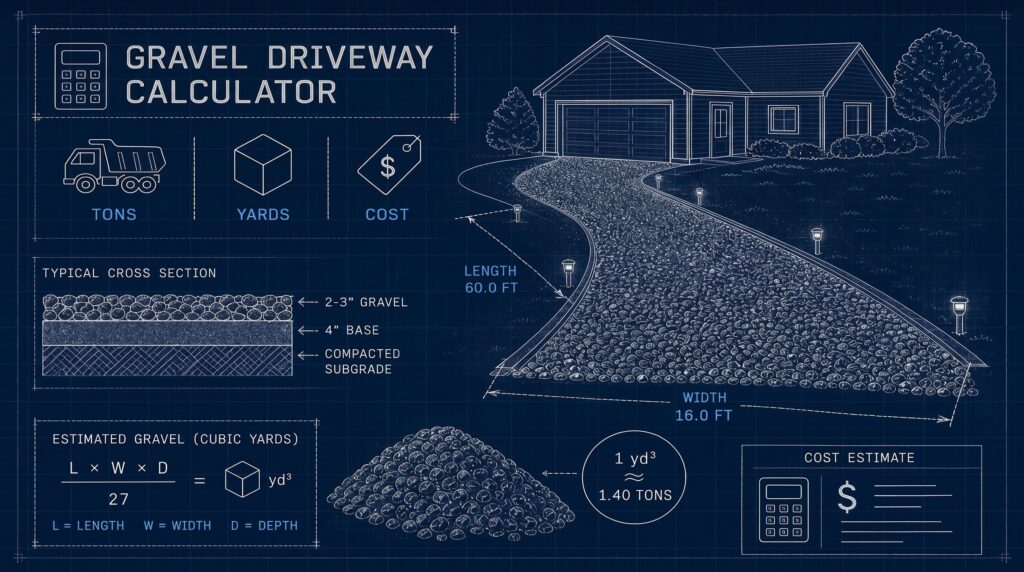
Different stone types have different densities because of how they’re crushed, how tightly particles pack together, and how much fine material is present. A cubic yard of #57 crushed stone weighs roughly 1.40 tons. A cubic yard of pea gravel weighs closer to 1.30 tons. Crusher run, which contains fine particles and compacts tightly, runs 1.50 tons per cubic yard.
On a 10-cubic-yard estimate, using the wrong density means you could be off by a full ton before you’ve even factored in waste, that’s $15 to $35 in material plus the real risk of running short on delivery day. For an external reference on the typical weight of #57 stone per cubic yard, see this guide on the tons of #57 stone per cubic yard (how many tons of #57 stone are in a cubic yard).
How a gravel driveway calculator converts measurements to cubic yards
The math is straightforward once you understand the units involved. Measure in feet, convert depth from inches to feet, multiply the three dimensions together for cubic feet, then divide by 27 to get cubic yards. That’s the complete formula, and it works every time on a rectangular driveway.
The formula: length × width × depth ÷ 27
Start with your driveway’s length and width in feet. Convert your depth from inches to feet by dividing by 12, a 4-inch depth becomes 0.3333 feet. Multiply all three numbers together to get cubic feet. Divide by 27 to convert to cubic yards. Here’s a worked example to show how much gravel the formula estimates: a driveway 60 feet long by 12 feet wide at 4 inches deep works out to (60 × 12 × 0.3333) ÷ 27, which equals roughly 8.89 cubic yards of gravel needed. Smaller single-car driveway areas may need only a few cubic yards, while longer driveways can require much more depending on length, width, and depth. That’s your starting volume before density or waste factor. If you want to test conversions directly with an external tool, try a cubic yards calculator
Converting depth in inches without making a rounding mistake
The most common error in this calculation is leaving depth in inches instead of converting to feet first. If you multiply 60 × 12 × 4 without the conversion, you get a cubic footage number that’s 12 times too large. A one-inch depth error across a 20 × 60 foot driveway equals roughly 3.7 cubic yards, which at standard crushed stone prices ($15–$30/ton) represents roughly $78–$155 in extra material. Always divide inches by 12 before multiplying. A shortcut worth knowing: with length and width in feet and depth in inches, divide all three multiplied together by 324 to determine cubic yards more quickly, because 12 × 27 = 324. Once you have the raw result, round up before ordering.
What to do with irregular or non-rectangular driveways
Circular areas require a different formula: π × radius² × depth ÷ 27, so measure the diameter first and convert it to radius. For L-shaped or irregular driveways and other irregular shapes, split the area into two or more rectangles, calculate each section separately using the calculator, and add the results together. This approach removes the risk of formula errors on complex layouts. If your driveway curves or widens at one end, use the rectangle method with the widest measurement and order a little extra gravel to compensate.
Converting cubic yards to tons: why the number changes by stone type
Once you have cubic yards, you need tons, and this is where most generic estimators fall short. They apply one average density to every material, which produces inaccurate weight estimates across stone types. Material-specific density is the most important variable in the entire calculation. It’s the step that separates a reliable order from a guess.
Common driveway stone types, including crushed stone, and their actual weight per cubic yard
Here are the ordering benchmarks for the most common driveway materials. Moisture content and stone angularity affect real-world density slightly, but these figures are solid for planning purposes, and weight and use vary by gravel type:
- #57 crushed stone: approximately 1.40 tons per cubic yard
- Crusher run (road base): approximately 1.50 tons per cubic yard, heavier due to fine particle content
- Pea gravel: approximately 1.30 tons per cubic yard; it is similar in size to garden peas
- Crushed limestone: approximately 1.45 tons per cubic yard
- River rock: approximately 1.35 tons per cubic yard
These planning densities are commonly useful for estimates, but actual bulk weight can vary by gravel type, aggregate gradation, material and moisture content, and local supplier source. Gravel, crushed stone, pea gravel, river rock, crusher run, stone dust, and other construction aggregate materials can all behave differently, so the best number for ordering is the density provided by your quarry or supplier.
For a closer look at recommended materials and how different stone types perform in driveways, see our guide on Best gravel for driveways: Types, Layers, and Costs Guide
Why using an average density can leave you short on delivery day
Here’s a scenario that plays out more often than it should. A homeowner uses a gravel calculator to convert 10 cubic yards at a generic 1.2 tons per cubic yard rate and orders 12 tons. But if the amount of gravel ordered is for crusher run, the gravel required is closer to 15 tons because it runs nearer 1.5 tons per cubic yard. That leaves the order short by three full tons before the waste factor is even applied. The second delivery costs $50 to $150 in fees, the project stalls, and the driveway sits half-finished for a week. That’s the real cost of using a generic gravel volume calculator instead of a material-specific one, especially since weight can vary further with material and moisture content.
How deep should driveway gravel be?
Depth is the variable most DIYers underestimate. Too shallow and the surface degrades under load within a season. Unnecessarily deep and you’re adding hundreds of dollars in material with no functional benefit. The right answer depends on what’s driving on it and how often.
For light surface refreshes or walkways, 2 to 4 inches may be enough, but new gravel driveways usually need a deeper base-and-surface system based on soil, drainage, and traffic.
Depth recommendations by vehicle type and traffic level
For a single-layer installation on light residential use, 4 to 6 inches is a common starting point. If you are planning a new driveway from scratch, for a properly built two-layer system — base plus surface — plan for 6 to 9 inches total, as described in the section below. Paths and walkways usually need 2 to 3 inches. For heavier loads, regular truck traffic, or anything beyond a typical passenger vehicle, plan for 8 to 12 inches total depending on how much gravel you need. The reason is mechanical: gravel under inadequate depth compresses into the subgrade under repeated loads and loses its function as a stable surface. A practical rule: if you regularly park anything heavier than a pickup truck on the driveway, plan for at least 8 inches. For additional reading on recommended depths, see this overview of proper gravel depth.
Base layer vs. finish layer: what each one does
The standard approach is two layers rather than one thick single-material application. The base layer, typically 4 to 6 inches of coarse angular stone like #3 (1½”–2½”) or crusher run, is a mixture that often includes fines such as stone dust for compaction, providing structural support and compacting tightly under load. Clean #57 stone, often around ¾ inch to 1 inch depending on the local gradation, drains freely and can work as a surface layer or drainage layer in some driveway systems, but it does not compact like crusher run or dense-graded road base with fines.
The finish layer, or top layer, typically 2 to 3 inches of smaller angular crushed stone, creates a smoother driving surface and locks the base material in place. For many residential driveways, a two-layer system usually performs better than one thick layer of a single material, especially when the base layer provides support and the top layer creates a smoother driving surface. For a detailed walkthrough of layers and cost estimates, see How Much Crushed Stone for a Driveway: Layers and Cost. Similar layered prep is also used under pavers and patio base projects.
Waste factor and compaction: how much extra to order
Ordering exactly what the formula returns is almost always a mistake. Gravel compacts when driven over and settles into the subgrade during the first few weeks. Material is also lost to spreading, edge spillage, and equipment movement. Adding a waste factor is the single most practical adjustment you can make to a gravel estimate, and it costs far less than the alternative.
The 10% rule and when to push it to 15%
For a flat, well-graded driveway base, order 5 to 10 percent extra gravel to account for settling, then increase to 15% for uneven terrain, curved driveways, or soft subgrade conditions. That buffer helps you order the right amount and avoid shortages after compaction. In dollar terms: if your base calculation returns 12 tons, you order 13.2 tons at 10% or 13.8 tons at 15%. The cost difference is typically $20 to $60 depending on your material price, far less than a second delivery charge, and the extra material also helps maintain even coverage after spreading losses or site variation. Crushed Stone Calculator includes an adjustable waste factor that defaults to 10%, with the option to increase it for your site conditions when estimating exactly how much gravel to order.
Why skipping the waste factor costs more than adding it
A second delivery from a quarry or landscape supply yard typically runs $50 to $150 in delivery fees on top of the additional material cost. Running short mid-project also means stopping work and waiting, on a DIY weekend timeline, that can leave an unfinished driveway sitting for days. The overage factor isn’t waste in any practical sense. It’s insurance against a problem that’s entirely avoidable at the planning stage.
Using a gravel calculator to estimate tons and cost
With cubic yards, tons, and waste factor in hand, the last step is a dollar figure. Knowing what a reasonable quote looks like before you call a supplier puts you in a much stronger position during that conversation.
What driveway gravel costs per ton in 2026
For planning, many basic driveway materials such as crushed stone, crusher run, and road base may fall around $15 to $30 per ton in some markets. Pea gravel, river rock, decorative stone, small orders, and delivered loads can cost more. Delivery fees for gravel orders may commonly fall around $100 to $200 in some areas, depending on distance, supplier, fuel charges, truck access, and order size. Ordering close to a full truckload can sometimes be more cost-effective because small orders often carry a higher delivery cost per ton. For current regional pricing averages and trends, see this reference on gravel prices.
How to calculate total cost before requesting a quote
Once you have your final tonnage, waste factor included, this step helps confirm how much gravel is in the budget and whether the quote matches the project scope. Multiply tons by the supplier’s price per ton, then add the delivery fee. For example: 14 tons at $22 per ton equals $308 in material. Add $150 for delivery and your total is $458. The same math also works for landscaping uses such as drainage stone or decorative coverage. That’s your working budget number before the phone call, which means you’re comparing quotes against a benchmark rather than just taking whatever you’re given. Crushed Stone Calculator’s optional gravel cost estimator handles this final step automatically: input your supplier’s price per ton and the tool returns a complete material cost estimate alongside the volume and weight outputs for this job or your next project.
Put it all together before you order
The full workflow: measure your driveway, determine how many cubic yards you need using the length × width × depth ÷ 27 formula (with depth in feet), apply the correct material density to get tons, choose the right depth for your traffic load, add 10 to 15% for compaction and waste, and calculate total cost before picking up the phone. Each step feeds the next. Skipping any one of them is where ordering errors happen, errors that show up as a second delivery charge, a project stall, or a surface that degrades ahead of schedule.
The same process also works for gravel driveways, French drains, and similar projects, but French drain stone depth depends on the trench design, pipe size, soil conditions, drainage load, and outlet location. Run your numbers in a gravel driveway calculator before calling the quarry. It can give you cubic yards, estimated tons, waste factor, and optional cost in one pass, using density presets, automatic cubic yard and ton outputs, an adjustable waste factor, and an optional cost estimator tied to your supplier’s price per ton. Gravel is also used with concrete, sand, and soil in other sitework, and clay conditions can affect planning. Walk into that conversation knowing exactly what to order, what it should cost, and whether the quote you receive is in the right range. For additional reading and related articles, visit our Crushed Stone Guides.
Pingback: How much gravel do I need per square foot for a driveway
Pingback: Order Right First Time: How Much Gravel You Need, Plus 10–15% Waste