Table of Contents
How much gravel do I need per square foot for a driveway? It’s the question every homeowner hits after measuring the space and pulling up a quarry price list. You’ve got the square footage scribbled on a notepad, but there’s a gap between that number and the tonnage you actually call in. The good news: the math is straightforward once you know two things, your depth and what that depth converts to in weight.
This article gives you the numbers most guides skip: cubic yards per square foot at common driveway depths, plus the tonnage those depths create for real driveway sizes. You’ll also get a reference table for common driveway sizes, guidance on choosing the right depth for your soil and climate, and a clear explanation of why you should always order a little extra. Readers who want instant results for custom driveway dimensions can use our free Gravel Calculator to estimate cubic yards, US tons, bags, waste factor, and optional cost in seconds. The formulas below make every result fully transparent.
How Much Gravel Do I Need Per Square Foot for a Driveway: Formula and Quick Guide
How depth in inches converts to yards
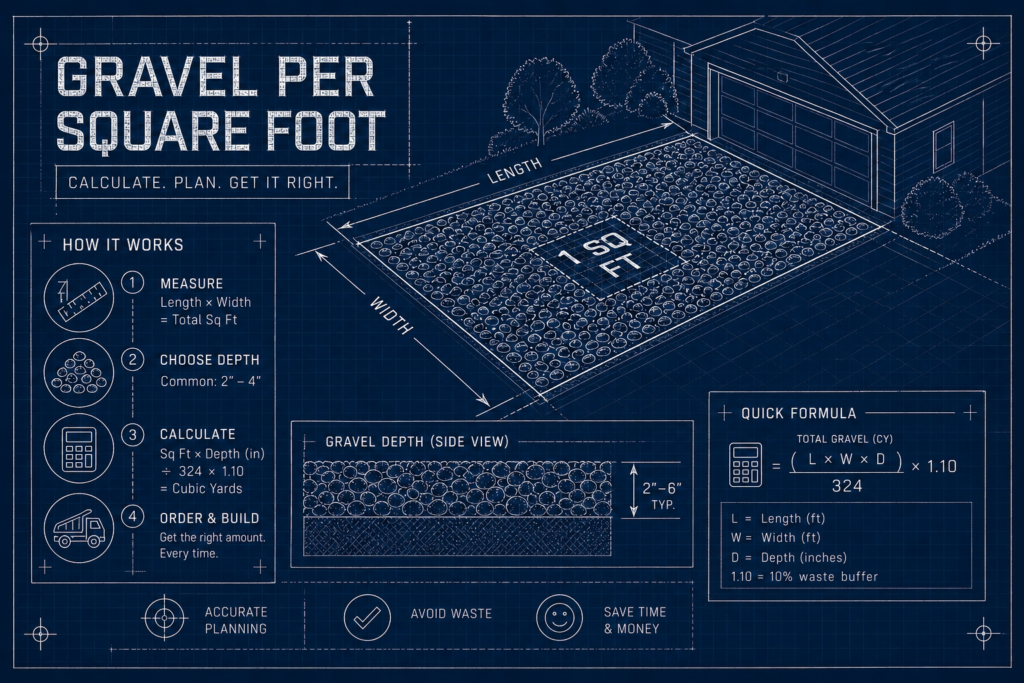
Cubic yards are the standard volume unit for ordering bulk gravel, so converting your depth from inches to yards is the first step. The formula: multiply your area in square feet by the depth in feet (inches divided by 12), then divide by 27 to get cubic yards. A shortcut version of that same math is to multiply square feet by depth in inches, then divide by 324.
One square foot at 4 inches deep equals 0.333 cubic feet, which equals 0.01235 cubic yards. That number looks small on its own, but it scales up fast once you apply it to a real driveway. Keep the formula handy so you can apply it to any depth you need.
How Much Gravel Per Square Foot at Three Common Depths
At the three depths most residential driveways use, the per-square-foot figures work out as follows: 2 inches requires 0.00617 cubic yards per square foot, 4 inches requires 0.01235 cubic yards per square foot, and 6 inches requires 0.01852 cubic yards per square foot. These numbers scale linearly, so 8 inches is simply double the 4-inch figure.
A 600-square-foot single-car driveway at 4 inches needs about 7.4 cubic yards. A 1,200-square-foot two-car driveway at the same depth needs nearly 15 cubic yards. That’s where driveway gravel estimates tend to surprise people, especially when the quarry converts that volume into tons. Understanding how much gravel you need per square foot for your driveway at each depth prevents exactly that sticker shock.
Converting Cubic Yards to Tons: What the Quarry Actually Sells You
Why weight matters more than volume at the supplier
Most quarries sell crushed stone by the ton, not by the cubic yard. That means your volume calculation is only halfway to a purchase order. One cubic yard of common driveway gravel, whether that’s 3/4″ crushed stone, crusher run, or a similar base material, weighs approximately 1.4 to 1.7 tons depending on stone type and moisture content. For planning purposes, 1.5 tons per cubic yard is a reliable middle-ground estimate for gravel weight per cubic yard.
Crusher run sits closer to 1.5 tons per cubic yard, while pea gravel runs lighter at around 1.25 to 1.35 tons per cubic yard. If you know your exact material, using its real bulk density gives you a more accurate tonnage. For pricing and tonnage examples tied to weight, see the Gravel Driveway Cost Per Ton, 2026 Pricing & Tonnage Guide to understand how different densities change your order size and cost.
Coverage in square feet per ton at each depth
Translating weight into area coverage makes it easy to size up any job quickly. At 2 inches deep, one ton of standard crushed stone or driveway gravel covers roughly 100–110 square feet. At 4 inches, coverage is closer to 50–60 square feet. At 6 inches, one ton usually covers about 35–40 square feet. The exact coverage depends on the material density, moisture, and compaction.
A standard two-car driveway measuring 20 by 40 feet (800 square feet) at 4 inches deep needs close to 15 tons of material before any waste factor. That figure catches a lot of homeowners off guard, and it’s the main reason first-time buyers show up at the quarry underprepared.
Reference Table: Gravel Quantities for Common Driveway Sizes
How to read the table
The table below uses per-square-foot gravel rates to estimate the total cubic yards and tons needed for common driveway sizes at 2″, 4″, and 6″ depths. All tonnage figures use 1.5 tons per cubic yard as the conversion factor. These are base quantities before any waste allowance, so treat them as your starting number before adding the buffer covered in the next section.
The table covers small parking pads, common residential driveway sizes, and one longer 20 × 100 ft driveway example. Tonnage can shift 10 to 15 percent depending on your specific stone type and its actual bulk density. For a more precise figure tied to your exact material, enter your dimensions into the Gravel Calculator and select your gravel type, depth, waste factor, and optional price.
| Driveway size | Sq ft | Cu yd @ 2″ | Tons @ 2″ | Cu yd @ 4″ | Tons @ 4″ | Cu yd @ 6″ | Tons @ 6″ |
|---|---|---|---|---|---|---|---|
| 10 × 20 ft | 200 | 1.23 | 1.85 | 2.47 | 3.70 | 3.70 | 5.56 |
| 12 × 20 ft | 240 | 1.48 | 2.22 | 2.96 | 4.44 | 4.44 | 6.67 |
| 12 × 30 ft | 360 | 2.22 | 3.33 | 4.44 | 6.67 | 6.67 | 10.00 |
| 16 × 40 ft | 640 | 3.95 | 5.93 | 7.90 | 11.85 | 11.85 | 17.78 |
| 20 × 40 ft | 800 | 4.94 | 7.41 | 9.88 | 14.81 | 14.81 | 22.22 |
| 20 × 100 ft | 2,000 | 12.35 | 18.52 | 24.69 | 37.04 | 37.04 | 55.56 |
Choosing the Right Depth for Your Specific Conditions
Soil type and traffic load determine your baseline
Four inches is a workable minimum for a light residential driveway on stable, well-drained soil. Once you introduce clay-heavy or softer subgrade, the recommended total depth moves to 6 to 8 inches. Driveways that carry trucks, SUVs, or consistent daily traffic benefit from 8 to 12 inches total. The depth works because you compact it in layers; dumping a thick pile in one shot doesn’t produce the same structural result.
Clay soil holds moisture and softens under load, which is exactly the condition a gravel base exists to counteract. On a sandy, stable subgrade with good natural drainage, 4 to 6 inches of well-compacted gravel handles normal passenger car traffic reliably. If you’re unsure which material suits your site, see our guide to the best gravel for driveways for recommended stone types and layer strategies; the industry write-up on best gravel for dirt driveways also offers a useful selection checklist. When you’re unsure about your subgrade quality, treat it like clay and build deeper.
Slope and freeze-thaw climate add depth to your calculation
Sloped driveways face runoff and erosion pressure that flat ones don’t, so a firmer, better-compacted base is non-negotiable on any grade. This typically means erring toward the upper end of the recommended depth range rather than the minimum. The slope doesn’t change the formula; it changes how much margin you want built in.
In cold-climate regions with freeze-thaw cycles, snowmelt creates drainage pressure and frost heave risk throughout the thaw season. A deep, well-compacted base of crushed angular stone resists capillary water movement and limits ice lens formation that heaves and cracks driveways over time. For severe frost zones, 8 to 10 inches of crusher run as a base layer is a widely used starting point. For technical background on frost heave mechanisms and design considerations, see this frost heave research article. When in doubt in a cold climate, add an inch or two rather than make a second trip to the quarry in spring.
For guidance on constructing a proper sub-base and layer sequencing, this practical gravel driveway sub-bases guide walks through typical layer setups and compaction targets.
Why You Should Always Order 10 to 15% More Than Your Base Calculation
Compaction reduces your finished depth
Loose gravel can settle after spreading and compaction, especially with crusher run, uneven ground, or soft subgrade. A 10% waste factor works for many clean projects, while 15% is safer for uneven, sloped, or compacted driveway work, depending on particle size and compaction method. A 4-inch specification requires more loose material in the truck than 4 finished inches on the ground. Ordering exactly to the calculated volume leaves you short after the first pass with a plate compactor or grading equipment, and a partial load delivery costs nearly as much as a full one.
To put that in real numbers: an 800-square-foot driveway at 4 inches calls for roughly 9.9 cubic yards, or about 14.8 tons, as your base figure. Add 15 percent for compaction and you’re ordering closer to 11.4 cubic yards and 17 tons. That extra material covers the settled difference and saves you from scheduling a second delivery.
Aggregate gradation and particle-size distribution significantly affect how material compacts and how much initial settlement to expect; for a clear explanation of that relationship, see this industry note on how aggregate gradation affects compaction.
Waste, spillage, and irregular terrain add up fast
Real-world losses are real: driveway edges aren’t perfect rectangles, slightly sloped driveways lose material at the sides, and delivery spill-off at the edge of the apron is normal. A 10 percent buffer handles clean, simple rectangular jobs well. Bump that to 15 percent for driveways with odd shapes, soft spots, or areas that need extra buildup to level out low sections.
The calculator includes an adjustable waste factor, set to 10 percent by default, so you can add a practical buffer for compaction, spreading, edge loss, and uneven driveway areas. That buffer can help reduce the chance of paying for a second delivery.
Get Your Exact Tonnage and Cost in Seconds
Why manual math breaks down for custom dimensions
The reference table works well for standard sizes, but most real driveways are slightly off: 14 by 38 feet, an L-shaped layout, or a circular turnaround at the end of a straight run. Each variation sends you back to a calculator or spreadsheet where a decimal error in the depth conversion means an expensive re-order or too much material sitting in a pile on your lawn.
How the Gravel Calculator handles the whole estimate for you
The Gravel Calculator is built for custom driveway dimensions. Enter your area, depth, gravel type, waste factor, and optional price, and the tool outputs cubic yards, cubic feet, US tons, bags, and estimated cost. It applies the waste factor automatically, uses the formula explained above, and supports rectangular, circular, and triangular area shapes. You can see exactly how the number was built, which makes the quarry conversation straightforward.
After reading this article, you understand the math. The gravel driveway calculator does the arithmetic for your specific numbers so you can place a confident order without second-guessing yourself or calling the supplier twice.
Putting It All Together
The core answer: how much gravel you need per square foot for a driveway depends directly on depth. At 2 inches, plan on about 0.00617 cubic yards or roughly 1/100 of a ton per square foot. At 4 inches, those numbers double. At 6 inches, they triple. The depth your soil and climate demand, the stone type and its actual gravel weight per cubic yard, and the waste factor for compaction and spillage, those are the inputs that drive any accurate driveway gravel estimate.
Once you’ve worked through those inputs, ordering from the quarry becomes a straightforward conversation. You show up with a tonnage number, confirm the stone type, and ask about delivery lead time. No guessing, no rounding up by a random amount and hoping for the best. The Gravel Calculator ties all of those inputs together for any driveway dimension, so run your numbers there before calling your supplier.
FAQ
How do I calculate how much gravel I need per square foot for a driveway?
A: Multiply your area in square feet by the depth in feet (inches divided by 12), then divide by 27 to get cubic yards. A shortcut is to multiply square feet by depth in inches and divide by 324 to get cubic yards, which you can then convert to tons if needed.
What are the cubic yards per square foot at common driveway depths (2, 4, 6 inches)?
A: At 2 inches you need 0.00617 cubic yards per square foot, at 4 inches 0.01235 cubic yards per square foot, and at 6 inches 0.01852 cubic yards per square foot. These scale linearly, so other depths are proportional to these values.
How do I convert cubic yards of gravel to tons for ordering?
A: Quarries usually sell by the ton, so multiply your cubic yards by the material’s bulk density in tons per cubic yard. Common driveway gravel runs roughly 1.4–1.7 tons per cubic yard, with 1.5 tons/yd³ a reliable middle‑ground estimate; pea gravel is lighter around 1.25–1.35 tons/yd³.
How much area does one ton of gravel cover at 2, 4, and 6 inches deep?
A: One ton of standard crushed stone or driveway gravel covers roughly 100–110 square feet at 2 inches deep, about 50–60 square feet at 4 inches deep, and about 35–40 square feet at 6 inches deep. Use those figures to quickly estimate tonnage before refining with cubic yards and your material’s density.
How much gravel does an 800 sq ft driveway need at 4 inches deep?
A: An 800 sq ft driveway at 4 inches is roughly 9.88 cubic yards before waste (800×4÷324). Using 1.5 tons per cubic yard, that equals about 14.8 tons, so it is close to 15 tons before adding any waste factor. Exact tonnage can vary by stone type, moisture, and bulk density.
How do I choose the right gravel depth for my soil and climate?
A: The article lists 2, 4, and 6 inches as common residential depths and recommends basing depth on soil strength, expected loads, and local frost or drainage conditions. Generally, 4 inches suits standard residential driveways while 6 inches is used for heavier loads or poorer soils; adjust upward in frost‑prone or very wet areas.
Should I order extra gravel beyond the calculated amount and why?
A: Yes — the article advises ordering a bit extra to allow for compaction, grading loss, edge loss, moisture content, and density variability at the supplier. A 10% buffer works for many clean projects, while 15% is safer for uneven, sloped, soft, or compacted driveway areas. For a custom estimate, use the free Gravel Calculator, or consult the Gravel Driveway Cost Per Ton, 2026 Pricing & Tonnage Guide for density-based pricing guidance.