Table of Contents
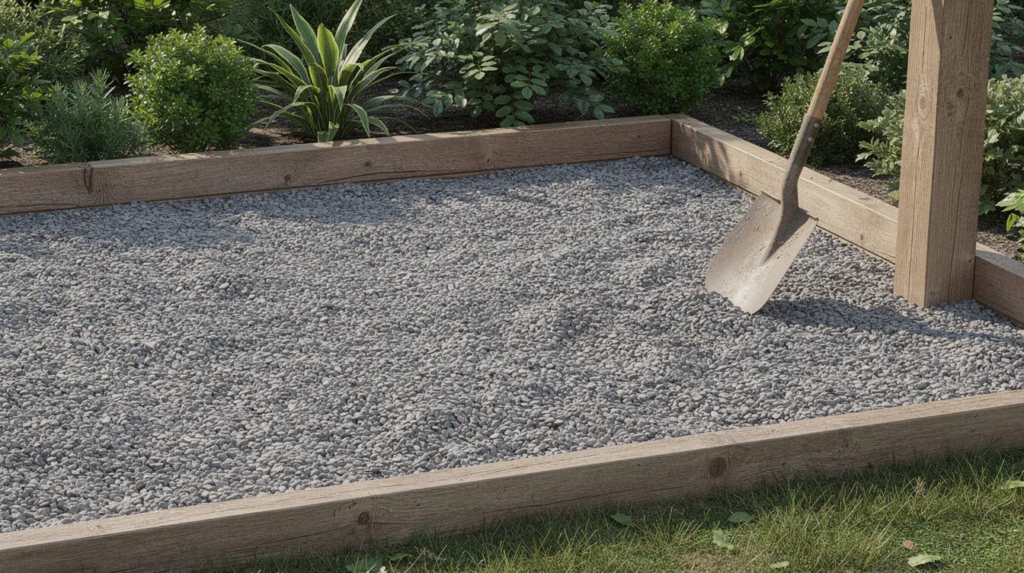
If you are planning a driveway, patio, walkway, or drainage project, one of the first questions you will ask is how much is a ton of gravel. This guide breaks down current pricing, how far one ton of gravel will spread, how to calculate how many tons you need, and what delivery actually costs in the real world.
Quick answer: how much is a ton of gravel in 2026?
Gravel costs $10 to $50 per ton on average across the U.S., with the average cost of gravel typically ranging between $25 and $55 per ton depending on material type, quality, and location. For common bulk driveway and base gravel like crushed stone and crushed limestone, expect roughly $20–$45 per ton before delivery.
Decorative stone options such as pea gravel, river rock, and marble chips often cost more, running $40–$100+ per ton. Small bag purchases at home centers push the effective cost well above $100–$150 per ton equivalent.
Basic materials are highly affordable compared to premium decorative choices, but prices can fluctuate based on regional geological supply and fuel costs. Gravel pricing can also vary by region depending on proximity to quarries. The bottom line: always get a local quote before ordering.
If you want a fast estimate of tons and total project cost, our free Crushed Stone Calculator handles the math for you.
Gravel price per ton by type
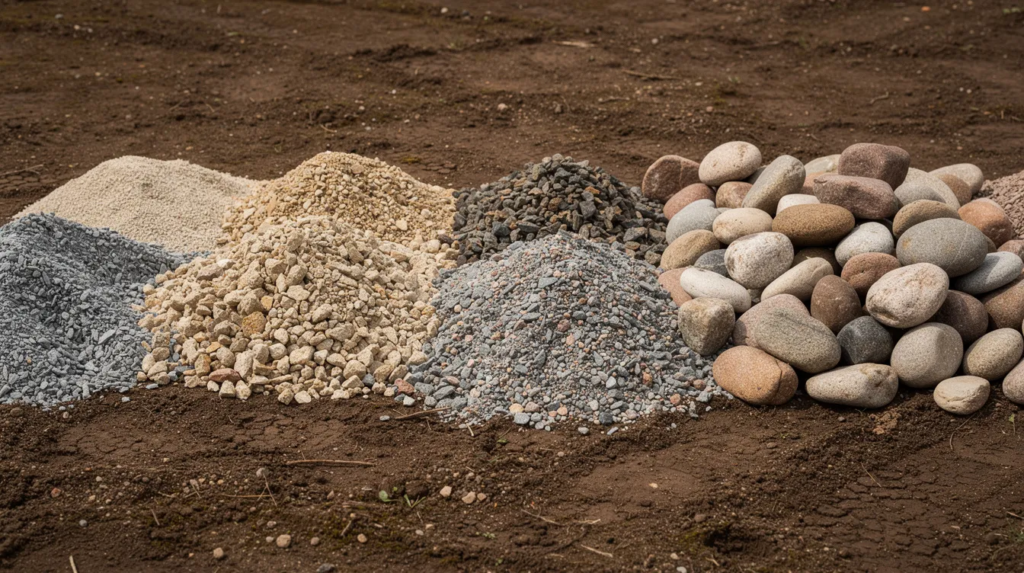
Below are typical per ton price ranges for common gravel types in the U.S. for 2025–2026. Gravel pricing varies based on type, quality, and location, so treat these as planning ranges rather than exact quotes.
| Gravel Type | Typical Price Per Ton | Common Uses |
|---|---|---|
| Basic construction gravel / crushed stone mix | $15–$35 | Sub-base, fill, utility trenches |
| Road base / crusher run / compactable driveway stone | $20–$40 | Under asphalt, driveway base layers |
| Crushed limestone / #57 stone | $25–$45 | Driveway surface, drainage, patios |
| Pea gravel | $28–$60 | Walkways, patios, decorative beds |
| River rock / decorative landscaping gravel | $45–$130+ | Landscaping, dry creek beds, accents |
| Recycled materials (crushed concrete, asphalt millings) | $15–$35 | Base layers, eco-friendly fill |
Crushed stone or crusher run typically costs between $15 and $40 per ton, while base materials typically cost between $20 and $50 per ton. Pea gravel costs $28 to $45 per ton in small quantities, with cheaper rates on full truck load orders. Multi colored decorative gravel and polished rock sit at the top of these ranges.
Ordering larger quantities often results in a lower price per ton. Small-quantity orders, hand-loaded pickups, and bagged landscaping material tend to cost at or above these ranges. For detailed regional pricing, check the Crushed Stone Cost Per Ton 2026 guide.
How much does a ton of gravel cover?
When people ask how much is a ton of gravel, they often mean how far will it spread. A ton of gravel covers 0.59 to 0.71 cubic yards in total volume, depending on stone size and density. One ton of gravel covers 60 to 120 square feet at 2 to 4 inches deep.
Here is a coverage table for one ton at common depths:
| Depth | Crushed Stone Coverage | Pea Gravel Coverage |
|---|---|---|
| 2 inches | ~100 sq ft | ~110–120 sq ft |
| 3 inches | ~65–75 sq ft | ~70–80 sq ft |
| 4 inches | ~50–55 sq ft | ~55–60 sq ft |
| 6 inches | ~25–35 sq ft | ~35–40 sq ft |
At 2 inches deep, a ton of pea gravel covers about 120 square feet. One ton of pea gravel covers roughly 60 square feet at 4 inches deep. A ton of gravel at 6 inches deep covers 25 to 35 square feet.
For example, one ton of pea gravel at 2 inches deep can usually provide gravel coverage for a small 10 by 10 foot patio area. If you go 4 inches deep for better drainage or heavier foot traffic (comfortable even in bare feet on smooth pea gravel), that same ton only handles about half the space.
These are planning estimates. Compaction, moisture, raking, and soil conditions all affect actual coverage.
How to calculate how many tons of gravel you need
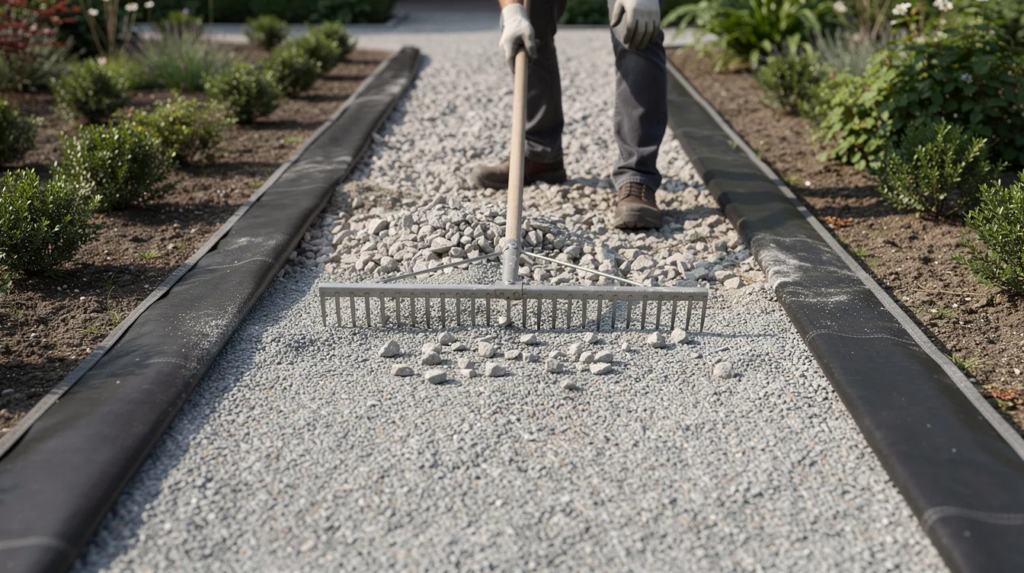
The best way to control your total cost is to know how many tons are needed before calling a supplier. Here is the step-by-step method in plain English:
- Measure the area in feet: length times width equals square feet.
- Choose your depth in inches and convert to feet by dividing by 12.
- Multiply square feet by depth in feet to get cubic feet.
- To convert cubic feet to cubic yards, divide by 27.
- Multiply cubic yards by the density factor for your material (typically 1.4–1.5 for crushed stone) to get tons of gravel.
Worked example: 12 by 25 foot driveway at 4 inches deep
- Area: 12 × 25 = 300 square feet
- Depth: 4 ÷ 12 = 0.333 feet
- Volume: 300 × 0.333 = 100 cubic feet
- Cubic yards: 100 ÷ 27 = 3.7 cubic yards
- Tons: 3.7 × 1.5 = about 5.6 tons
If you are using a lighter gravel mix like pea gravel at roughly 1.3 tons per cubic yard, you would need about 4.8 tons instead. Different materials like river rock, crushed limestone, and sand all have different densities, so confirm with your supplier or select the specific material in the gravel calculator to get an accurate unit conversion.
You can plug your exact dimensions (length, width, depth) into the Crushed Stone Calculator for fast, error-free results.
Cubic yards to tons: quick gravel conversion guide
Some suppliers quote in cubic yards while others quote per ton. Here is how to convert between the two so you can compare bulk gravel prices on equal footing.
Typical density rules of thumb:
- Most crushed gravel: a cubic yard of gravel equals approximately 1.4 to 1.5 tons
- Pea gravel: about 1.25–1.35 tons per cubic yard
- Road base or compacted fill with fines: gravel typically weighs 1.4 to 1.7 tons per cubic yard
One cubic yard of gravel weighs 1.4 to 1.5 tons for most standard types. When exact density is unknown, multiplying cubic yards by 1.4 or 1.5 gives a solid planning shortcut.
Quick conversions:
- 5 cubic yards of driveway gravel × 1.5 = about 7.5 tons
- 10 cubic yards of pea gravel × 1.3 = about 13 tons
The gravel calculator on Crushed Stone Calculator automatically handles these conversions for multiple stone types, so you can skip the manual math.
Gravel delivery cost, dump truck loads & real-world pricing
Per ton material cost is only part of the bill. Delivery and load sizing can significantly shift the final price.
Delivery pricing:
- Gravel delivery costs $10 to $25 per ton as a common surcharge range. Delivery fees often range from $30 to $120 per ton when you factor in material cost, longer haul distance, or difficult site access.
- Many suppliers charge a flat $75–$150 per trip within a local radius, or offer free delivery over a minimum order of 5–10 tons.
- Proximity to local quarries can significantly lower transportation fees, sometimes by $5–$15 per ton compared to a quarry 30 or 40 miles away.
Dump truck capacities:
| Truck Type | Typical Load Capacity |
|---|---|
| Small single-axle dump truck | 5–8 tons |
| Standard tandem dump truck | 10–15 tons |
| Large tri-axle or semi | 18–24 tons |
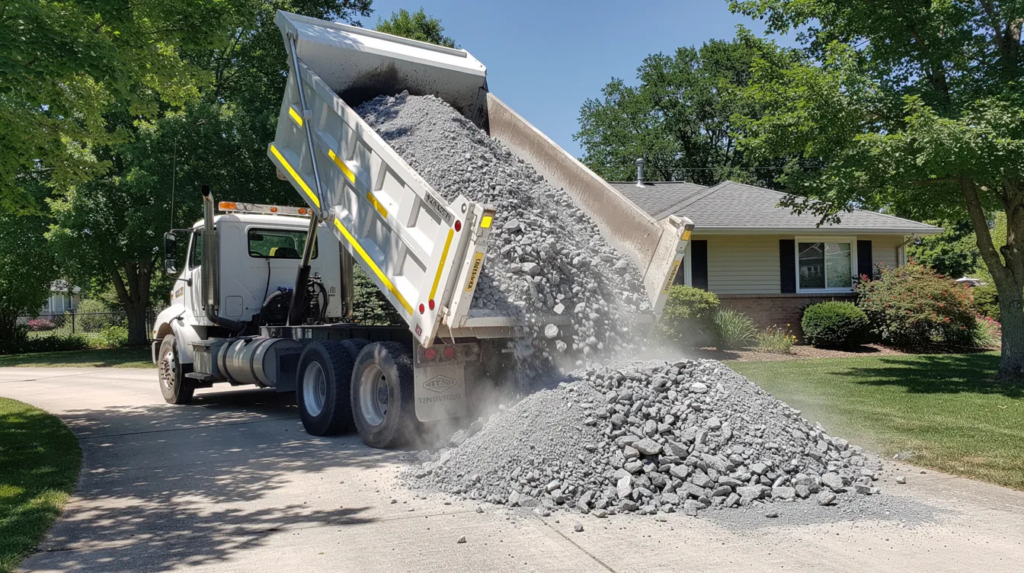
A truckload of gravel costs $1,350 or more with a 10-cubic-yard minimum at many suppliers. For a full 10–15 ton load of mid-range crushed stone, expect roughly $600–$1,200 total depending on material and region.
For larger projects like driveways, parking pads, and long walkways, ordering full truckloads is almost always cheaper per ton than multiple small deliveries or buckets of bagged rock from a home center.
Sample gravel cost scenarios for common projects
Here is how per ton price, coverage, and delivery come together for real projects. All numbers are typical ranges for 2025–2026.
1. Small 10 × 10 pea gravel patio at 3 inches deep 100 sq ft × 0.25 ft = 25 cubic feet → about 0.93 cubic yards → roughly 1.2 tons. At $35–$55 per ton, material runs $45–$70. Add a minimum delivery fee of $50–$100. Total: roughly $100–$170.
2. Standard 12 × 25 two-layer gravel driveway 300 sq ft total area. Base layer (crusher run at 4 inches): about 5.6 tons. Top layer (#57 stone at 2 inches): about 2.6 tons. Total: roughly 8 tons. Material cost: approximately $230–$350. Delivery: $100–$200. Grand total: $330–$550 for materials delivered. For help choosing layers, see the best gravel for driveways guide.
3. 50-foot French drain trench (2 feet wide × 1.5 feet deep) Volume: 150 cubic feet → 5.6 cubic yards → about 7.8 tons of drainage gravel. Material: $240–$350. Delivery: $100–$150. Total: $350–$550.
4. Decorative river rock landscaping bed (200 sq ft at 2 inches deep) About 1.2 cubic yards → roughly 1.9 tons. Decorative stone at $45–$80 per ton: $90–$160 material. Delivery minimum fee applies. Total: $150–$250. Consider laying landscape fabric beneath the rock to suppress weeds and keep the stone clean.
You can plug your exact project dimensions into the gravel calculator to replace these sample numbers with your own.
How to avoid overordering or underordering tons of gravel
Ordering too much gravel wastes money. Too little means an extra delivery trip and project delays. Here is how to get it right:
- Measure twice. Use a tape measure for length and width in feet rather than eyeballing it. For irregular shapes, break the area into rectangles and add them up.
- Pick a consistent depth and stick to it: 2–3 inches for paths and decorative beds, 4–6 inches for driveways with multiple layers.
- Use a gravel calculator to see total volume in cubic yards and weight in tons before calling suppliers.
- For compaction, add 10% to your gravel order. Base layers that get compacted will settle and you do not want to come up short.
- For layered projects, calculate each layer separately. A driveway might use coarse rock as a base and a finer gravel as a top layer, and each has a different density.
- Ask your supplier about moisture content. Wet material weighs more per shovel or per yard, which can affect how much actually arrives versus what you expected.
When to use Crushed Stone Calculator’s Gravel Calculator
Our free online calculators handle gravel, crushed stone, and other aggregates, so you do not have to do any of the math by hand.
The gravel calculator is especially helpful when you are:
- Planning a new driveway or parking area and need to know how much gravel in tons, truckloads, and cost
- Estimating pea gravel for patios, play areas, or walkways
- Calculating drainage gravel for French drains or swales
- Comparing quotes where one supplier prices per cubic yard and another prices per ton
You enter length, width, and depth. The calculator outputs cubic yards, approximate tons, and estimated cost. You can choose from different gravel types (crushed stone, pea gravel, river rock, crushed limestone) so the density adjusts automatically. You can also include a cost per ton figure to see a total project budget before you ever pick up the phone.
FAQ: tons of gravel, cost, and coverage
How much is a ton of gravel near me?
Expect $20–$45 per ton for basic crushed stone and driveway gravel, with decorative stone running $40–$100+ per ton. Your local quarry distance and competition between suppliers strongly affect price. A pile of natural stone from a quarry 5 miles away will almost always beat material shipped from 50 miles out. Get at least two local quotes.
Is gravel cheaper by the ton or by the yard?
Suppliers price it so that ton vs yard comes out roughly similar once you account for density. Since gravel typically weighs 1.4 to 1.5 tons per cubic yard, a $40 per ton price equals about $56–$60 per yard. Compare total job cost rather than just the unit label.
How many tons of gravel are in a dump truck?
A small single-axle dump truck holds about 5–8 tons. A standard tandem carries 10–15 tons. Larger tri-axle or highway-legal trucks can haul 18–24 tons where weight limits and road access allow. Capacity varies by state.
How much pea gravel do I need for a walkway or patio?
Walkways and patios typically use 2–3 inches of depth. For 200 square feet at 2 inches deep, you need about 1.6 tons of pea gravel. At 3 inches, that jumps to roughly 2.4 tons. Use the pea gravel option in the calculator for a precise number. Lay landscape fabric first if you want to keep weeds from coming through, and spread with a rake for an even walk surface.
What is the difference between pea gravel and crushed stone for cost and performance?
Pea gravel is a popular decorative gravel that feels smooth underfoot and looks great on paths and patios, but it shifts easily without edging. Crushed stone locks together under compaction, handles vehicle weight on driveways, and usually costs less per ton for basic grades. For structural base work, crushed stone or the right crushed stone size wins. For looks, pea gravel or polished river rock is the better pick. You can also use mulch or stone dust as alternatives in some landscaping beds.
Can I just guess how much gravel I need?
Guessing often leads to 20–30% errors in tonnage, which means either wasted money on a surplus pile or a costly second delivery. Spending five minutes with the Crushed Stone Calculator to enter your area’s dimensions is the simplest way to avoid both problems and walk into the project with accurate numbers.