Table of Contents
Sandstone dust is one of those materials that quietly does the heavy lifting in countless landscaping and construction projects. Whether you’re building a compacted path base, filling joints between flagstones, or leveling low spots across your property, understanding this affordable byproduct can save you time, money, and a wasted trip to the supplier.
What Is Sandstone Dust (Stone Dust, Quarry Dust)?
Sandstone dust is a fine particulate byproduct generated when sandstone is cut, crushed, drilled, or quarried. At the quarry, raw sandstone is fed through a crushing machine, then screened to separate coarser crushed stone from the fine dust fraction. The result is a gritty material-sometimes called stone dust, quarry dust, screenings, or simply grit-that can be as fine as powder yet is coarser than regular sand.
The exact composition depends on the source rock, but sandstone dust primarily consists of weathered mineral particles and crystalline silica. Its composition includes silicon dioxide along with feldspar, mica, and clay minerals. Because stone dust varies in properties based on the stone type crushed, sandstone dust differs from granite or limestone dust in color, density, and chemical behavior. Sandstone dust is generally lighter-roughly 2.60 specific gravity-with a tan to reddish texture depending on iron oxide content.
One safety note: sandstone dust contains respirable crystalline silica, which can bypass the body’s natural airway filters. Always wear appropriate PPE when handling it.
Key properties at a glance:
- Particle size: Up to about 3.5 mm; finer than ¼-inch aggregates
- Alternate names: Stone dust, quarry dust, grit, screenings, filler
- Density: Approximately 1.35 tons per cubic yard
- Behavior: Fine sandstone particles compact well and provide a natural mineral texture for construction
- Color/grades: Tan, buff, reddish-varies by location and sandstone source
Common Uses of Sandstone Dust in Landscaping and Construction
Sandstone dust is widely used as a base and leveling material in small projects around homes and farms. Its ability to compact into a stable, smooth layer makes it a go-to choice for homeowners and contractors working on patios, walkways, sidewalks, driveways, and even streets.
Stone dust is often sold as a paver setting bed, but that use is now discouraged — it holds moisture and heaves in freeze-thaw conditions, which lifts and tilts pavers over time. Use washed concrete sand for the bedding layer under pavers instead, and keep stone dust for the compacted sub-base or as a joint filler in wide, irregular gaps. It helps prevent weed growth between paving stones and can fill potholes in concrete areas. Sandstone dust can also fill gaps and improve the structural porosity of clay or concrete bricks, making it useful around holes in older masonry.
It provides a stable sub-base for pathways and driveways when compacted, and is used as an aggregate in masonry mortar and concrete mixes-some regions blend it with cement, asphalt, or gravel as a partial sand replacement. Some gardeners mix rock dust into soil as a mineral amendment, though the evidence for it is thin. Heavy accumulation can compact soil and hurt plant growth, so keep it out of planting beds.
Typical project types:
- Compacted sub-base under patios and walkways
- Garden walkways and light driveways
- Leveling low spots and building subgrades
- Filling joints between flagstone or bricks
- Equestrian arenas and barn aisles
- Erosion control on slopes and shoulders
- Filler in mortar and concrete mixes
Sandstone Dust vs Sand and Other Crushed Stone Aggregates
Homeowners often face confusion when choosing between sandstone dust, concrete sand, and other crushed stone products. Here’s how they compare:
- Compaction & stability: Stone dust compacts and hardens when wet, delivering a firmer base than sand. It can withstand foot traffic and light vehicle loads on driveways.
- Drainage: Stone dust drains poorly because its fine particles fill the voids between larger grains, so water moves through slowly. Once compacted it forms a low-permeability layer that holds moisture rather than letting it pass. Sand is coarser and more open, allowing water to drain out — critical in freeze-thaw climates where trapped moisture causes heaving.
- Price: Stone dust is generally cheaper than sand, making it attractive for budget-conscious projects.
- Crusher run & #57 stone: These are a coarser version of crushed stone used as structural base layers beneath dust. Decomposed granite sits between stone dust and gravel in size-better drainage, more natural look.
- Polymeric sand vs stone dust in joints: Polymeric sand contains a bonding agent that hardens and locks pavers; stone dust stays loose but compacts over time with consistency. Polymeric is better for tight joints; stone dust suits wider, irregular gaps.
Stone dust is also sold as quarry dust, screenings, or grit. Some suppliers list decomposed granite under the same names, though true DG is weathered granite rather than a crushing byproduct, so confirm what you are actually getting. Note that the right pick depends on your project dimensions, climate, and load requirements.
How Much Sandstone Dust Do You Need? (Material Estimation Guide)
Under- or over-ordering wastes money and delays your project, so knowing how much material you need is essential. Here’s how to calculate it:
Measure the length, width, and depth of your area in feet (convert inches to feet by dividing by 12). Multiply all three to get cubic feet, then divide by 27 to get cubic yards. At roughly 1.35 tons per cubic yard, you can convert volume to weight for purchasing.
Example: A 10 ft × 12 ft patio with a 1-inch layer of stone dust = 120 × 0.0833 = 10 cubic feet ≈ 0.37 cubic yard ≈ 0.50 tons. Add 10% to 15% for waste.
Stone dust costs $28 to $44 per cubic yard picked up at the quarry, which works out to roughly $19 to $29 per ton. Delivery typically adds $50 to $150 per load for local drops, and long hauls or small orders can push the delivered total well above the material price.
Typical depths:
- Joint filler between flagstone or pavers: ½ to 1 inch deep, swept in until flush
- Flagstone beds: 2 inches
- Walkway/driveway top layer: 1–2 inches over proper base depth
Rather than doing manual math, use our free Gravel Calculator or Stone Weight Calculator to quickly determine how much material you need. Enter your project dimensions and material type-these tools handle cubic yard and tonnage conversions automatically, so you can deliver an accurate order to your supplier.
Practical Tips for Buying, Installing, and Maintaining Sandstone Dust
Buying: Local quarries and landscape supply centers sell sandstone dust under various names-screenings, quarry dust, stone dust. Contact your supplier to confirm the source rock and ask about gradation. Confirm the delivery location, access for a dump truck, and whether there’s an additional fee for placement beyond curbside. Purchasing in bulk is generally more cost-effective; check current crushed stone pricing before you commit.
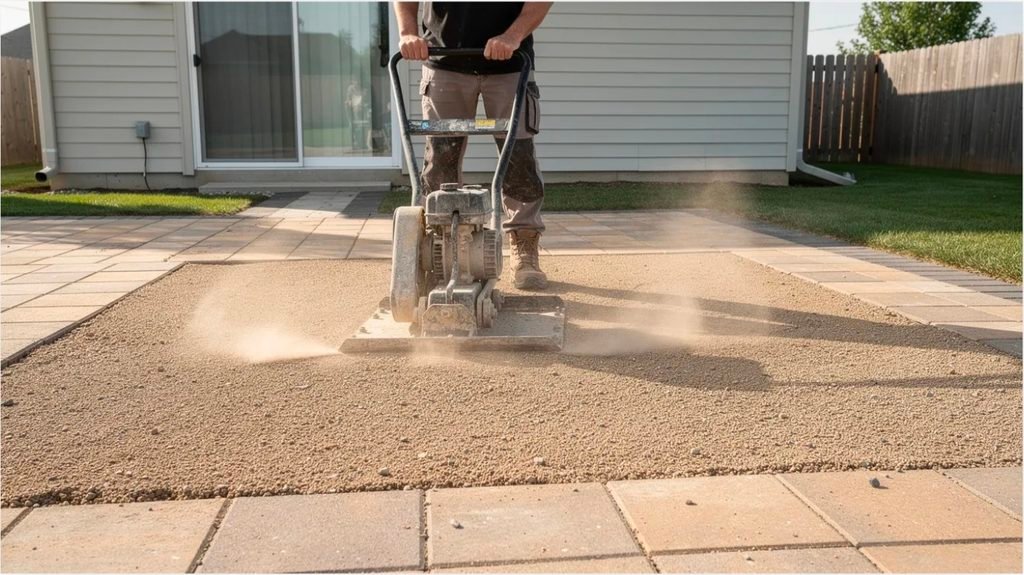
Installing: Before you start, wear an N95 respirator — dry stone dust releases respirable silica, which is a serious long-term lung hazard. Compact in 2–3 inch lifts using a plate compactor machine. Keep moisture content slightly damp, not muddy, so the dust compacts into a firm layer and stays out of the air. Always place sandstone dust over a properly drained base of coarser crushed stone to assist drainage and cover your base against frost.
Maintaining: Top up low spots seasonally. Manage weeds in joints by sweeping in fresh dust or applying sealer. If water pools, regrade or add drainage paths beneath.
Health & environmental precautions: Sandstone dust poses serious health risks when inhaled. Handle it with proper protection every time.
Health risks:
- Silica dust is classified as a Group 1 human carcinogen by the International Agency for Research on Cancer
- Inhaling respirable crystalline silica can cause silicosis, a progressive lung condition
- Chronic exposure can lead to Chronic Obstructive Pulmonary Disease (COPD)
- Dust from sandstone during construction can irritate the respiratory system
- Silica exposure in workplaces is regulated, with permissible exposure limits set by OSHA
How to control it:
- Wet methods and local exhaust ventilation are the recommended controls
- Keep the material damp while working so it does not go airborne
- Wear an N95 respirator or better, every time
Environmental notes:
- Airborne sandstone dust is a particulates problem affecting air quality, not a toxic chemical, but it can reduce local air quality and visibility
- Runoff can contaminate water sources and harm aquatic life, so keep it away from storm drains and waterways
Ready to get your estimate? Open our Gravel Calculator, plug in your project dimensions, and save the result before calling your local supplier. Getting the numbers right on the first trip keeps your project on budget and on schedule.