Table of Contents
If you’re planning a driveway base, drainage project, or heavy-duty pad, you’ve probably come across terms like 2″ gravel, No. 2 stone, or #2 gravel. This guide covers what this material actually is, how to estimate quantities, and when it makes sense for your project.
What Is 2″ Gravel?
The terms “2 inch gravel,” “2 inch stone,” “No. 2 stone,” and “#2 gravel” are all common names for coarse aggregate products found at quarries and landscape supply yards across the United States. However, exact size and gradation are supplier-specific, so there is no single national standard that governs what every supplier means by this label.
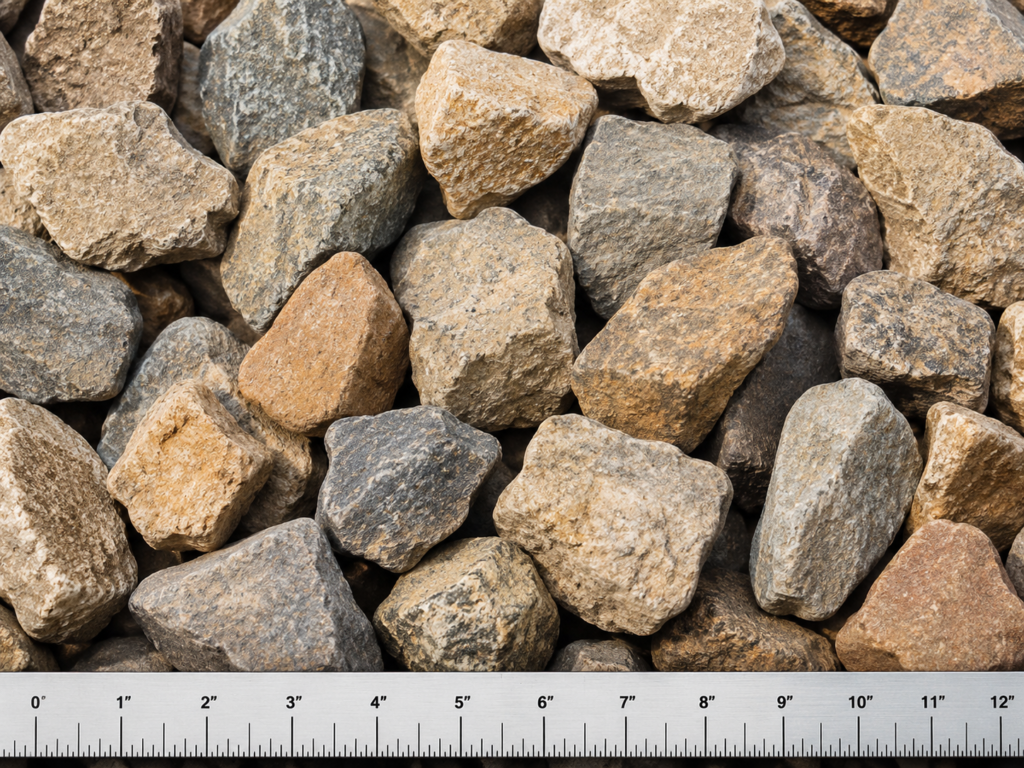
In many U.S. regions, #2 gravel or No. 2 stone includes pieces roughly 1½” to 3″ in size. The U.S. Department of Agriculture defines gravel broadly as particles from 2 to 80 mm, while the U.S. Army Corps of Engineers defines gravel as material under 3 inches. Gravel itself consists of loose rounded rock particles over 2 mm in diameter, and quartz is the most common mineral found in gravel. In some supplier systems, 2-inch gravel is often referred to as #3 or #4 coarse aggregate rather than strictly “#2,” so confirming the local product name matters.
This material may be natural gravel (rounded, river rock style) or crushed stone (angular, mechanically processed). 2-inch gravel is available in clean stone and crushed run categories, each suited to different jobs. Because the stones are large, this is a coarse aggregate used under driveways, roads, and for heavy drainage-not for smooth walking surfaces.
Once you know your local product name and size, you can use the free Gravel Calculator from Crushed Stone Calculator to estimate cubic yards, tons, and rough cost before calling suppliers.
How 2″ Gravel Is Classified and Labeled
Aggregate names vary by state DOT specification, quarry, and supplier brand. What one yard in Colorado calls “#2 stone” might be labeled “2-inch washed gravel” or “1½–3″ crushed limestone” at another. The number 2 designation is often a coarse size class in regional grading systems, but the top size, bottom size, and allowable fines can differ widely.
The main types you’ll encounter include 2″ gravel (rounded, river rock style), 2″ crushed stone (angular, mechanically crushed rock), and 2″ minus versus 2″ clean. Clean stone is used primarily for drainage purposes, while “minus” blends include fines and dirt for better compaction. Crushed run is used for structural bases and can help reduce rutting, settling, and soft spots when it is installed over a properly prepared subgrade. In many cases, 2-inch stone can work well as a sub-base for driveways and construction entrances, but the best choice depends on whether the material is clean, minus, rounded, or angular.
When working with suppliers, ask about the nominal top size in inches, whether it’s clean or with fines, whether it’s gravel or crushed stone, and what types of projects it’s typically used for. Keep a short list of local terms-#2 stone, 2″ washed gravel, 2″ crushed limestone, 2″ minus stone blend-so you avoid confusion when reordering.
Typical Size, Shape, and Density of 2″ Gravel
Many #2 or 2″ products contain stones roughly between about 1″ and 3″ in diameter, but the exact gradation must be confirmed on a current spec sheet or supplier website page. Limestone gravel, for example, commonly ranges from 2 to 4 inches in size depending on the quarry. Natural 2″ gravel tends to be rounded or oval, while 2″ crushed stone is angular with sharper edges that help pieces interlock under load.
For planning, gravel bulk density is often listed in the range of about 1,460 to 1,920 kg/m³. In U.S. terms, many 2″ gravel and crushed stone products fall around 1.3–1.6 tons per cubic yard (2,600–3,200 lb/yd³), though actual density depends on rock type, gradation, moisture, and whether the material is clean, open-graded, or mixed with fines. Clean, open-graded gravel can drain well because water moves through the void spaces between larger particles.
Always ask your supplier for an approximate tons-per-cubic-yard figure for their specific 2″ material, since granite, limestone, and basalt differ meaningfully. The Gravel Calculator can use a typical density range to estimate tonnage from cubic yards, but it is still an approximation-your supplier’s number is always better.
Common Uses for 2″ Gravel in Residential and Small-Contractor Projects
Two-inch gravel is usually a structural or drainage layer, not a finish surface, for most home projects. Here’s where it fits.
Driveway and parking area base. 2-inch gravel serves as a heavy-duty base layer for driveways and roads. Over soft or clay soils, it’s often placed 4″–12″ deep before adding a smaller top layer like ¾” or #57 stone. This approach helps create a stable foundation and prevents rutting. 2-inch gravel provides a stable base for heavy flagstones and similar hard surfaces too.
Heavy-duty access roads and equipment pads. Farm lanes, temporary construction entrances, and area pads for heavy trucks benefit from this coarse base. 2-inch gravel can provide structural stability in landscaping and construction, and it may help support concrete or asphalt surfaces when used as part of a properly designed sub-base. Gravel and crushed stone are also used as aggregate in many construction applications, including concrete mixes, but driveway base and drainage stone should still match the project specification.
Drainage and erosion control. Larger clean stone works well for maximum water flow in drainage applications. Gravel allows water to flow freely in drainage areas, and 2-inch gravel is used for projects requiring high drainage capacity. The large stones in 2-inch gravel can help slow movement in drainage and erosion-prone areas, but high-velocity water or streambank work may require properly sized rip rap and local design guidance. Erosion control gravel can help reduce washouts and stabilize soil in drainage areas, while clean 2-inch gravel allows water to pass through the void spaces and may help reduce standing water when installed correctly.
Landscape and decorative uses. Gravel is suitable for various landscape designs due to its range of colors, and decorative ground cover made of gravel creates a natural look in landscapes. Downspout splash pads, swales, and rock-lined channels are common applications. Gravel does not decompose or rot over time, requiring minimal replenishment. Gravel can be low maintenance when combined with proper edging and a suitable weed barrier, but weeds may still grow through dust, soil, or organic debris that collects between stones.
Safety trade-offs. 2-inch gravel is rarely used for walking paths due to its large size. These stones are hard to walk on, not fun for children’s play areas, and rough on gravel bikes or any bike tire. Pushing a cart or stroller across 2″ stone is uncomfortable, and you may be unable to shovel snow effectively over a surface this coarse.
2″ Gravel vs Smaller Gravel Sizes (Driveways, Paths, and Drainage)
Most projects work best with a combination of sizes. A common way to build a long gravel driveway is to place 2″ gravel as the base and ¾” or #57 stone as the top layer. Compared to ¾” crushed stone, 2″ gravel has larger voids and better drainage but a rougher surface. Compared to 3/8″ pea gravel or small river rock, it’s far more structural but uncomfortable underfoot. Crusher run or ¾” minus gravel compacts into a smoother, tighter surface but lacks the drainage capacity of clean 2″ stone.
Two-inch gravel is likely too big for thin driveways over firm soils, narrow walkways, patio bases, and areas where snow shoveling is frequent. It’s often the right choice for very soft subgrades, thick base layers for RV pads, and high-flow drainage or erosion zones. 2-inch gravel is a cost-effective material for large-scale fill projects where you need to place large quantities of stone quickly.
If your soil is soft and heavy vehicles are expected, consider a 2″ base topped with smaller stone. If only light cars use the driveway and soil is firm, a smaller base stone may be enough-confirm with a local professional before making a purchase.
Estimating How Much 2″ Gravel You Need
To prepare your order, measure the length and width of the area in feet, then decide on a base thickness (height) in inches. Convert to cubic yards: length × width × depth in inches ÷ 324.
For example, a 50 ft × 12 ft driveway strip with a 6″ base of 2″ gravel needs (50 × 12 × 6) ÷ 324 ≈ 11.1 cubic yards. At roughly 1.4 tons per cubic yard, that’s about 15.5 tons. Round up 5–10% to cover waste and compaction-so you might order around 17 tons to complete the job without a second delivery.
Many homeowners underestimate depth. Don’t wait until the materials arrive to realize 2–3 inches of coarse stone over dirt won’t hold up. Planning a realistic base thickness reduces rutting and mud later. Use the Gravel Calculator to input your dimensions and get cubic yards, tons, and rough cost ranges before calling for quotes.
Cost of 2″ Gravel and What Affects Price
Gravel costs approximately $35 per ton as a rough national average, but gravel prices vary by region and supplier. Many bulk 2″ gravel products fall in a range of roughly $20–$60+ per ton, depending on rock type, distance from quarry, and whether the stone is washed. Gravel and crushed stone are major construction materials in the U.S., so pricing can vary widely by region, quarry location, fuel costs, delivery distance, and local demand.
Major cost drivers include delivery mileage, rock type (limestone vs. granite vs. river gravel), whether the stone is clean or includes fines, and order size. Buying in larger quantities or full truckloads may reduce the effective per-ton price, depending on the supplier, delivery distance, and truck capacity. Some suppliers charge separate delivery fees, fuel surcharges, or enforce minimum order amounts of 2–5 tons for residential delivery. The quality of the material and the customer service experience also vary, so compare multiple quotes.
Use the Gravel Calculator to get a rough project total before calling suppliers-it helps you compare quotes and avoid budget surprises.
Ordering Tips: Questions to Ask About 2″ Gravel
Clear communication with your supplier prevents wrong-size deliveries and extra trucking fees. Before you order, ask about the exact size range and gradation (for example, “about 1½”–3″, clean”), whether the material is rounded gravel or angular crushed stone, whether it’s clean or minus, approximate tons per cubic yard, and delivery minimums or tailgate spreading availability.
Mention your project type-driveway base, drainage, erosion control-so the supplier can confirm if 2″ gravel is the right product for your situation or suggest an alternative. Confirm the total price including material, delivery, taxes, and any fees. Keep a written quote or email so there are no surprises on delivery day. Re-check your measurements with the Gravel Calculator right before calling so you know the number of tons or yards you plan to request.
When 2″ Gravel Might Not Be the Best Choice (Alternatives to Consider)
While 2″ gravel is excellent for heavy bases and drainage, it can be overkill in many residential situations. For driveway surfaces, ¾” gravel, #57 stone, or crusher run offers a smoother driving surface that’s easier on tires. For walkways and seating areas, pea gravel or smaller decorative stone is usually safer and more comfortable. Paver patios and sidewalks typically need ¾” minus or a similar compactable base instead of large 2″ rock.
The best compromise for reasons of both strength and comfort is combining a 2″ base with a smaller top layer. For critical structures, retaining walls, or steep slopes, consult local building guidelines or an experienced contractor before making decisions.
Explore our other guides on the Crushed Stone Calculator website, and use the Gravel Calculator for any gravel size-not just 2″ gravel-before you place your order. With the right size confirmed and quantities estimated, you can move from planning to ordering with confidence.