Table of Contents
Introduction to Buying Landscape Stone in Bulk
A landscape calculator stone tool helps you estimate how much bulk landscape stone to order by converting your project dimensions, depth, and material type into volume in cubic yards, weight in US tons, and an optional cost estimate. “Landscape stone bulk” refers to decorative stone products sold in large, unpackaged quantities, typically by the cubic yard or US ton. Instead of buying dozens of small bags from a home improvement store, homeowners, small contractors, landscapers, and outdoor project planners in the U.S. often order stone by the truckload from a local landscape supply yard. For garden beds, walkways, driveways, and drainage swales, bulk ordering is usually the faster and lower-cost option once you move beyond a bag or two.
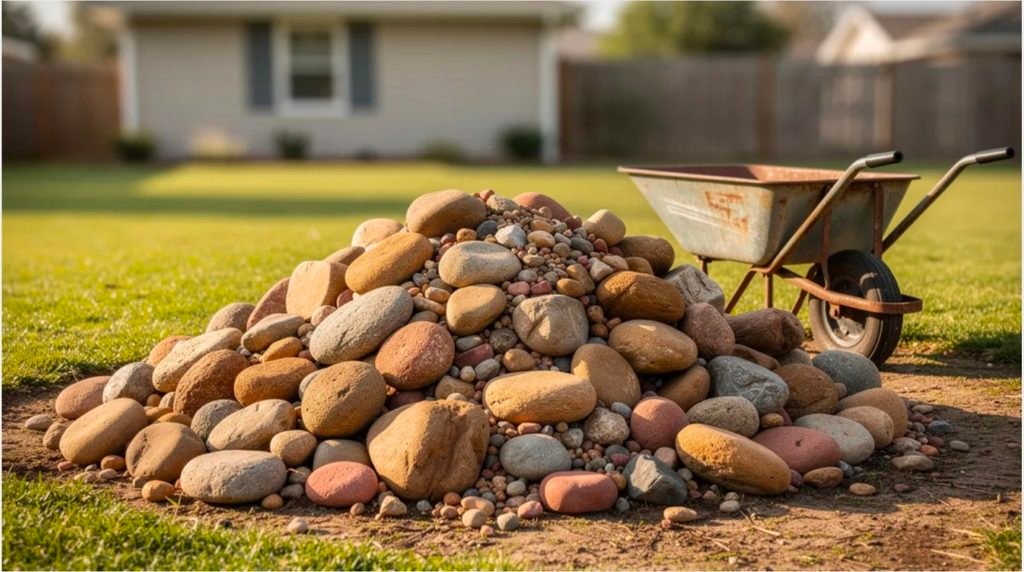
Common bulk materials include pea gravel (rounded, ¼ to ½ inch), river rock (1 to 6 inches, water-worn), crushed limestone (angular, 3/4 inch), decomposed granite (fine granules), red lava rock (porous, lightweight), and white marble chips (bright, angular). Each stone type fits a different job, and stone size, shape, and density all affect coverage, weight, drainage, and final cost. Pea gravel is commonly used for pathways and drainage. River rock works well in dry creek beds and accent areas. Crushed stone is frequently used for driveways and foundation layers. White marble stones are popular for enhancing garden aesthetics. The right selection depends on your project, your climate, and your budget.
Bulk landscape stone is typically sold by the ton or cubic yard, and actual coverage can vary slightly depending on stone size, shape, and how compacted the material is. One cubic yard of gravel weighs about 1.4 tons, but lighter rocks like lava will weigh less per yard, while dense crushed granite will weigh more. Because these numbers shift by material, accurate estimating helps you avoid paying for too much stone or delaying the job because you ordered too little. The Crushed Stone Calculator is a free online tool that automates this. Enter your project dimensions, depth, and material type, and it returns volume in cubic yards, weight in US tons, and an optional cost estimate. Related tools like the Gravel Calculator and Rock Calculator handle specific material categories.
This guide is for DIY homeowners, small contractors, landscapers, and small landscaping project planners who need practical advice for measuring an area, choosing the right stone, converting volume to weight, adding a waste factor, estimating costs, and handling ordering, delivery, and installation for bulk landscape stone. By the end, you will know how to choose the right stone, measure your area, estimate tonnage, and place an order without wasting money on extras you do not need.
Types of Decorative Stones Commonly Sold in Bulk
Different stone types carry different weights, textures, and price points. A stone that looks perfect for a patio border could be a poor fit for a driveway. This section breaks down the most popular bulk options so you can choose the right decorative stones for your landscaping project.
Pea Gravel
Pea gravel runs about ¼ to ½ inch depending on the supplier, with smooth, rounded edges. Colors range from tan and brown to gray and white mixes. It is a go-to option for pathways, between pavers, French drains, and play areas because it is comfortable underfoot. The trade-off: rounded stones do not interlock, so pea gravel shifts under loads and migrates on slopes without edging. Pea Gravel costs $27.99 per ton at many supply yards, making it one of the least expensive decorative options.
River Rock
River rock varies from small pebbles to large boulders and is excellent for drainage. Sizes run from about 1 inch to 6 inches or more, with smooth, water-worn surfaces in natural grays, tans, and browns. River rocks are ideal for creating natural-looking landscapes, dry creek beds, water features, and accent beds around fire pits. The rounded shape makes river rock uncomfortable to walk on and unstable under vehicle traffic. Density sits around 1.35 tons per cubic yard, so delivery loads are lighter than most other decorative stones.
Crushed Limestone / #57 Stone
Angular, sharp-edged pieces in light gray or buff tones, typically graded at 3/4 inch. The angular shape lets pieces lock together under compaction, which is why crushed limestone is a staple for driveways, paver bases, and structural fill. For a deeper look at grading and pricing, see the Clean Stone Guide. Density runs around 1.45 tons per cubic yard. The downside: angular edges are rougher underfoot, and fine dust can track onto nearby surfaces.
Decomposed Granite (DG)
Fine granules under 1/4 inch, often mixed with natural silt. Colors include rust, tan, and honey depending on the quarry source. Decomposed granite forms a compact, semi-solid surface ideal for pathways, patios, and xeriscapes. It is popular in drought-tolerant landscaping because it does not need water to look good. In wet climates, DG can become muddy, and high-traffic areas may need a stabilizer additive.
Red Lava Rock
Lava rock is lightweight and retains heat, making it suitable for xeriscaping and decorative garden beds where color contrast matters. Red lava rocks provide a unique color for garden beds, standing out against green foliage. Sizes typically range from 3/4 inch to 1.5 inches. Because lava rock is porous, it weighs only about 0.7 to 0.9 tons per cubic yard, so you need more volume by weight compared to denser stones. Red Spardust, a popular lava-based variety, costs $130.00 per ton.
White Marble Chips
Angular, reflective chips in the 1/2 to 1 inch range. White marble creates high contrast against dark mulch or green plantings, making it a strong option for borders and accent zones. It reflects heat rather than absorbing it, which matters in hot climates. The flip side: white stones show dirt and grime faster, and cost per ton runs higher than basic crushed stone.
Specialty and Regional Options
- Alpine stone is a decorative option for landscaping projects, with earthy tones that blend well in mountain or woodland settings. Alpine Stone costs $29.99 per ton.
- Mississippi stone is often used for decorative landscaping features and carries a mid-range price at $103.99 per ton.
- 3/8″ Black Raven costs $136.00 per ton and adds a sleek, dark contrast to light-colored plantings or sand-toned hardscapes.
- Flagstone or boulders can be used for custom patios or structural features where you need flat stepping surfaces or large focal points.
Prices shown are examples from regional suppliers as of 2026 and will vary by location, season, and availability. Always confirm current pricing with your local yard before budgeting.
How Color, Size, and Shape Affect Performance
Dark stones absorb and retain more heat; in summer, a bed of black lava rock will be noticeably warmer than white marble chips. Larger rocks (2 to 6 inches) work well for decoration and drainage but can be hazardous in play areas or on steep slopes. Rounded stones roll and shift; angular stones interlock for stability. Stone density varies by type, affecting weight calculations, so suppliers and calculators like the Crushed Stone Calculator ask the user to select a specific material before generating an estimate.
If you can visit a supply yard in person, pick up a handful from the stock pile. Photos on a website cannot fully convey the variety of textures and color variation you will see in the actual products.
How to Estimate Bulk Landscape Stone: Volume, Cubic Yards, Weight, and Cost
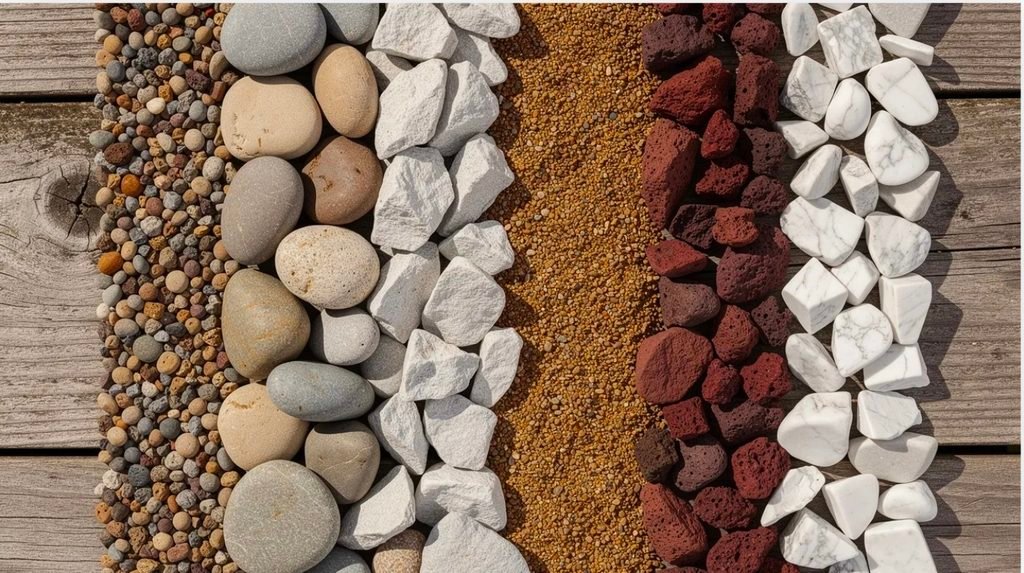
This is the “how much do I need?” section. Getting the estimate right means you avoid paying for a second delivery or staring at a leftover pile of rocks in your driveway for months. Estimate crushed stone by calculating volume in cubic yards, then converting to tons using the density of your chosen material.
Step 1: Measure Your Area in Square Feet
For rectangular or square beds and patios, multiply length by width in feet to get square feet. A 10 ft by 20 ft garden bed is 200 square feet.
For circular features like fire pit rings or round flower beds, measure the radius (half the diameter) in feet. Area equals pi times radius squared. A circle with a 5-foot radius covers about 78.5 square feet.
For irregular areas, break the space into smaller rectangles or triangles, calculate each, and add them up. If the shape has gentle curves, multiply a bounding rectangle by 0.8 as a rough adjustment.
Step 2: Choose a Realistic Depth
Consider project depth when estimating crushed stone needed. Different projects call for different stone depths:
| Project Type | Recommended Depth |
|---|---|
| Decorative top dressing (garden beds, tree rings) | 2 to 3 inches |
| Walkways and moderate foot traffic | 3 to 4 inches |
| Driveway base or structural aggregate | 4 to 6 inches or more |
A thick layer of stone blocks sunlight and suppresses weed growth, so going too thin leaves bare spots and lets weeds through. Convert depth in inches to feet by dividing by 12. Three inches becomes 0.25 feet.
Step 3: Calculate Volume Using a Stone Calculator
Multiply your area in square feet by your depth in feet to get cubic feet. Then divide by 27 (because one cubic yard equals 27 cubic feet) to get cubic yards.
A shortcut: (square feet times depth in inches) divided by 324 gives cubic yards directly. This bundles both unit conversions into one step.
For the 10 ft by 20 ft bed at 3 inches:
- 200 sq ft times 0.25 ft = 50 cubic feet
- 50 divided by 27 = 1.85 cubic yards
Step 4: Convert Volume to Weight
To convert cubic yards to tons, multiply by material density. Different decorative stones vary slightly in density. Here are common ranges:
| Material | Approximate Density (tons per cubic yard) |
|---|---|
| Pea gravel | ~1.30 |
| Crushed limestone | ~1.45 |
| River rock | ~1.35 |
| Lava rock | ~0.7 to 0.9 |
For pea gravel at 1.30 tons per cubic yard, 1.85 yards becomes about 2.41 tons. Crushed stone weight is typically measured in US tons (2,000 lbs). A ton of crushed stone is roughly 0.71 cubic yards at typical densities, which covers about 115 square feet at 2 inches of depth. Lighter materials like lava rock cover considerably more area per ton, denser crushed stone less.
The Stone Weight Calculator handles this conversion for you once you enter volume and material type.
Step 5: Add a Waste Factor
Ordering 10% to 15% extra stone is advisable to account for waste, settling, irregular edges, and small measurement errors. Use a waste allowance to avoid under-ordering crushed stone. For the example above, 2.41 tons plus 10% equals about 2.65 tons. Round up to 3 tons when placing your order.
The Waste Factor for Stone Projects page explains when to lean toward 10% versus 15% based on project complexity.
Step 6: Estimate Cost
Bulk stone pricing can range from $25 to $140 per ton depending on material and region. Multiply your tonnage by the supplier’s per-ton price. For 3 tons of pea gravel at $27.99 per ton, material cost is about $84. A premium stone like Mississippi Stone at $103.99 per ton would run $312 for the same tonnage. Delivery fees add another layer; more on that below.
For a walkthrough of how this calculation works for driveway projects specifically, see How to Calculate Crushed Stone Quantity for Any Project.
Ordering, Delivery, and Practical Tips for Bulk Landscape Stone
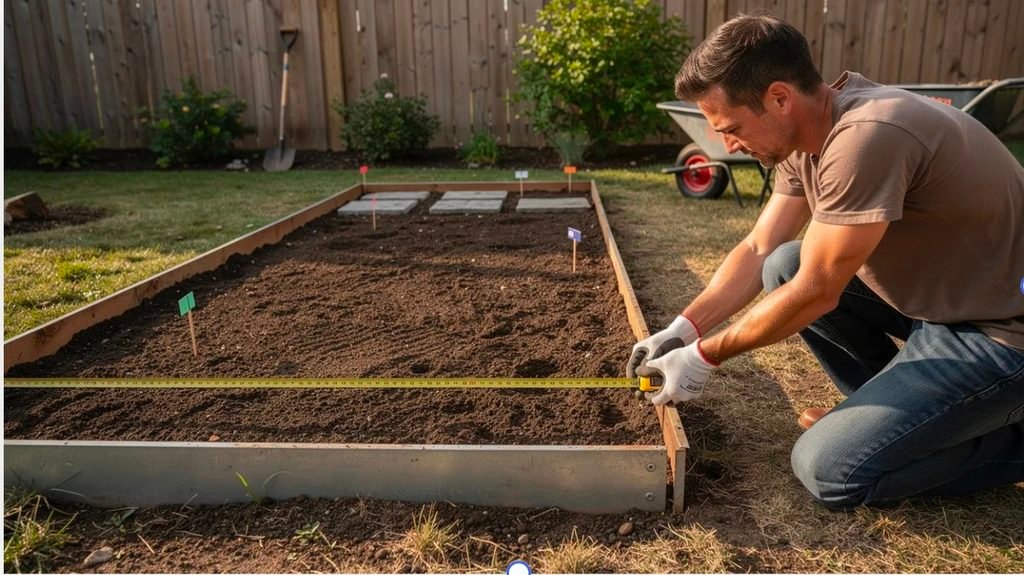
Once you know your required cubic yards and tons, the next step is choosing where to buy, scheduling delivery, and preparing your site. Getting this part right saves money and avoids damage to your property.
Where to Buy and How It Arrives
Bulk stone typically arrives one of two ways:
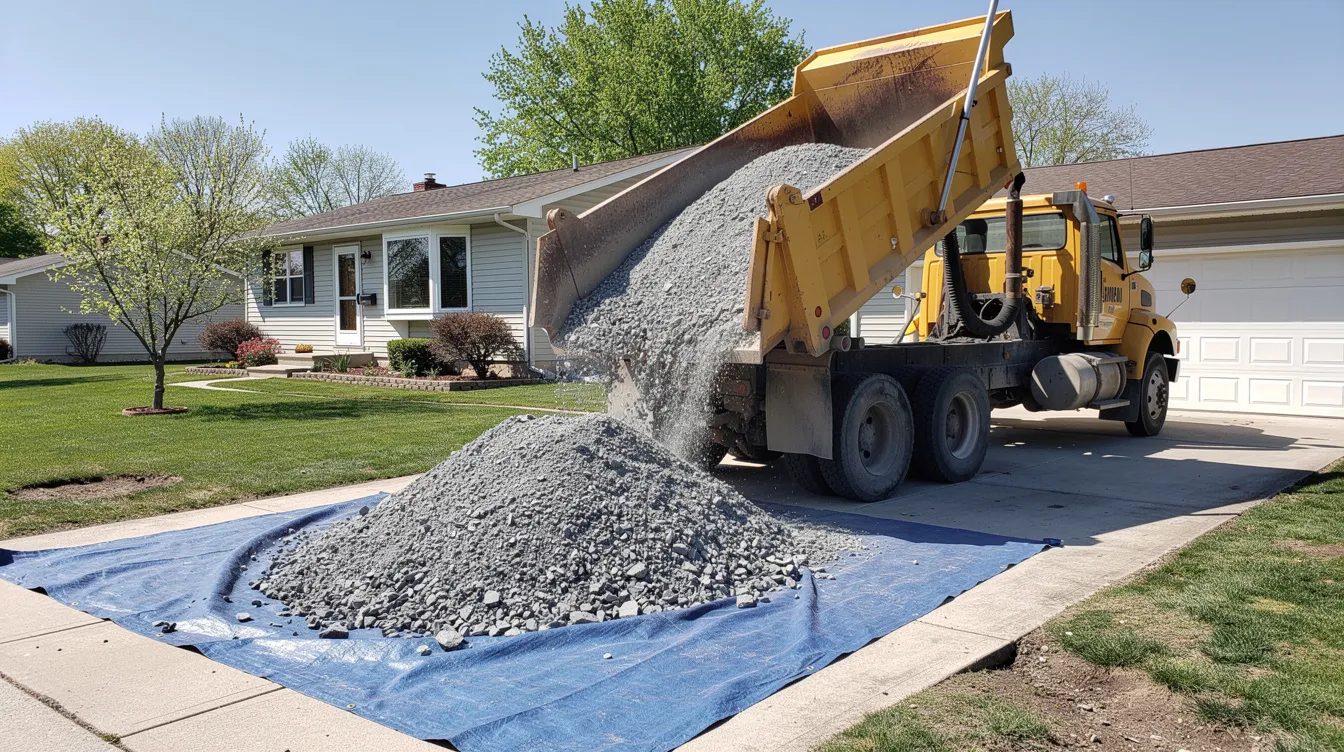
- Dump truck delivery. Most landscape supply yards offer delivery with minimum order sizes (often 1 to 3 tons or 1 to 2 cubic yards). The truck backs into your driveway and dumps the load where you direct it. Delivery fees for bulk stone vary based on distance and truck capacity.
- Pickup at the yard. Local suppliers often provide better pricing and convenience than national retailers because you skip the delivery fee. If you have a pickup truck or trailer, you can load stone directly from the stock pile. Most half-ton trucks can carry about 1 ton of stone safely; check your vehicle’s payload rating first.
Online platforms can help locate bulk landscape suppliers in your area. Search for “landscape supply near me” and compare per-ton pricing before committing. Bulk landscape suppliers allow inspection of stones before purchase, so visit the yard and view the materials in person if you can. Ordering from a single bulk pile ensures visual consistency across your entire project, which matters when color uniformity is the goal.
Site Preparation and Access
Before the truck arrives, check these details:
Driveway width and overhead clearance. Dump trucks need about 10 feet of width and clear height for the raised bed. Low-hanging branches and power lines are common obstacles.
Ground firmness. A loaded truck weighs tens of thousands of pounds. Soft lawn, wet soil, or thin asphalt can be damaged. Have the driver dump on a paved surface or place plywood sheets on grass.
Drop zone. Lay a tarp where the stone will land to protect pavement or lawn underneath. Place the pile as close to your work area as possible; every extra 50 feet of wheelbarrow distance adds real labor time when you are moving 3 tons by hand with a cart.
Pricing Factors
Several things push the cost up or down beyond the base per-ton price:
- Material type. Basic crushed stone or pea gravel runs $25 to $40 per ton. Premium decorative options like polished river rock or 3/8″ Black Raven can reach $136 per ton or more. For a breakdown of common crushed stone costs, see Gravel Driveway Cost Per Ton.
- Distance from quarry. Stone is heavy. A 20-mile haul from quarry to your home costs less than a 60-mile haul. Ask the supplier where their stone is sourced.
- Seasonal demand. Spring is peak season for landscaping. Ordering in late winter or early fall can sometimes yield better pricing and faster delivery windows.
- Quantity breaks. Many yards offer a lower per-ton rate once you order above a threshold, often 5 or 10 tons.
Installation and Usage Tips
Laying stone correctly protects your investment and keeps your garden looking clean for years:
- Weed suppression. Weed suppression is a benefit of using stone in landscaping, but stone alone is not enough. Landscape fabric can enhance the effectiveness of stone for weed suppression by blocking seeds from reaching soil. Lay fabric before spreading any decorative layer.
- Edging. Rounded stones like pea gravel and river rock will migrate into lawns without a physical border. Steel, aluminum, or plastic edging holds the line. For paver projects, see Gravel Base for Pavers for edging and base layer guidance.
- Depth and leveling. Rake stone to your target depth and check with a ruler in several spots. Stone helps retain moisture in the soil during hot months by reducing evaporation, but only if the layer is thick enough to shade the ground. Two inches is the minimum for decorative beds; less than that and you will see soil peeking through within weeks.
- Stone provides improved drainage in landscaping applications when installed over permeable fabric. Avoid placing stone over compacted clay without a drainage plan, or water will pool on the surface.
- Amendments and add-ons. If your project involves plantings alongside stone beds, keep sand or soil amendments accessible before covering the area. Once 3 tons of river rock is in place, adding soil becomes a much harder job.
A knowledgeable supplier can help you match stone kind and size to your specific home and yard conditions. Do not hesitate to ask for coverage charts or sample bags before making a large order.
Next Steps
You now have everything you need to find the right stone, measure your space, and place an order with confidence. Open the Crushed Stone Calculator, plug in your project dimensions, and compare a few decorative stone options side by side. The tool will return cubic yards, tons, and a cost estimate you can take directly to your local supplier for final pricing and scheduling. Accurate estimates save you money, and getting the quantities right the first time means you spend your weekend beautifying your yard instead of waiting for a second delivery.