Crushed Limestone At‑a‑Glance
Crushed limestone is a type of crushed stone made from sedimentary rock rich in calcium carbonate. It is widely used in construction and landscaping for driveways, drainage features, paver bases, pathways, and decorative ground cover. Different sizes-from fine screenings up to 2–3 inch stone-serve different layers and applications.
If you are planning a driveway, walkway, patio base, drainage project, or landscaping area, crushed limestone can be one of the most practical aggregate options to compare before ordering. Crushed Stone Calculator provides free online tools on our website to help you calculate how many cubic yards, tons, or bags of crushed limestone you need before calling a supplier.
- Driveways and parking areas
- Walkways and pathways
- Patio bases
- Drainage ditches and French drains
- Landscaping ground cover
What Is Crushed Limestone?
Limestone is quarried from natural deposits, then crushed and screened into standardized sizes ranging from fine screenings (3/8″ minus) to large No. 2 stone (2–4″ diameter). Crushed limestone provides structural strength due to its coarse, angular edges, and the angularity allows it to pack tightly as a foundation material. When compacted, crushed limestone interlocks tightly, creating a stable foundation.
Key properties in plain language: crushed limestone is durable and weather-resistant, with a density range of roughly 1.3–1.6 tons per cubic yard depending on size and moisture. Its color is generally grey to off-white with darker specks, which can improve appearance and curb appeal compared to plain gravel. Clean, open-graded crushed limestone can drain well, while dense grades with fines compact more tightly and are better for base layers. Some suppliers sell by the ton, while others offer the product per cubic yard or in bulk bags.
Common Crushed Limestone Sizes & Names
Limestone is sold in standardized size ranges, commonly identified by number. Choosing the right type is crucial for performance. Local names vary by region, so always confirm actual sizes with your supplier.
| Size Name | Approx. Diameter | Typical Uses |
|---|---|---|
| No. 2 Limestone | 2″–4″ | Deep base layer under driveways and roads; stabilizing soft ground; erosion control |
| No. 304 / Dense Grade | 1.5″ minus | Compactable base where depth exceeds ~5″; parking areas |
| No. 57 Limestone | ~¾”–1″ | Drainage stone for French drains, driveway middle layer, under decks |
| No. 8 Limestone | 3/8″–5/8″ | Decorative top layer for driveways, walkways |
| #9 Limestone | ~3/8″ | Leveling patios and walkways; 1 ton covers approximately 102 square feet at 2″ depth |
| DGA / Crusher Run | ~1″ minus | General-purpose base for driveways, under concrete slabs |
| Screenings / Fines | 3/8″ minus | Paver base, walkway surface, thin topcoat (recommended up to ~2″ depth) |
Most Popular Uses for Crushed Limestone
Crushed limestone is versatile and cost-effective for many residential and light commercial projects. Here are its most common uses:
Driveways: Crushed limestone acts as a foundational base layer for roads and driveways, and it acts as a premier material for road bases. A multi-layer system-No. 2 or 304 for the base, No. 57 for the middle, No. 8 for the topcoat-is recommended at 6″–12″ total depth.
Walkways and paths: Screenings or #9 limestone laid over compacted base stay in place and drain well. It serves as a leveling agent for patios and walkways.
Patios and pavers: Crusher run or screenings spread and compacted in thin lifts (2″ at a time) create a firm, level base that resists settling.
Drainage: Crushed limestone is used for drainage ditches and French drains. No. 57 or similar clean stone allows water to flow freely while crushed limestone improves drainage and prevents erosion in landscaping.
Foundations and structural bases: Crushed limestone is used as a durable base for building foundations and cellars, and it provides a stable load-bearing sub-base underneath concrete slabs. It is essential for foundational support and structural mixtures, effective for load support, and prevents foundation sinking. It is also used as an aggregate to strengthen concrete and is employed as a reliable fill material in construction. Crushed limestone provides a stable subbase that supports heavy loads without shifting, and it is commonly used in infrastructure projects like railways and bridges-including as ballast for railways to support railroad ties.
Landscaping: Crushed limestone is commonly used as ground cover in landscaping and enhances aesthetics due to its color variety. Larger pieces are used for erosion control. Installing landscape fabric underneath helps with weed control.
Soil and agriculture: Finely ground agricultural limestone (“ag lime”) is used for soil conditioning to raise soil pH. Crushed limestone helps reduce soil acidity when used as agricultural lime, and it is excellent for soil treatment due to its alkaline properties. It enhances soil for gardening and agricultural applications. Note that ag lime is a powder-like product, not standard driveway stone.
Crushed Limestone for Driveways
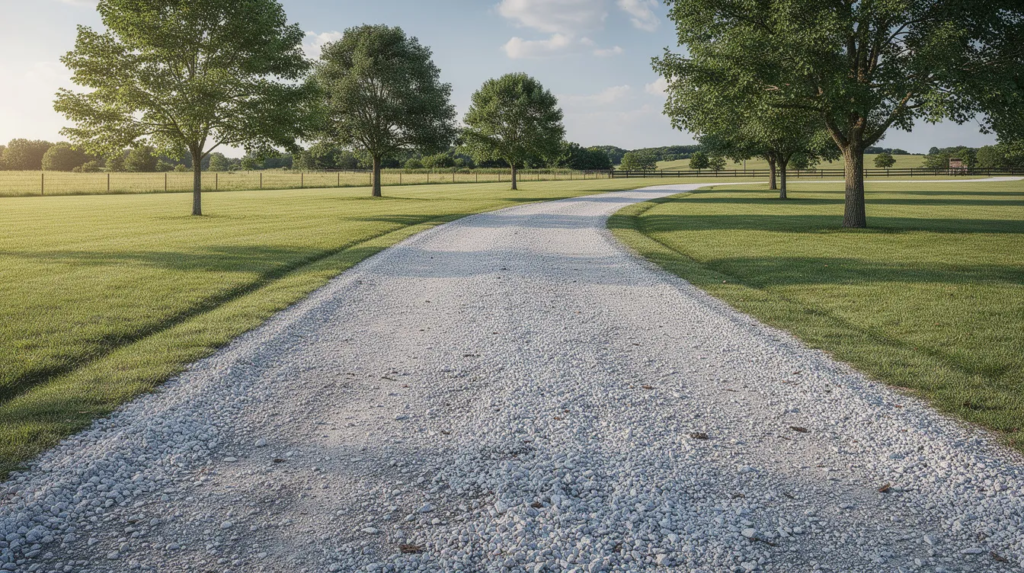
Crushed limestone is a budget-friendly alternative to asphalt driveways and is more affordable than asphalt in most regions. A typical structure uses a 4″–8″ base of No. 2 or 304, a 2″–4″ middle layer of No. 57, and a 2″ topcoat of smaller stone. New driveways are often built 8″–12″ deep overall. For choosing the best option for a long driveway, stone selection matters.
When installed with the right depth, base preparation, and slope, crushed limestone can help water move through the surface better than rigid pavement. Crushed limestone requires less maintenance than asphalt driveways-periodic raking and adding fresh topcoat every few years is the main work needed. A well-built crushed limestone driveway can improve curb appeal and make the property look more finished. In snowy climates, set plow blades above the surface to avoid digging into the stone, and cart loose stone back from the edges over time.
For a standard 2-car driveway (12 feet wide × 50 feet long), you can use the Crushed Stone Calculator as a driveway calculator to estimate cubic yards and tons.
Cost of Crushed Limestone (Per Ton, Per Yard & Per Driveway)
Prices vary by region, supplier, and stone size. These ranges are approximate. In many U.S. areas, common crushed limestone grades often fall around $30–$65 per ton for bulk orders before delivery. Decorative, specialty, or small-quantity limestone products can cost more. See our crushed stone cost guide for more information.
Since 1 cubic yard weighs about 1.3–1.6 tons, that means per-unit cost converts to roughly $40–$100 per cubic yard. Delivery fees add up: expect flat trip charges, minimum orders (often 2+ tons), and distance surcharges. Smaller bagged quantities usually cost more per ton than bulk delivery, but they can be convenient for small patching or repair work. Bulk crushed limestone can be delivered in SuperSacks for mid-size projects.
Quick example: A 1,000 sq ft drive at 8″ depth needs roughly 25 cubic yards (~35–40 tons). At $40/ton, material alone runs about $1,400–$1,600 before delivery. Use the Crushed Stone Calculator to get a tighter estimate.
How to Estimate How Much Crushed Limestone You Need
Accurate estimation avoids wasted money on over-ordering or extra delivery fees from coming up short.
- Measure length, width, and depth in feet
- Multiply to get cubic feet (length × width × depth)
- Divide by 27 to get cubic yards
- Multiply cubic yards by 1.3–1.6 to convert to tons
- Add 5%–10% waste factor for compaction and uneven ground
Worked example: 50 ft × 10 ft at 4″ (0.333 ft) depth = 166.7 cu ft ÷ 27 = 6.17 cubic yards × 1.45 = ~8.95 tons. Add 10% → ~9.85 tons needed.
You can use the Crushed Stone Calculator as a crushed limestone calculator—enter your dimensions, choose your material, add a waste factor and cost per ton, and get instant results. Final quantities may still change based on site conditions, so treat estimates as a planning tool, not a purchase contract.
Pros and Cons of Crushed Limestone
When comparing limestone vs granite gravel or other options, weigh these factors:
Advantages:
- Strong compaction and load-bearing capacity
- Excellent drainage with clean stone sizes
- Crushed limestone is cost-effective compared to other paving materials like concrete or asphalt
- Easy to install, repair, or reshape for DIYers
- Attractive natural color and appearance
- Wide availability across much of the U.S.
Limitations:
- Dust production from fines and screenings
- Stone migration and scattering require periodic raking
- More maintenance time than solid pavements
- Snow plowing requires care to avoid displacing stone
- Gaps between stones can collect leaves and debris
- HOA restrictions may limit this option in some neighborhoods
Buying, Delivery, and Ordering Tips
Crushed limestone is typically purchased from a quarry, landscape yard, or aggregate supplier in bulk by the ton or cubic yard. Contact multiple suppliers to compare price per ton, product names and sizes, minimum order requirements, and delivery fees.
Before ordering, confirm: exact stone size, whether the sand and fines are included or the stone is “clean washed,” the unit of sale, and approximate coverage per ton at your depth. Verify that delivery trucks can access your site-check driveway width, overhead clearance, and where the load can safely be dumped.
Calculate how many tons you need ahead of time so you can provide confident numbers when you call. It is generally safer to round up slightly rather than risk a short load. In fact, checking local codes, HOA rules, and drainage requirements before ordering can save you from questions and surprises down the road.