Table of Contents
If you’re planning a driveway, drainage project, or landscaping upgrade, 57 stone rock is a material you’ll encounter quickly. It’s extremely common across U.S. aggregate yards, but it’s not one universal product. Here’s what you need to know about its sizes, uses, and how to estimate the right quantity for your project.
What Is 57 Stone Rock?
57 stone rock is a coarse aggregate commonly supplied as crushed, angular stone and widely used in construction and landscaping projects across the United States. The names “57 stone,” “#57 rock,” “57 stone gravel,” and “57 crushed stone” all refer to the same gradation class – not a single branded product. 57 stone is commonly sold as roughly 3/4-inch stone, but it is actually a graded mix of sizes rather than one exact size. Nearly all of the material passes a 1-inch sieve, and the exact gradation can vary by supplier.
The “57” comes from standard size classifications defined by ASTM D448 and AASHTO M 43, which describe gradation ranges rather than a specific color or rock type. That means 57 stone can be produced from limestone, granite, trap rock, gravel, or other suitable aggregate depending on what’s locally available. Limestone is widely available across much of the Midwest and Southeast, while granite is especially common in the Carolinas and Georgia.
The size classification of 57 stone allows for various applications in construction and landscaping, from drainage to driveways to concrete production. For a deeper dive into gradation specs and regional differences, see our No. 57 Stone guide.
Keep in mind that exact size, density, and appearance vary by supplier. Crushed Stone Calculator is an educational planning resource – not a material supplier – so always confirm local specifications before ordering.
57 Stone vs. Other Crushed Stone and Gravel Sizes
57 stone is one of several standard aggregate sizes, and understanding the differences helps you pick the right material for your project.
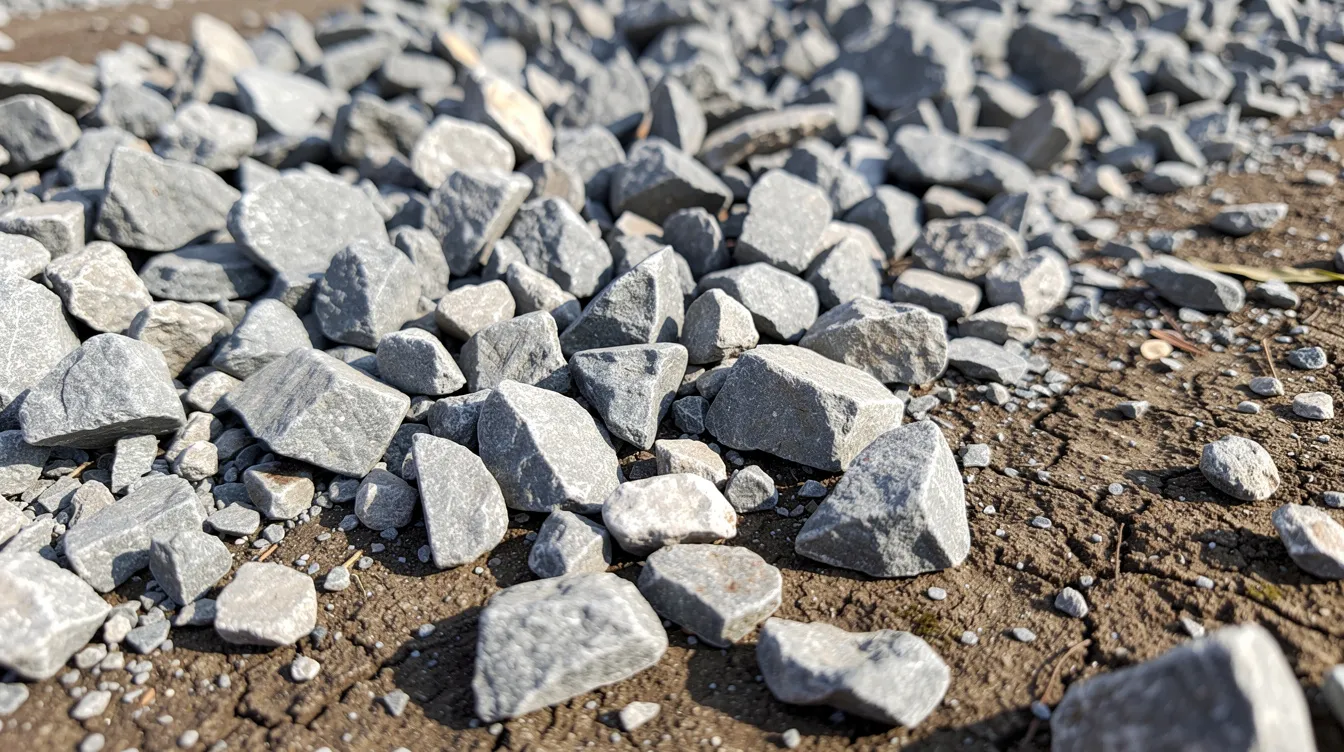
Crushed stone is manufactured by mechanically breaking larger natural rock deposits and screening the fragments into defined size ranges. Common gravels and stone sizes include #8, #57, #67, and larger base stone like #3 and #5. Each serves different types of applications. For example, #8 stone (nominally 3/8″ to No. 8) is smaller and commonly used in concrete mixes and thin top dressings. #67 stone is similar to #57 but slightly finer and may be specified for concrete, drainage, and other aggregate applications. #57 falls in a versatile middle range, frequently chosen for drainage systems, gravel driveways, and backfill.
When 57 stone is produced from crushed rock, its angular shape provides interlocking stability when confined, but it behaves very differently from crusher run or road base. Crusher run is a mixture of crushed stone and stone dust that achieves excellent compaction, locking into a dense, stable surface. Pure 57 stone has minimal fines, so it does not compact into a solid mass. That makes it less suitable for projects requiring a solid compact surface but ideal where water movement matters.
Also note that naming conventions differ regionally. Some suppliers use local terms instead of the #57 designation, so asking for a gradation chart or product photo is always worthwhile. For help comparing options, see Which Crushed Stone Size Is Best for a Long Gravel Driveway.
Material Types: Limestone 57, Granite 57, and Other 57 Rock
57 stone rock can be produced from several rock types, and the parent material can affect color, hardness, durability, bulk density, and sometimes cost.
- Limestone #57: Typically light gray to off-white, sometimes chalky when dry. It’s very common in states like Florida, Tennessee, Indiana, and Texas. Limestone is softer than granite and often costs less where it is locally available, while granite is generally harder and more resistant to wear under heavy traffic.
- Granite #57: Usually darker gray with visible speckles, harder, and more resistant to weathering. In parts of the Carolinas and Georgia, 57 stone is commonly produced from granite; whether it is clean or washed depends on the supplier’s processing and specification. It’s known for its durability and resistance to weathering, making it a popular choice for exposed surfaces.
- Other materials: In some metro markets, 57 rock is made from crushed gravel, traprock, or recycled concrete. Recycled options may have more color variation and require careful screening to meet gradation specs.
Washed 57 stone has most fines removed, creating better drainage characteristics. Unwashed or partially washed products may contain small amounts of dust, which can reduce drainage performance.
Ask your supplier which rock type they stock as “57 stone,” whether it’s washed, and request sample photos – especially if the stone will be a visible surface layer. For a detailed comparison, check out Limestone vs Granite Gravel: Cost, Strength & Best Uses.
Common Uses for 57 Stone Rock
The No. 57 gradation and, when crushed, its angular shape make it one of the most widely used aggregates for residential and commercial projects. Here are its common uses:
Drainage: 57 stone features minimal fines, which facilitate drainage, making it commonly used for drainage applications including French drains, trench drains, foundation drain tile, retaining wall backfill, and septic drain field construction. Local codes control exact specs for septic and wall backfill work, so check before ordering.
Driveways and parking: It provides a durable surface for gravel driveways when installed over a compacted base. It’s also used as a base layer for some driveways, walkways, and parking pads, especially where water needs to drain through the base; conventional compacted bases more often use crusher run or another compactable road-base material. However, it stays somewhat loose compared to crusher run, so it works best on flat to gently sloped areas.
Bedding and backfill: 57 stone is commonly used around perforated drain pipe and as bedding or backfill for some utility lines and culverts. 57 stone works well for drainage around structures, but exposed slopes or areas with fast-moving water often need larger stone or riprap for erosion control.
Concrete and construction: It is frequently used in concrete production as coarse aggregate in many concrete mixes, and as a stabilizing layer under slabs when paired with a compacted base layer.
Landscaping: 57 stone is often used in landscaping for pathways and decorative applications, including garden beds, areas under decks, and along walkways where a clean angular stone is desired for both function and appearance. It’s a solid option for decorative landscaping where you want to improve drainage simultaneously.
Common uses vary by local practice, so confirm that 57 stone meets your project specification before proceeding.
57 Stone Rock for Drainage and French Drains
Clean, free-draining 57 stone is a frequent choice for DIY drainage projects – and for good reason. The individual stones create interconnected voids that allow water to drain naturally, while clean stone and a filter system appropriate to the surrounding soil help limit soil migration into those voids. Washed 57 stone is especially preferred because removing fines improves water movement through the stone envelope.
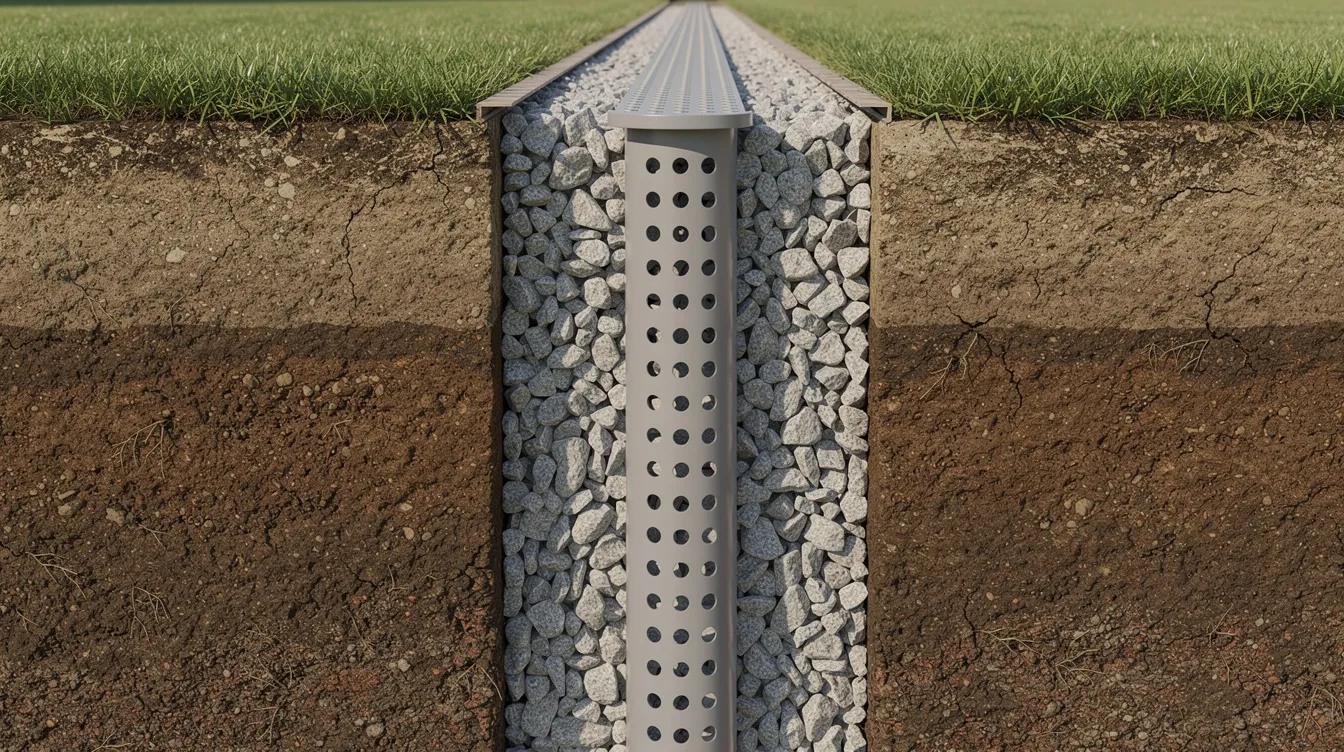
A typical residential French drain consists of a sloped trench lined with geotextile fabric, with a perforated pipe surrounded by clean drainage stone such as 57 stone, and the fabric wrapped over the gravel before backfilling with soil or a top covering. Depth, width, and slope depend on your specific drainage need and soil conditions.
57 stone is also commonly used around foundation drains and behind retaining walls to help drain water and reduce hydrostatic pressure buildup. It’s well suited for French drains and can be used in septic drain field construction where local codes permit.
That said, 57 rock is not a cure-all for flooding. Soil type (especially clay), slope, outlet location, and local rainfall all affect performance. For serious water problems, professional design is recommended. Always confirm with your local inspector whether washed 57 stone rock meets code requirements for your drainage project.
The Gravel Calculator at CrushedStoneCalculator.com can estimate how many cubic yards or tons of 57 stone to plan for a French drain trench based on its length, width, and depth. Because the drain pipe also takes up some space in the trench, treat the result as a practical ordering estimate rather than an exact stone volume.
Driveways, Bases, and Compaction: 57 Stone vs. Crusher Run
57 stone can play a useful role in driveways and parking pads, but it behaves very differently from crusher run or road base material.
Pure 57 stone rock contains little to no fines, so it does not lock together into a dense, smooth surface. Crusher run – a mixture of angular stone and stone dust – achieves excellent compaction and creates a stable, tightly bound base suitable for road construction and heavy traffic. By contrast, 57 stone remains open-graded and textured even after it is seated or compacted.
A common driveway build-up uses a compacted base of crusher run or similar dense-grade aggregate for stability, topped with a thinner layer of 57 stone for drainage and appearance. This approach gives you a compacted supporting base and a coarse, free-draining surface, but the driveway still needs proper grading and a clear path for water to drain away.
Pros of crushed 57 stone on driveways include good drainage, angular stones that interlock somewhat when confined, and a durable surface in flat to gently sloped areas. Limitations include potential raveling on steep slopes, movement under snow plows, and noise underfoot. On high-traffic or commercial projects, an engineer should recommend appropriate base layers.
For more on building a proper gravel driveway, see the Gravel Driveway Installation Guide. And for help comparing crusher run and other base materials, check out The Benefits of Using 22A Gravel.
How Much 57 Stone Rock Do You Need? (Cubic Yards, Tons, and Coverage)
Accurately estimating quantity avoids shortfalls, extra delivery fees, and leftover material sitting in your yard.
Basic volume method: Measure your project’s length, width, and planned depth in feet. Multiply all three for cubic feet, then divide by 27 to convert to cubic yards. For weight, 57 stone is often estimated around 1.3 to 1.5 tons per cubic yard depending on rock type and moisture – actual weights come from your supplier’s scale ticket.
Coverage rules of thumb:
- One ton of 57 stone typically covers about 100–120 square feet at 2 inches deep.
- 57 stone typically covers about 20 cubic feet per ton
- 1 ton of 57 stone equals approximately 0.74 cubic yards
- Coverage varies based on placement depth and stone gradation – deeper applications reduce area covered proportionally
Waste factor: Add 10% extra for waste or placement variation when calculating. French drain trenches may need a little extra stone if the actual excavation ends up wider or more irregular than the planned dimensions.
The free Crushed Stone Calculator at CrushedStoneCalculator.com converts your project dimensions into estimated cubic yards, tons, and optional rough cost so you have supplier-ready numbers. For current pricing ranges, see Crushed Stone Cost Per Ton 2026.
All calculator results are planning-level estimates only. Verify final quantity, density, and pricing with your local aggregate yard before placing an order.