Table of Contents
Planning a driveway, patio base, or drainage project? Knowing how much a yard of gravel weighs helps you order the right amount, avoid overloading trucks, and keep your project on budget. This guide covers planning-level weights for common gravel types, explains what shifts those numbers, and shows you how to convert cubic yards to tons for your specific job.
Quick Answer: How Much Does a Yard of Gravel Weigh?
One cubic yard of gravel weighs about 2,400–3,200 lbs as a general planning range, or roughly 1.2–1.6 U.S. tons. A “yard of gravel” means 1 cubic yard – a volume measurement equal to 3 ft × 3 ft × 3 ft, or 27 cubic feet. It is not a weight measurement, which is why the final weight depends on what type of material fills that volume.
Gravel typically weighs 1.4 to 1.5 tons per cubic yard for most crushed stone products. Here are typical planning ranges for dry, loosely placed material:
- Crushed stone / #57 stone / crusher run: Crushed gravel typically weighs 2,800–3,000 lbs per cubic yard (1.4–1.5 tons)
- Pea gravel / rounded river gravel: About 2,500–2,800 lbs per cubic yard (1.25–1.4 tons)
- Limestone gravel and crushed granite: About 2,700–3,200 lbs per cubic yard (1.35–1.6 tons)
The exact weight depends on rock type, moisture content, gradation, and compaction. The sections below explain each variable and show how to convert cubic yards to tons for a real project.
What Is a Cubic Yard of Gravel?
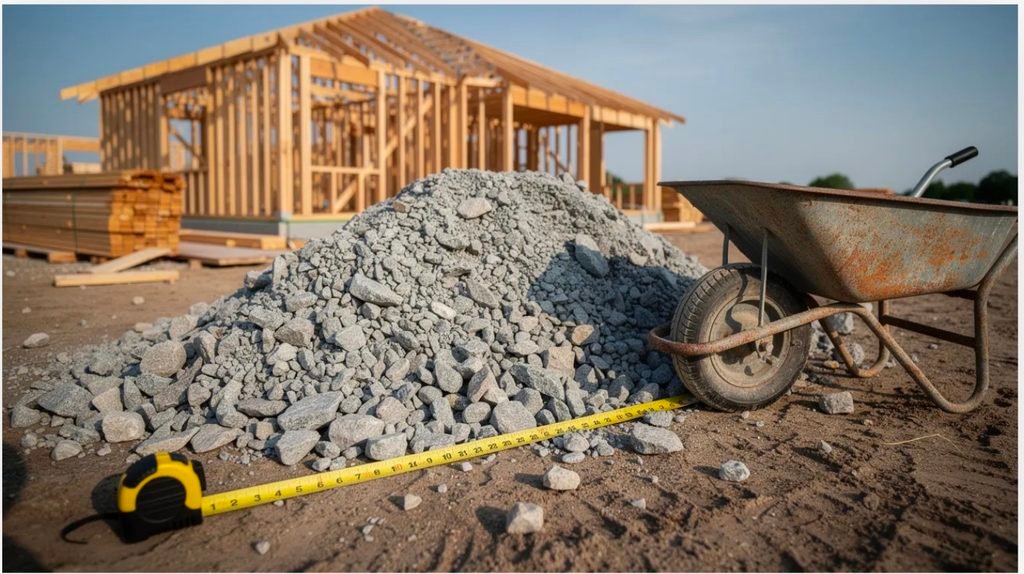
A cubic yard is a cube measuring 3 feet on each side – 27 cubic feet of volume. Gravel suppliers quote bulk orders by the cubic yard and often price by the ton for delivery.
- Volume units: cubic feet, cubic yards
- Weight units: pounds (lbs), U.S. tons (1 ton = 2,000 lbs)
- Coverage example: A cubic yard of gravel covers about 100 square feet at 3 inches deep – useful for quick area estimates
- Depth guidelines: Use 2 to 3 inches of gravel for walkways and 4 to 6 inches for driveways
- Solid rock vs. bulk gravel: Solid stone has no air gaps and weighs far more per cubic yard than loose aggregate, which has voids between particles
To calculate gravel volume, measure your area in feet and depth in inches. For example, a driveway 20 ft long × 10 ft wide × 4 inches deep works out to about 2.5 cubic yards. Our gravel calculator takes length, width, and depth and converts directly to cubic yards and tons.
Gravel Weight per Cubic Yard: Planning Ranges and Table
Most homeowners and landscapers need planning numbers for ordering and hauling, not lab-precision density values. The weight per cubic yard varies depending on the type and size of stone. Below are approximate ranges for dry material in a loose state.
| Material Type | Approx. lbs per Cubic Yard | Approx. Tons per Cubic Yard |
|---|---|---|
| Crushed stone / #57 stone | 2,800–3,000 | 1.4–1.5 |
| Crusher run (with fines) | 2,900–3,200 | 1.45–1.6 |
| Pea gravel | 2,500–2,700 | 1.25–1.35 |
| River rock (1–2 in.) | 2,600–2,900 | 1.3–1.45 |
| Crushed limestone | 2,800–3,200 | 1.4–1.6 |
| Crushed granite | 2,700–3,200 | 1.35–1.6 |
| Stone dust / screenings | 2,600–3,000 | 1.3–1.5 |
| Fill dirt (comparison) | 2,000–2,400 | 1.0–1.2 |
These are planning-level ranges. Your local supplier may quote slightly different values based on their quarry source and how they measure. Crushed limestone can weigh 2,800–3,200 lbs per cubic yard depending on porosity, while pea gravel typically weighs 2,500–2,700 lbs per cubic yard because of its rounded shape. If your supplier gives you a specific tons-per-cubic-yard figure, plug that into the Crushed Stone Calculator for a tighter estimate. California DOT maintenance tables list similar ranges for common aggregates.
What Affects How Much a Yard of Gravel Weighs?
The exact weight of a cubic yard is not a single fixed number. Several physical factors push it up or down:
- Rock type: Crushed stone and limestone are denser than river rock or pea gravel. Sandstone-based gravel can be 10–15% lighter than granite.
- Particle size and gradation: Smaller stone sizes with rock dust pack tighter and weigh more per cubic yard than large, uniform stones with more air gaps.
- Amount of fines: Crusher run includes fine material that fills voids. Clean stone like #57 typically has very few fines compared with crusher run, so it generally packs differently.
- Moisture content: Wet gravel adds water weight to every void between particles.
- Compaction level: Compacted base material has fewer air gaps – and more stone per cubic yard – than a loose pile.
Because these variables stack, two cubic yards of “gravel” from different quarries or weather conditions can differ by several hundred pounds per yard.
How Gravel Type and Size Change Weight per Cubic Yard
Gravel types include crushed stone, pea gravel, and decorative stone – and each behaves differently in a pile. Crushed stone and crushed granite are angular with tighter packing, while rounded small stones like pea gravel and river rock leave more air gaps and weigh less per yard.
- #57 stone (≈3/4 in.): Common for driveway surfaces and drainage applications, around 2,800–3,000 lbs per cubic yard
- Crusher run / dense-grade aggregate: Fines fill voids, pushing weight to 2,900–3,200+ lbs per cubic yard
- Pea gravel (3/8 in.): Lighter material popular for walkways and garden paths, about 2,500–2,700 lbs per yard
- River rock / decorative gravel: Rounded shape with more voids; similar range to pea gravel depending on aggregate size
- Limestone vs. granite: Both are dense. Hard limestone and granite often land at the upper end near 2,800–3,200 lbs per yard.
- Stone dust / screenings: Very fine particles that pack tightly, generally toward the heavier end of typical crushed stone ranges
If you switch from #57 stone at 1.4 tons per cubic yard to a fine crusher run at 1.6 tons per cubic yard on a large driveway project, that difference can mean one extra truckload.
Moisture Content and Compaction: Dry vs Wet, Loose vs Compacted
Water weighs about 8.3 lbs per gallon, and the voids between gravel particles can hold a surprising amount of it. Moisture and compaction significantly influence the weight of gravel.
- Dry material sits at the low end of the planning ranges listed above
- Damp or saturated gravel can weigh 5–20% more per cubic yard than dry baseline. Wet gravel can weigh up to 3,375 pounds per cubic yard in heavily saturated conditions
- Loose gravel has maximum voids. A compacted base layer can weigh several hundred pounds more per cubic yard than the same dry material dumped loosely
- Numeric example: If dry #57 stone is about 2,800 lbs per cubic yard, the same stone damp and compacted could be closer to 3,000–3,100 lbs per yard
Moisture content affects the weight of gravel enough that a delivery on a rainy day may come in noticeably heavier than one on a dry day. Most suppliers quote an average that assumes some typical moisture, but conditions on delivery day can shift the real weight.
Converting Cubic Yards of Gravel to Tons (With Examples)
Here is the simple formula:
Tons = (Cubic Yards × Pounds per Cubic Yard) ÷ 2,000
As a general rule, most crushed gravel weighs about 1.4 to 1.5 tons per cubic yard. Pea gravel is often closer to 1.25–1.35 tons per cubic yard. One ton equals 2,000 pounds.
Worked examples:
- 5 cubic yards of crushed stone at 3,000 lbs/yd³ → 5 × 3,000 = 15,000 lbs ÷ 2,000 = 7.5 tons
- 3 cubic yards of pea gravel at 2,600 lbs/yd³ → 3 × 2,600 = 7,800 lbs ÷ 2,000 = 3.9 tons
- 10 × 20 ft driveway at 4 inches deep: A 10 × 20 foot driveway at 4 inches deep requires about 2.47 cubic yards before any order allowance. At 1.45 tons per cubic yard, that is about 3.58 tons.
When you are ordering multiple yards – say 8–10 cubic yards – small differences in density multiply into hundreds of extra pounds, affecting delivery cost and truckload count. Our tools handle these conversions instantly once you enter your measurements. For a deeper breakdown, see Cubic Yards vs. Tons for Gravel.
Ordering, Hauling, and Truckload Considerations
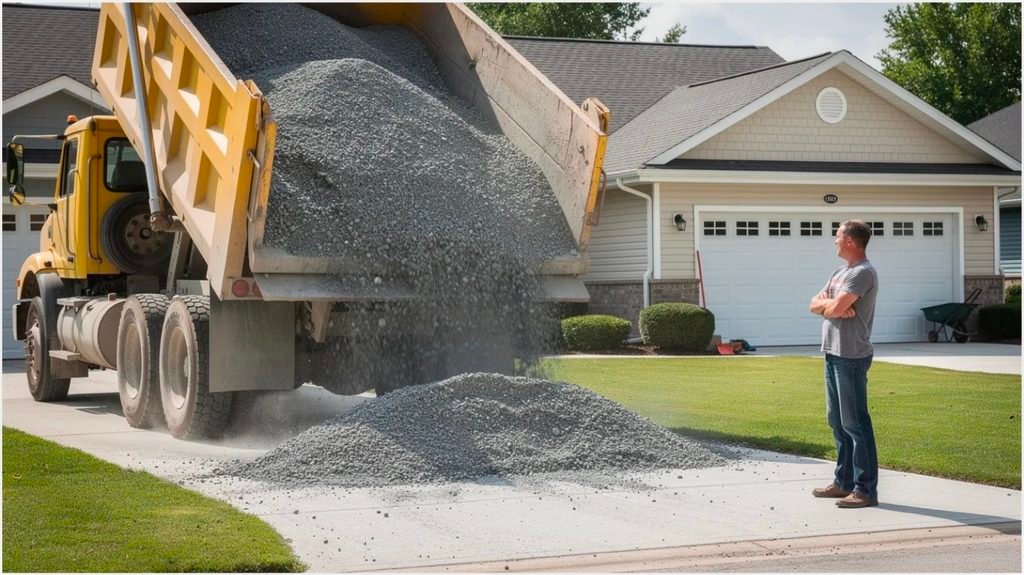
Knowing the weight helps you plan the number of trucks, protect your driveway surface, and avoid overloading.
- Dump trucks commonly carry about 8–12 cubic yards of gravel per load. At roughly 1.4–1.5 tons per cubic yard, that works out to about 11–18 tons of gravel, although actual legal load depends on the truck configuration, axle limits, route, and local regulations.
- Pickup trucks are often rated around 1,500–2,000 lbs of payload, although actual capacity varies by vehicle and configuration — often less than one full cubic yard of heavy gravel.
- Heavier materials like crusher run or wet crushed limestone require fewer cubic yards per load than lighter pea gravel or fill dirt to stay under road limits
- Site access: Asphalt or paver driveways can be damaged by heavy trucks if the base is thin. Narrow or steep access may force smaller loads and more trips
Before ordering, ask your supplier:
- What weight limit they use per truck (in tons)
- Their assumed weight per cubic yard for the specific material
- Whether delivery fees change beyond a certain mile radius
How to Get a Project-Specific Gravel Weight and Quantity Estimate
The fastest way to estimate for a specific job is to combine accurate dimensions, a reasonable density, and a small waste factor for spillage and settling.
- Measure your area – length and width in feet, depth in inches
- Choose your material – crushed stone, pea gravel, crusher run, river rock, or crushed granite – and target depth
- Calculate – let the tool convert to cubic yards, tons, and estimated cost, then add an appropriate order allowance for measurement uncertainty, irregular edges, spillage, or minor material loss. Do not treat the allowance as a structural compaction factor.
If your supplier provides a specific tons-per-cubic-yard value, plug that in for more precise planning. For critical structural projects like paver bases or engineered road base, confirm densities with your contractor or engineer.
FAQs About How Much a Yard of Gravel Weighs
How much does 1 cubic yard of gravel weigh in pounds and tons? Most gravel falls in the 2,400–3,000 lb range per cubic yard, or about 1.2–1.5 tons. The exact weight depends on rock type, moisture, and how loosely the material is placed.
Is a yard of pea gravel lighter than a yard of crushed stone? Yes. Pea gravel is rounded with more air gaps and fewer fines, so it generally weighs less – roughly 2,500–2,700 lbs per cubic yard versus 2,800–3,000+ for angular crushed stone.
How many tons is 10 cubic yards of gravel? At 1.4–1.5 tons per cubic yard, 10 cubic yards would weigh about 14–15 tons. Confirm with your supplier’s density figure for the specific material you are ordering.
Does wet gravel really weigh more? Yes. Moisture fills voids between particles. Depending on saturation, wet gravel can be 5–20% heavier than the same dry material.
Can my pickup truck haul a yard of gravel? Often not safely. A full yard of heavy gravel can exceed 2,800 lbs, while many light-duty pickups have payload ratings around 1,500–2,000 lbs, depending on the vehicle and configuration. Check your truck’s actual payload rating before loading; a partial-yard or bagged load may be more appropriate.
Is crushed granite heavier than limestone gravel? They are often similar – both land in the upper part of typical ranges (2,700–3,200 lbs per cubic yard). Local rock hardness and fine content usually matter more than the label alone.
Is weight per cubic yard the same for all suppliers? No. Different types of rock, gradation, and moisture levels at the quarry all cause variation. Always ask your supplier for their standard tons-per-yard figure, then use our Crushed Stone Calculator to determine how many tons and truckloads your project needs. That way you can spread your budget across the right number of deliveries and avoid ordering too little – or paying for material you do not need.