This gravel driveway installation guide covers the whole job: layout, excavation, the three stone layers, compaction, drainage, quantities and cost. In short, a typical residential gravel driveway is built in three compacted layers, roughly 8 to 13 inches deep in total: coarse base stone, a middle layer of #57 stone, and a 2- to 3-inch surface layer, shaped with a crown so water runs off the sides.
Most failures, such as ruts, potholes and washouts, come from a soft subgrade, layers that were never compacted, or water with nowhere to go. Get those three right and the driveway will need little more than occasional top-ups. When you know the size, our Crushed Stone Calculator works out the cubic yards and tons for each layer.
Table of Contents
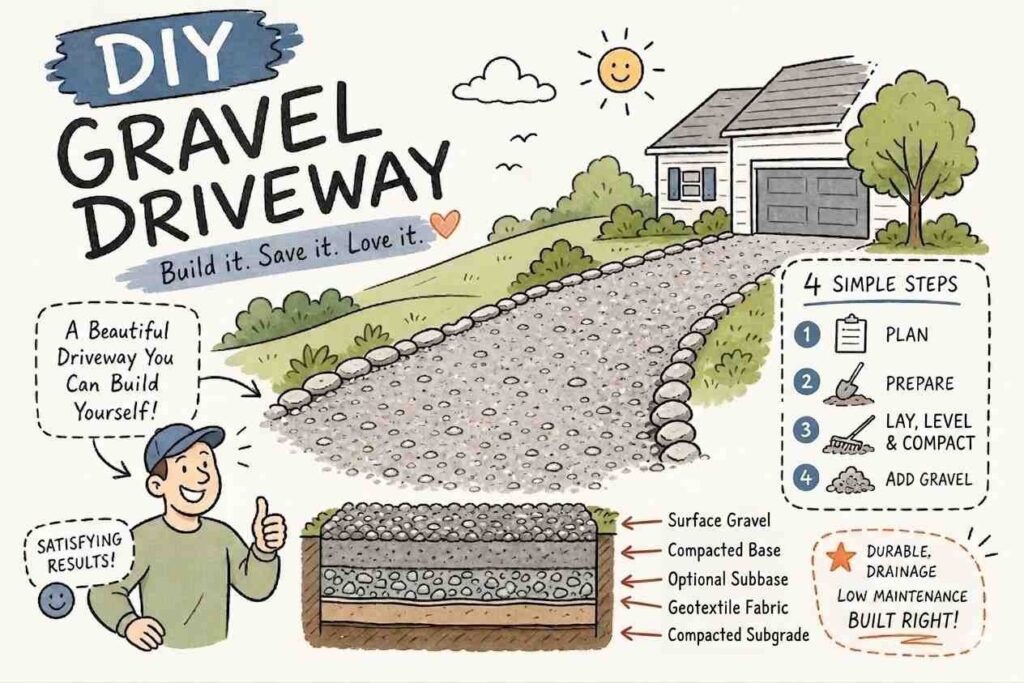
Gravel Driveway Installation Guide: Layers and Depth at a Glance
Stone Center, an Ohio stone supplier, describes this common three-layer build and puts the total at 8 to 12 inches; its layer ranges add up to 9 to 13 inches. The stone choices for each layer are common options, so pick what your local yard stocks.
| Layer | Typical Stone | Thickness | What It Does |
|---|---|---|---|
| Surface (top) | Decorative gravel, ¾-inch crushed stone or crusher run | 2–3 in | The driving surface |
| Middle | #57 crushed stone (about ¾ inch) | 3–4 in | Fills and locks the base, gives an even bed |
| Base (bottom) | Coarse crushed stone such as #3 | 4–6 in | Carries the load and drains water |
| Geotextile fabric | Woven or non-woven fabric | — | Keeps soil and stone apart on soft ground |
| Subgrade | Native soil, compacted | — | Firm, shaped support for everything above |

For sizes of coarse stone such as #3, see our guide to number 2 and number 3 stone. For the middle layer, our #57 stone guide explains the size and why it drains well.
How Deep Should a Gravel Driveway Be?
The right depth depends on your soil, your vehicles and your climate. These are common starting points:
| Situation | Total Depth | Source |
|---|---|---|
| Light use on firm soil (minimum) | 5–6 in, built in layers | HomeGuide |
| Typical three-layer residential driveway | 8–12 in (layer ranges add to 9–13 in) | Stone Center |
| Trucks, RVs or other heavy vehicles | At least 8–12 in | HomeGuide |
On soft clay, wet ground or in areas with hard freezes, plan toward the deep end, use geotextile fabric and ask a local contractor or supplier what works on your soil. Dig deep enough that the finished surface sits where you want it. Excavation depth is the total layer thickness plus any height you need above or below the surrounding ground.
Choosing Stone for Each Layer
Base Layer
The base uses large, angular crushed stone such as #3. The big stones carry weight and leave space for water to drain. Some regions use a dense-graded base instead, such as Michigan’s 22A gravel or Minnesota’s Class 5 gravel, which packs very tight because its fines fill the gaps.
Middle Layer
#57 stone, about ¾ inch, fills the gaps on top of the base and gives the surface layer an even bed. Stone Center places 3 to 4 inches of it over the compacted base.
Surface Layer
The top 2 to 3 inches is what you drive on. Angular stone locks together better than rounded stone. ¾-inch crushed stone drains well and stays clean. Crusher run, which mixes stone with fine dust, packs into a firmer surface but can be dusty. Rounded pea gravel and river rock roll under tires and move around, so they are poor choices for a working driveway. Our guide to the best gravel for driveways compares the options in more detail.
How to Install a Gravel Driveway: Step by Step
- Plan the layout and drainage. Mark the length, width and curves with stakes, string and paint. A single-lane driveway is usually 10 to 12 feet wide. Walk the site after rain to see where water flows and pools.
- Check permits and call 811. Ask your city or county about permits, especially if you connect to a public road or add a culvert. Angi puts permit costs at about $50 to $300. Call 811 so underground utilities are marked before you dig.
- Remove sod, topsoil and soft spots. Organic material rots and settles, so dig down to firm mineral soil and replace soft pockets.
- Grade and compact the subgrade. Shape the crown and slopes in the soil itself, not only in the stone, then compact it until it is firm.
- Lay geotextile fabric if the soil is soft. Overlap the seams so stone cannot push into the soil below.
- Spread and compact the base layer. Place it in thin lifts and compact each one before adding the next.
- Add and compact the middle layer. Keep the thickness even across the width.
- Spread the surface layer and shape the crown. Rake it to the final shape, compact it, and check the slope toward the edges.
- Finish the edges and drainage. Support the edges and make sure ditches, swales or culverts carry water away.
Compaction Tips
Compact every layer, not just the top. A plate compactor works for most residential driveways, and larger jobs may use a vibratory roller. Thick layers don’t compact evenly from the top, so spread the stone in thin lifts. Unilock’s paver installation guide, for example, compacts gravel base with a plate compactor in 2- to 3-inch layers. Keep compacting until the stone no longer moves under the machine. Hand tamping is fine for small patches but not for a whole driveway.
Drainage: Crown, Slope and Ditches
Water is the main reason gravel driveways fail. The Center for Dirt and Gravel Road Studies at Penn State recommends a cross slope of 4% to 6% for gravel roads, which is ½ to ¾ inch of fall per foot of width. On a 12-foot driveway with the crown in the middle, the edges sit about 3 to 4½ inches lower than the center. A flatter surface holds water in puddles that turn into potholes.
Also slope the driveway away from buildings. Where water runs along the driveway, a shallow swale or ditch along the edge carries it away. Where a ditch or stream crosses the driveway, a culvert lets water pass under it; stream crossings usually need a permit. For wet spots that surface drainage can’t fix, a French drain can help, and our guide to French drain gravel covers the stone to use. On steep driveways, broad-based dips or water bars set across the surface turn water off before it builds speed and washes out the stone.
How Much Gravel to Order for Each Layer
Work out each layer separately:
Cubic yards = length (ft) × width (ft) × depth (in) ÷ 12 ÷ 27
Add about a 10% order allowance for spreading loss and uneven ground, then multiply by the stone’s weight per cubic yard to get tons. The allowance is not a compaction factor. See our guide to the waste factor for stone projects for when to use more. A cubic yard of crushed stone typically weighs about 1.3 to 1.55 US tons, depending on the stone; our guide to how much a yard of gravel weighs lists common materials.
Example: a 100 × 12 ft driveway with 4 inches of #3 base, 4 inches of #57 and 2 inches of crusher run on top:
| Layer | Depth | Cubic Yards | With 10% Allowance | Tons |
|---|---|---|---|---|
| #3 base (1.30 t/yd³) | 4 in | 14.8 | 16.3 | About 21.2 |
| #57 middle (1.40 t/yd³) | 4 in | 14.8 | 16.3 | About 22.8 |
| Crusher run top (1.50 t/yd³) | 2 in | 7.4 | 8.1 | About 12.2 |
| Total | 10 in | 37.0 | 40.7 | About 56 tons |
Your supplier’s weights may differ by about 10%, so confirm before you order. The gravel calculator handles multiple areas if your driveway has a parking pad or turnaround.
Gravel Driveway Cost
Costs depend on size, stone, site prep and delivery distance. Two national guides give these ranges:
- Angi (updated July 2026): about $1,800 on average, with most projects between $500 and $3,500. Grading or excavation by a specialist costs about $1,000 to $2,500 for a driveway. A DIY job runs about $800 to $2,500 for materials and equipment.
- HomeGuide (December 2025): $4 to $10 per square foot installed, or about $2,000 to $5,000 for a 500 sq ft driveway and $4,000 to $10,000 for 1,000 sq ft. Grading adds $1 to $3 per square foot. Delivered stone runs about $30 to $60 per ton for crushed stone and $25 to $50 per ton for crusher run.
The two guides differ a lot, partly because HomeGuide’s per-foot figure includes full installation. Prices vary by region, material, quantity and delivery distance, so get at least two local quotes that list stone, delivery, grading and compaction separately.
Stabilization Grids and Maintenance
On slopes, turnarounds and entrances where tires scuff the stone, plastic honeycomb grids filled with gravel hold the stone in place. They go on a compacted base like a normal driveway and cost more up front.
Every gravel driveway needs some upkeep. Rake or grade ruts and potholes before adding new stone, so you don’t bury the problem. Top up thin areas every few years, and check the crown and ditches each spring after freeze-thaw. Most problems come from three causes: ruts from a base that was never compacted, edges that spread because nothing holds them, and washouts from poor drainage.
Gravel Driveway FAQ
How deep should a gravel driveway base be?
For a typical three-layer driveway, the base layer is 4 to 6 inches of coarse stone, and all layers together are roughly 8 to 13 inches. HomeGuide puts the minimum for light use at 5 to 6 inches total, and at least 8 to 12 inches for heavy vehicles.
What are the layers of a gravel driveway?
From the bottom up: compacted subgrade, geotextile fabric on soft soil, a base of coarse crushed stone such as #3, a middle layer of #57 stone, and a 2- to 3-inch surface of ¾-inch crushed stone, crusher run or decorative gravel.
Build It Once, Build It Right
This gravel driveway installation guide comes down to a few rules: dig out soft and organic soil, build three compacted layers, crown the surface, and give water somewhere to go. Work out the stone for each layer before you call a supplier, and order the full amount at once so you aren’t waiting on a second delivery.
Last reviewed: October 2026
Pingback: French Drain Gravel: Right Type, Size & How Much to Order
Pingback: Gravel base for pavers: materials, depth, and installation
Pingback: Which Crushed Stone Size Is Best for a Long Gravel Driveway
Pingback: Understanding Class Five Gravel: The Best Choice for Your Project
Pingback: The Benefits of Using 22A Gravel for Your Landscaping Projects
Pingback: Pea Gravel Prices in 2026: Per Ton, Per Yard & Installed
Pingback: How to Fix Gravel Driveway Potholes That Keep Coming Back