Table of Contents
Gravel yards sell gravel in bulk, and buying from a local yard saves 50% or more compared to bagged material at big-box stores. The catch: you need to know how many tons or cubic yards your project requires before you show up or call for a quote. This guide walks through every step of that process, from measuring square feet and choosing the right gravel to comparing costs and scheduling delivery.
What Is a Gravel Yard and How Our Calculator Helps
A gravel yard (sometimes called a landscape supply yard or quarry retail outlet) sells crushed stone, pea gravel, river rock, and other aggregate in bulk. Depending on the supplier, pricing is listed per ton (weighed on a truck scale) or per cubic yard (measured by loader bucket).
Crushed Stone Calculator is a free online tool that sits between your project sketch and a real supplier quote. Enter your project’s length, width, and depth; the calculator outputs cubic feet, cubic yards, tons, and an estimated material cost. No manual math, no guesswork on gravel cover.
Typical US projects that send homeowners to gravel yards include:
- Resurfacing or building a driveway
- Laying walkways and paths through gardens
- Installing a French drain alongside a foundation
- Building RV pads or parking areas
- Filling decorative beds and borders around homes
This article focuses on bulk purchases from gravel yards, not $5 bags from a hardware store. The gravel calculator bridges the gap between a rough measurement and a supplier conversation grounded in real numbers.
Common Gravel Types You’ll See at a Gravel Yard
Gravel types differ by shape, size, and functionality in construction and landscaping. Bins at a typical yard are labeled by product name and particle size. Gravel and crushed stone are categorized by particle size and shape, and each category serves a different set of projects.
Crushed stone is angular stone produced by mechanically breaking rock. Common sizes include #57 (about 3/4 inch, clean) and 3/4-inch minus (stone mixed with fines, often sold as crusher run or road base). It compacts well for driveways, patio bases, and structural layers because the angular fragments interlock under pressure.
A cubic yard of crushed stone weighs about 1.4 tons loose and dry (roughly 1.3 to 1.55 tons depending on the stone). Angular gravel types compact well and resist movement under heavy load, which is why crushed stone is the preferred choice for stable driveways. Properly graded concrete aggregate also supports strength and mix performance in construction applications. At the yard, crushed stone looks sharp-edged and grey or tan depending on parent rock.
Pea gravel consists of small, rounded stones roughly 3/8-inch in diameter. It stays loose, drains well, and feels comfortable underfoot, making it a go-to for play areas, dog runs, fire pit zones, and garden paths. Density averages around 1.3 tons per cubic yard. One ton of pea gravel covers approximately 125 sq ft at 2 inches deep. Pea gravel needs firm edging to prevent migration because the round particles shift freely. At the yard, it looks like small, smooth, multicolored pebbles.
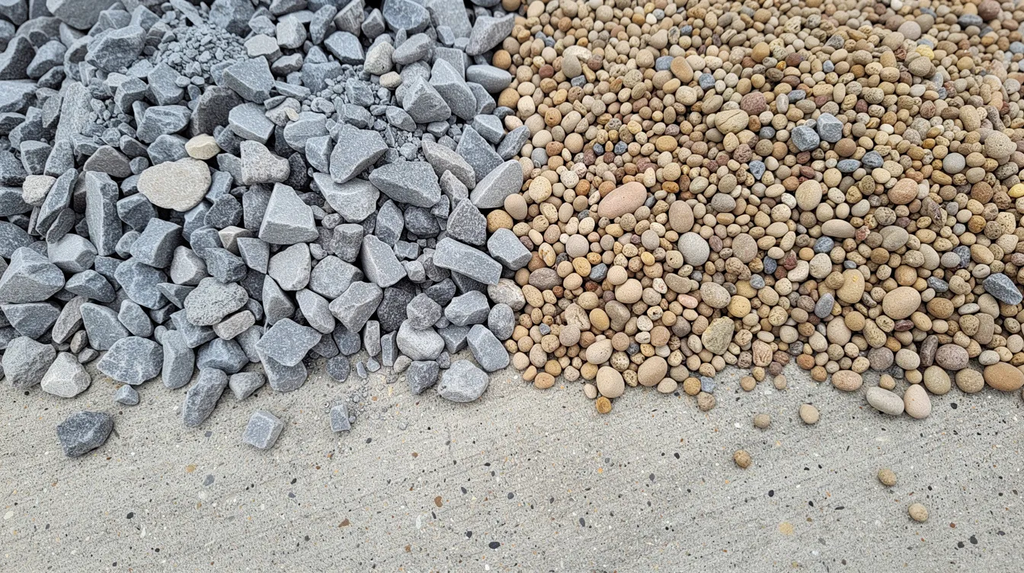
River rock is smooth, rounded stone ranging from about 1 to 3 inches in diameter. River rock is used primarily for decorative landscaping and water management: dry creek beds, borders around downspouts, and ornamental ground cover. It weighs about 1.35 tons per cubic yard, a little less than crushed stone, but it is more expensive per ton than standard crushed stone.
Many gravel yards also stock specialty products. Decomposed granite is finely fractured granite that packs down tightly, useful for paths and patios. Crusher run blends angular stone with fines for a road base that locks together after compaction. Lava rock, colored chips, and washed stone fill other niches. Durable stones like granite resist discoloration and breakdown better than softer stones, and lighter-colored gravels reflect sunlight and keep surrounding areas cooler than darker stones. Users can select a matching material, or enter their supplier’s density, in the Crushed Stone Calculator for more accurate gravel type density and tonnage output.
How Gravel Yards Sell: Tons vs Cubic Yards
- Gravel yards typically sell materials by cubic yard or ton. Some yards scoop with a loader and charge per cubic yard; quarries weigh the truck and charge per ton. Buyers comparing quotes from different suppliers need to convert between the two.
- Realistic loose-dry densities: pea gravel at about 1.30 tons per cubic yard, crushed stone at about 1.40 tons per cubic yard (roughly 1.3 to 1.55 depending on the stone), and river rock at roughly 1.35 tons per cubic yard. A general-purpose figure: a cubic yard of gravel weighs about 1.3 to 1.5 tons, from lighter materials like pea gravel up to denser road base.
- The Crushed Stone Calculator lets users toggle between cubic yards and tons, so the output matches whatever unit the local supplier uses.
- Example: ordering 5 cu yd of road base at about 1.5 tons per yard equals 7.5 tons. That fits in one dump truck load: Gravel Monkey puts a single-axle truck at about 6 to 10 tons and a tandem-axle truck at 12 to 16 tons.
- Many yards enforce minimum orders of 1 to 2 cubic yards or 2 to 3 tons. Knowing your volume in both units before calling speeds up the quote conversation and avoids surprises.
Estimating Volume: From Square Feet to Cubic Yards
Gravel is ordered by volume, but you measure your project in square feet and inches of depth. Converting between the two is the first real step.
For rectangles, multiply length by width to get the area in square feet. Multiply that area by depth in feet (divide inches by 12) to get cubic feet. Divide cubic feet by 27 to reach cubic yards, since one cubic yard equals 27 cubic feet.
Worked example: A 12 × 30 ft parking pad at 4 inches of gravel depth. Area = 360 square feet. Depth = 4 ÷ 12 = 0.333 ft. Volume = 360 × 0.333 = 120 cubic feet. Cubic yards = 120 ÷ 27 ≈ 4.44 cu yd. A smaller 20 × 10 ft area at the same 4 inches deep needs 2.47 cubic yards of gravel.
The calculator works the same way but automates every step: enter length, width, and depth, select feet or inches, and get cubic yards and cubic feet instantly.
For irregular shapes (curved paths, kidney-shaped beds), break the space into rectangles or approximate circles, sum their square feet, and enter the total. The same volume formula applies.
Using Waste Factor So You Don’t Run Short
A waste factor is a small percentage added to your base volume to cover spill-off at edges, uneven ground, and small measuring errors. It is an ordering buffer, not a compaction factor. Without it, most projects end up a few wheelbarrows short.
- Crushed Stone Calculator starts at 10% waste, a common starting point for most projects. Users can lower it to 5% for small, flat, bordered areas or raise it to 15% or higher for slopes, irregular edges, or hand-spread gravel cover.
- Example: a French drain calculation yields 2.0 cubic yards. Adding a 10% waste factor gives 2.2 cu yd, enough to avoid a second trip for a few missing loads.
- Many gravel yards round orders to the nearest half or whole yard anyway, so arriving with waste-adjusted numbers prevents being caught off guard when the supplier suggests adding more.
Overshooting by 5 to 10% is cheaper than a second delivery fee. Leftover gravel fills a low spot or tops off a garden bed; running short mid-project means downtime and another hauling charge.
Real-World Gravel Yard Examples
These scenarios reflect what homeowners and contractors encounter when ordering from a local gravel yard.
- Example 1: Driveway resurfacing. A 40 × 15 ft driveway at 3 inches of crushed stone. Area = 600 sq ft. Depth = 0.25 ft. Volume = 600 × 0.25 = 150 cubic feet ÷ 27 ≈ 5.56 cubic yards. At a density of 1.4 tons per cubic yard, that is about 7.8 tons. A single dump truck load handles the entire job. Plug these dimensions into the Gravel Driveway Calculator for instant confirmation.
- Example 2: French drain trench. 20 ft long, 12 inches wide, 18 inches deep. Cross section = 1 × 1.5 = 1.5 sq ft. Volume = 20 × 1.5 = 30 cubic feet ÷ 27 ≈ 1.11 cu yd. Clean gravel allows water to pass through more freely than crushed stone containing fines, so use washed stone here. At 1.4 tons per yard, that is about 1.56 tons. If the yard enforces a 2-ton minimum, the calculator helps you decide between delivery and pickup.
- Example 3: Decorative river rock border. A 90 ft border around three sides of a 30 × 30 ft patio, 2 ft wide and 3 inches deep. Area = 90 linear ft × 2 ft width = 180 sq ft. Volume = 180 × 0.25 = 45 cubic feet ÷ 27 ≈ 1.67 cu yd. River rock at $80 per cubic yard runs about $134 in material alone versus roughly $67 for the same volume of pea gravel at $40 per cubic yard.
In each case, users can enter dimensions into the gravel calculator, see cubic yards and tons, and call local suppliers armed with exact quantities.
Planning Gravel Yard Trips: Delivery vs Pickup
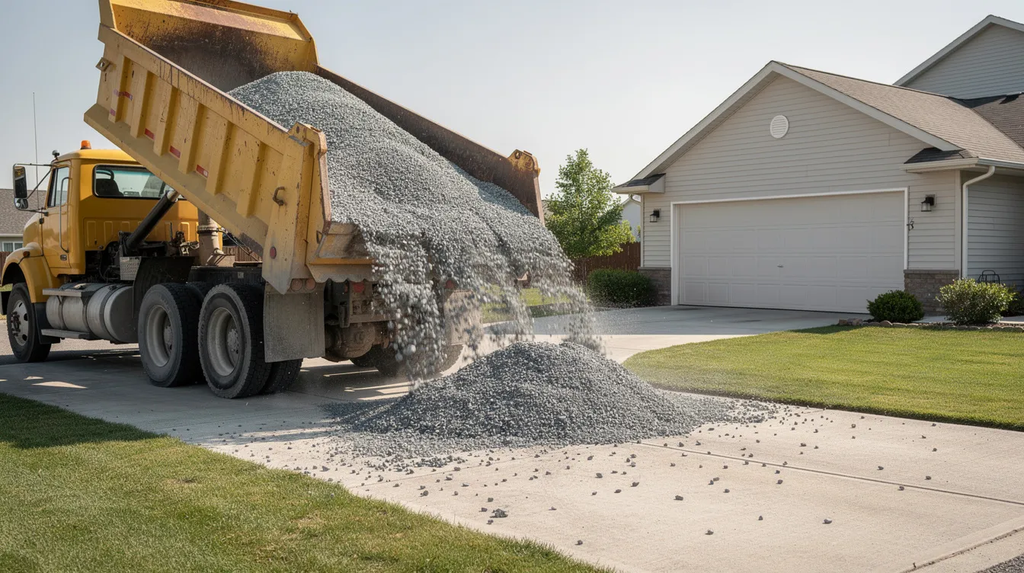
Gravel yards offer delivery by dump truck and customer pickup using a personal truck or trailer. Each option has trade-offs in cost, convenience, and safety.
- Delivery minimums typically start at 1 cubic yard or 2 to 3 tons. Angi puts gravel delivery fees at about $100 to $500 per load, depending on distance. Some yards charge a flat fee within a set radius and add a per-mile charge beyond it, so ask how the fee is figured.
- One cubic yard of crushed stone weighs roughly 2,800 lb (about 1.4 tons). That exceeds the safe payload of most half-ton pickups, so DIYers hauling their own material are limited to about 0.5 to 0.75 cubic yards per trip.
- If your job needs 5 cubic yards, seven to ten pickup trips will cost more in fuel, time, and wear than a single delivery. Use the calculator’s tonnage output to compare.
- Some yards can “tailgate spread” gravel along a driveway surface while dumping, saving hours of raking. Request this at scheduling and ask whether the yard charges extra for it.
- Labor rates for gravel installation run about $30 to $90 per hour if you hire help to rake and level after delivery: Angi lists about $30 per hour for a paving contractor, and Lawn Love lists $40 to $90 per hour for rock installation.
Choosing Gravel Depth and Layering for Different Projects
Gravel depth and layering strategy depend on the driving surface or landscape material application. Gravel should be ordered loose, then compacted in lifts for the best results. Compact each layer with a plate compactor for stability before adding the next.
- Driveways: A new gravel driveway is built in layers of about 4 to 6 inches each, for a total of 12 to 18 inches, according to Angi. The top layers are often 4 inches of compacted crusher run or road base topped with 2 inches of 3/4-inch crushed stone as the driving surface. Angular stones provide stability and interlock better than rounded stones for driveways. A geotextile fabric laid beneath the base layer helps prevent gravel from sinking into soil.
- Walkways and patios: About 2 to 3 inches of pea gravel or small crushed stone over a firm compacted base. Pea gravel and decomposed granite are suitable for garden walkways due to their comfort underfoot. Run separate calculations for the base layer and surface layer, then sum the volume.
- French drain: At least 6 inches of clean, washed crushed stone around the perforated pipe, filling a 12-inch-wide trench. Site preparation matters here; proper grading prevents water pooling near the foundation.
- Decorative beds: Most decorative or ground-cover gravel requires a depth of about 2 inches (50 mm), or 2 to 3 inches for larger river rock. Pea gravel or river rock at this depth hides soil and landscape fabric, but going shallower risks exposure over time as settling occurs. Mulch and sand are alternatives, but gravel lasts longer in beds where grass suppression is the goal.
Choosing the right gravel affects the cost, appearance, and longevity of landscaping projects. Each layer can be entered separately into the calculator for accurate totals.
Comparing Costs at Gravel Yards with Our Calculator
Material cost at gravel yards varies by gravel type, region, and haul distance. Gravel driveway costs run about $1 to $10 per square foot, depending on gravel type, driveway size, and site prep, according to Angi. Our calculator lets you plug in a local price per ton or per cubic yard for a quick estimate.
Call 2 to 3 local suppliers and ask for current per-ton pricing. Typical ranges: crushed stone costs about $20 to $45 per ton, pea gravel typically costs $30 to $55 per ton, and river rock runs $45 to $130 per ton depending on size and stone type.
Cost comparison example: A 400 sq ft patio at 3 inches of gravel depth needs roughly 3.7 cubic yards. At $40 per cubic yard for crushed stone, material cost is $148. At $80 per cubic yard for decorative river rock, the same volume costs $296. Heavier materials also yield more tons per cubic yard, which raises the delivery fee if the supplier charges by weight.
Under-ordering by even half a yard can trigger a second delivery fee of $100 or more, erasing any savings from picking a cheaper stone. The calculator’s waste factor and ton conversion address this directly.
Crushed Stone Calculator does not sell landscape material. It provides neutral, data-driven quantity and cost planning so you walk into a gravel yard knowing the difference between a $150 job and a $300 job for the same space.
Using Crushed Stone Calculator Before You Visit a Gravel Yard
Here is the workflow:
- Measure your space in feet (length and width). Decide on gravel depth in inches based on the project type.
- Choose a gravel type: crushed stone, pea gravel, river rock, decomposed granite, or another product available in different sizes at your local yard.
- Enter dimensions into the calculator. It outputs cubic yards, tons, and an optional cost estimate once you add a price per ton or per cubic yard from your supplier.
- Save or print the results. Bring “4.2 cubic yards of 3/4-inch crushed stone” to the yard instead of “I need some gravel for my driveway.”
- If the yard suggests adjusting depth or switching stone, rerun the calculator for instant feedback on how that changes cubic yards and budget.
Many gravel suppliers offer expert advice on selecting suitable materials for specific applications. Pairing their on-site knowledge with your pre-calculated quantities keeps the conversation focused on pavers, borders, concrete work, or whatever landscaping projects you have next, not on basic arithmetic.
Measure, calculate, call, order. Open the Crushed Stone Calculator now and get your numbers before your next trip to a gravel yard.