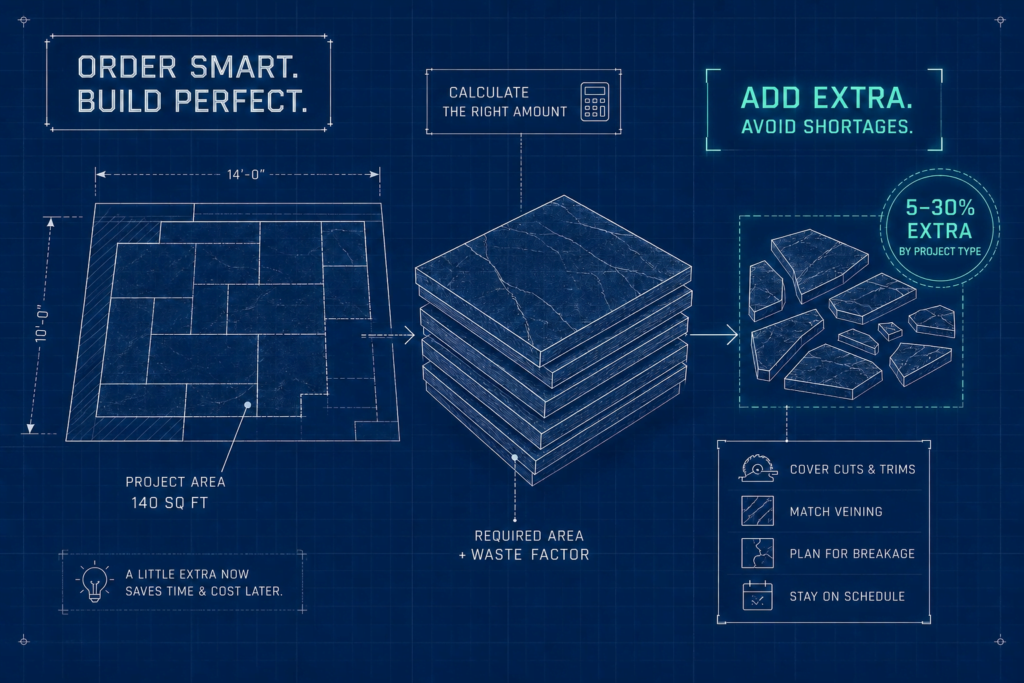
The waste factor for stone projects is the extra material you order beyond your measured area. For most jobs, order 10% extra for straight, simple layouts, 15% for diagonal or intricate patterns, and 15% to 20% for herringbone. Very intricate designs can need up to 30%. That extra is the waste factor: material lost to cuts, breakage and pieces you reject for color or shape.
This guide gives the waste factor for natural stone and travertine tile, stone cladding and veneer, slabs, pavers, flagstone and gravel, with the formula and worked examples. For crushed stone or gravel, our Crushed Stone Calculator adds a 10% order allowance automatically.
Table of Contents
Waste Factor for Stone Projects at a Glance: 10%, 15% or 20%?
Use this table as a starting point, then move up a step if your layout has many cuts, corners or curves.
| Project | Order Extra | Source |
|---|---|---|
| Tile, including natural stone and travertine, straight layout | 10% | HomeAdvisor, Clé Tile |
| Tile in a diagonal or intricate pattern | 15% | Clé Tile |
| Herringbone pattern | 15–20% | HomeAdvisor |
| Very intricate or complex designs | Up to 30% | HomeAdvisor |
| Stone veneer or cladding, flat walls | 10% | Stoneyard |
| Veneer with many corners, arches or irregular edges | 12–15% | Stoneyard |
| Flagstone patio or path | 10–15% | Hunker |
| Crushed stone and gravel | About 10% (15% for irregular areas) | Our calculators’ default |
| Bookmatched slabs | Set by the fabricator’s layout | See below |
What the Waste Factor Covers
Your measured area is the net area: the finished surface you want to cover. You almost always need to buy more than that, because some material never ends up in the finished surface:
- Off-cuts at edges, borders and around posts, steps and openings
- Pieces that break in delivery, unloading or cutting
- Pieces you reject for color, veining or shape
- A few spares for future repairs
Ordering everything at once also matters for appearance. Clé Tile notes that batches can vary in shade and finish, so buying all the tile and the extras together helps keep the color consistent. A second order later may not match.
For crushed stone and gravel, the waste factor is an order allowance for spreading loss, uneven ground and rounding. It is not a compaction factor. If the finished layer must be a set depth after compacting, plan the loose depth separately.
Waste Factor by Stone Type
Natural Stone and Travertine Tile
Natural stone tile, including travertine, follows the same rule of thumb as other tile. HomeAdvisor’s tile calculator recommends a 10% overage for cutting and breakage, 15% to 20% for herringbone because the pattern is cut at a 45-degree angle, and as much as 30% for intricate or complex designs. Clé Tile suggests 15% for intricate patterns or diagonal layouts, and notes that some diagonal layouts can need up to 25%.
Because natural stone varies in color and veining, you may also set aside pieces that do not blend. If you expect to sort carefully, stay toward the top of your range.
Stone Cladding and Veneer
For thin stone veneer and cladding, Stoneyard calls 10% the industry standard for flat walls and suggests 12% to 15% for projects with many corners, arches or irregular edges. Coronado Stone’s installation guide suggests ordering 5% to 10% extra.
Corners are a separate line item. They are sold by the linear foot, and Coronado says one linear foot of corner covers about ¾ sq ft of wall, so subtract that area from your flat stone. Stoneyard applies the same 10% waste factor to corners. Veneer quantities also assume a set joint width. Coronado’s profiles are packaged for a ½-inch grout joint, and it notes that you may need to adjust quantities for a different joint size, so tight-fit or dry-stack walls deserve a supplier check.
Bookmatched Slabs and Countertops
Slab projects are counted in whole slabs, not a percentage. The number of slabs comes from the fabricator’s layout of your countertops or wall panels. Bookmatched slabs are adjacent slabs cut from the same block with opposite faces polished, so the veins mirror each other. You cannot add a matching slab later from a different block, so confirm the full slab count with your fabricator before the slabs are cut or reserved.
Pavers and Flagstone
For pavers in a straight layout, 10% is the usual starting point. Move to 15% or more for diagonal layouts, curves and herringbone, as in the tile ranges above. For flagstone, Hunker’s estimating guide recommends adding 10% to 15% to your square footage to cover sizing and waste. Irregular pieces have to be fitted and trimmed, so random layouts sit toward the top of that range. Before you lay pavers or flagstone, see our patio base depth guide for the base under them.
Crushed Stone and Gravel
Bulk stone has no cuts or pattern waste, so about 10% is enough for most rectangular areas. Use about 15% for irregular shapes, slopes or uneven subgrade. Our gravel calculator and rock calculator use the same allowance, and you can change it.
Remember that this allowance does not account for compaction. Dense base materials such as crusher run compact more than clean stone such as #57, so if you need a set finished depth, plan the loose depth with your supplier.
What Pushes the Waste Factor Higher
- Pattern and angle: diagonal layouts and herringbone need more cuts than a straight layout.
- Shape of the area: curves, circles, bay windows, steps and posts each add cuts that leave small, unusable off-cuts.
- Joints: tight or dry-stacked joints leave little room to adjust a piece, so more pieces get trimmed.
- Fragile or thin material: thin veneer and large flagstone break more easily during handling.
- Color sorting: natural stone that varies a lot may need more pieces set aside.
Store stone off the ground, keep it covered and handle it carefully. Less breakage keeps you closer to the low end of your range.
The Formula: Net Area to Order Quantity
Use one formula for every stone type:
Order quantity = net quantity × (1 + waste factor)
Work out the net area (or volume) first, apply the waste factor, then round up to your supplier’s selling unit: boxes, pallets, cubic yards or tons.
Example 1: Paver Patio at 10%
A 300 sq ft patio with pavers in a straight layout: 300 × 1.10 = 330 sq ft. If your supplier’s pallet covers 100 sq ft, that is 3.3 pallets, so order 4. Pallet coverage varies by product, so use the figure your supplier gives. For the layers underneath, see our guide to gravel base for pavers.
Example 2: Stone Veneer Wall With Corners
A 200 sq ft wall (after subtracting windows and doors) with 12 linear feet of outside corners and several openings:
- Corner coverage: 12 × 0.75 = 9 sq ft
- Flat stone before waste: 200 − 9 = 191 sq ft
- Flats at 15% (many corners and openings): 191 × 1.15 = 219.7, order about 220 sq ft
- Corners at 10%: 12 × 1.10 = 13.2, order 14 linear feet
Example 3: Gravel Base in Tons
A 20 × 10 ft area at 4 inches deep with crushed limestone: 20 × 10 × (4 ÷ 12) ÷ 27 = 2.47 cubic yards. With a 10% allowance that is 2.72 cubic yards. At about 1.45 tons per cubic yard, order about 3.94 tons, so round up to 4 tons. One cubic yard of crushed stone typically weighs about 1.3 to 1.55 US tons, so check how much a yard of gravel weighs for your material, and see cubic yards vs tons if your supplier sells by weight.
As a quick check, one cubic yard covers about 81 sq ft at 4 inches deep, 108 sq ft at 3 inches and 162 sq ft at 2 inches.
How Much Flagstone Do I Need?
Measure the area in square feet, add 10% to 15% for fitting and waste, then divide by the coverage per ton or per pallet for your stone and thickness.
Flagstone Coverage per Ton
Thicker stone covers less area per ton. SiteOne lists most 1- to 2-inch flagstone varieties at about 80–100 sq ft per ton, with a few grades listed higher. Hunker’s rule of thumb gives more coverage:
| Flagstone Thickness | Coverage per Ton (Hunker) |
|---|---|
| ½ inch | About 400 sq ft |
| 1 inch | About 200 sq ft |
| 1½ inches | About 150 sq ft |
| 2 inches | About 100 sq ft |
| 3 inches | About 75 sq ft |
Real flagstone is irregular in thickness and shape, so coverage varies by stone and by yard. Use your supplier’s figure for the exact stone you buy. If you know the thickness and the stone type, our stone weight calculator can estimate the weight.
How Much Does a Pallet of Flagstone Cover?
It depends on the stone and thickness, but suppliers commonly list around 200–250 sq ft per pallet for patio flagstone. Texas Garden Materials (Houston) says a pallet of 1½- to 2-inch patio flagstone covers about 220 sq ft and weighs about 3,800–4,000 lb. Bee Green (Oakland, California) says a full pallet of its #2 Patio flagstone covers about 200–250 sq ft.
Example: 12 × 12 Flagstone Patio
A 12 × 12 ft patio is 144 sq ft. Adding 10% to 15% gives about 158–166 sq ft. At SiteOne’s 80–100 sq ft per ton, that is about 1.6 to 2.1 tons of 1- to 2-inch flagstone, or roughly one pallet at about 220 sq ft per pallet. Ask the yard to confirm before you order.
Waste Factor FAQ
What waste percentage should I use for travertine tile?
Use about 10% for a straight layout and 15% for diagonal or intricate patterns. Herringbone needs 15% to 20%, and very intricate designs can need up to 30%. Add a little more if you plan to sort pieces for color.
What waste allowance is normal for stone cladding?
About 10% for flat walls, and 12% to 15% for walls with many corners, arches or irregular edges. Order corners separately by the linear foot.
How much extra do bookmatched slabs need?
There is no single percentage. Your fabricator lays out the pieces on the slabs and tells you how many matching slabs you need. Reserve them all from the same block at once, because a slab from a different block will not mirror the others.
Order Right the First Time
Measure the net area, pick the waste factor for stone projects from the table above, apply the formula and round up to the supplier’s unit. For gravel and crushed stone, the Crushed Stone Calculator does the volume, tons and 10% allowance for you. If you are choosing stone for a drive, our guide to the best gravel for driveways compares the common options.
Before you order, ask the supplier about return policies. Restocking fees and rules for partial pallets or special orders vary, so a correct first order saves money.
Last reviewed: October 2026
Pingback: French Drain Gravel: Right Type, Size & How Much to Order
Pingback: Estimate Landscape Rock Fast: Calculator, Density, 3 Examples
Pingback: Order Right First Time: How Much Gravel You Need, Plus 10–15% Waste