Table of Contents
The best gravel for driveway surfaces is usually clean, angular crushed stone such as #57 stone, but the best overall driveway setup depends on your drainage, soil, climate, slope, and vehicle load. Most durable gravel driveways use a layered system, with crusher run or road base underneath for strength and compaction, then a stable top layer that sheds water and stays in place better than loose, rounded stone.
Choosing the wrong material shows up fast: ruts after the first heavy delivery, stone washing into the lawn, soft spots from poor drainage, and repair costs that wipe out any savings from picking the cheapest option. That is why homeowners, property owners, landscapers, and small contractors need to compare gravel by performance, not just by price or appearance.
This guide breaks down common driveway gravel types such as #57 stone, crusher run, pea gravel, limestone, and road base; explains where each one works best in the base, middle, or surface layer; and shows how drainage, freeze-thaw cycles, and traffic should shape your choice. It also covers installation basics, cost ranges, ordering tips, and how to estimate quantity with the Crushed Stone Calculator before you call a supplier, plus long-term maintenance so the driveway lasts.
Best gravel for driveways: types and how they actually compare
Crushed stone #57: the go-to surface layer
Number 57 stone is a common clean crushed stone used for driveway surfaces, drainage, and base projects. It is usually around 3/4 inch, though exact gradation can vary by supplier. Because it is clean and open-graded, water drains through it more easily than dense materials that contain fines.
The trade-off is compaction. #57 stone does not lock together as tightly as crusher run or dense-grade aggregate because it has fewer fines to fill the gaps. It works best as a surface or drainage-friendly layer over a properly compacted base. Used alone from top to bottom, it may shift or rut under repeated vehicle traffic, especially on soft soil or sloped driveways.
Crusher run and quarry process: the base layer workhorse
Crusher run, also called quarry process or dense-grade aggregate in some regions, is a mix of crushed stone and fines. The fines help fill voids between larger stones, allowing the material to compact into a dense, stable base. That is why crusher run is commonly used under gravel driveways, parking areas, and other surfaces that need load support.
The downside is appearance and drainage. Crusher run can be dusty in dry weather and may hold more moisture than clean stone because it contains fines. It can work as a budget surface material in some driveways, but many homeowners prefer using it as the base layer and adding a cleaner surface stone such as #57 on top. For a side-by-side look at how crusher run compares with clean surface stones, this comparison of crusher run vs #57 gravel is a useful reference.
Pea gravel: decorative but limited
Pea gravel’s smooth, rounded stones look attractive in photos and feel gentle underfoot on walkways. That rounded shape is also the reason it performs poorly as a primary driveway surface. Without angular edges to interlock after compaction, the stones can roll under vehicle weight, creating unstable footing and constant surface migration. Edging helps contain the material, but it does not solve the underlying problem.
Reserve pea gravel for light-traffic applications on flat, short driveways where aesthetics matter more than structural performance. Similar rounded options like river rock are usually better reserved for decorative accents or very low-traffic driveway sections, not primary driving surfaces. River gravel can work in those limited cases, but avoid using it on slopes or as the main surface on a driveway that sees daily vehicle use.
Limestone and road base: reliable across most projects
Crushed limestone can perform similarly to other angular driveway stones when cut to a similar gradation, and it is widely available across many parts of the U.S. Where available, crushed granite is another reliable option because it can offer strong durability and an upscale color palette with a more polished look. It often compacts well and provides solid footing, especially when used in base or surface layers suited to the project. Road base, sometimes called aggregate base or dense-grade aggregate, is functionally similar to crusher run in many regions and is commonly used as a base material.
Both materials suit projects where a stable, practical driveway surface matters more than a decorative finish. If your supplier offers limestone crusher run or local road base, it can be a solid choice for base layers at a competitive cost, depending on local availability and gradation.
Getting the layer system right: which size goes where
Base layer: the structural foundation
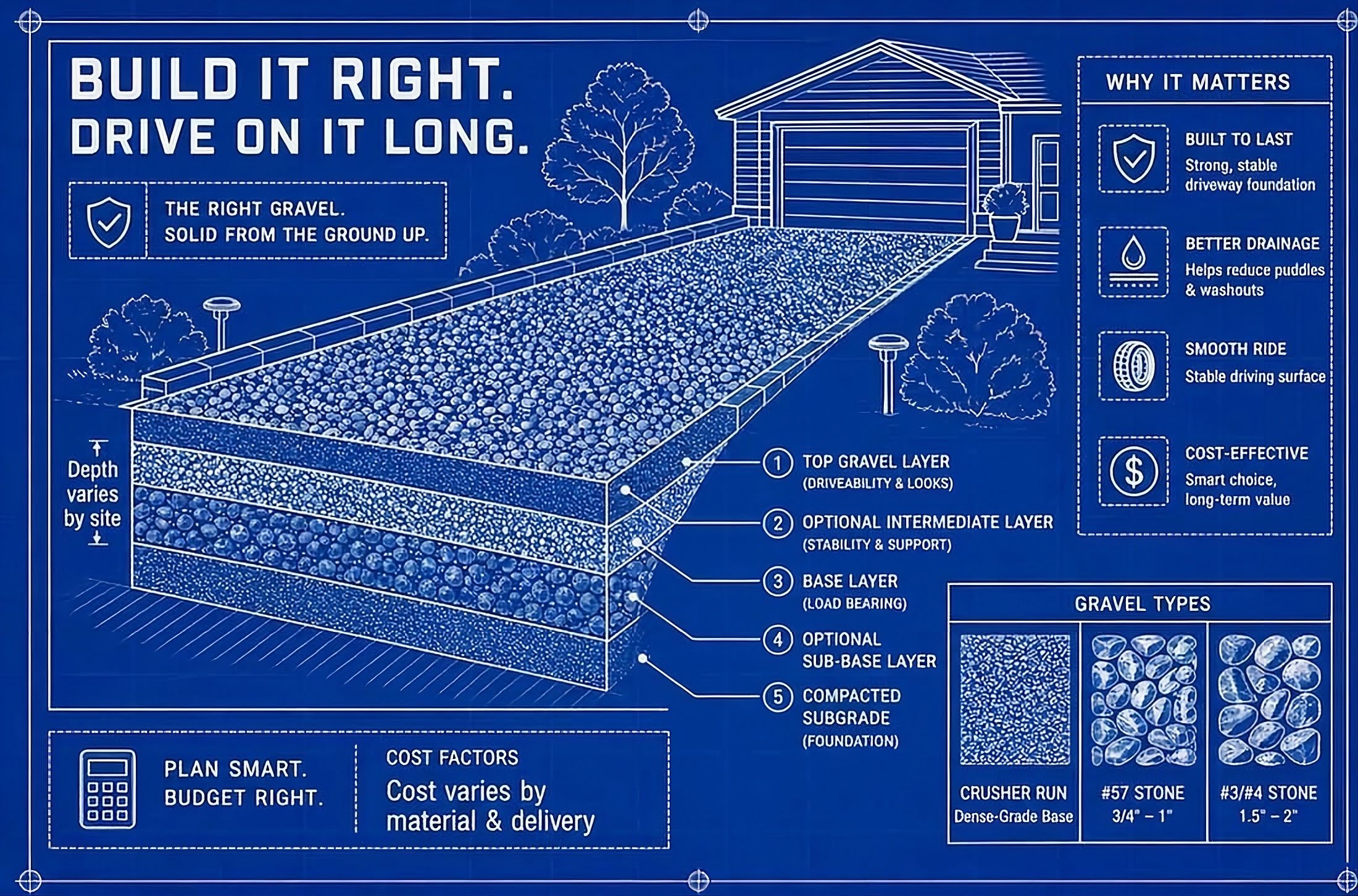
For many residential gravel driveways, the base layer is a compacted dense material such as crusher run, road base, or dense-grade aggregate. A 4 to 6 inch compacted base is a common starting point for light residential use, but weak soil, poor drainage, heavy vehicles, or freeze-thaw climates may require more depth.
In some projects, especially where the soil is soft or the driveway will carry heavier loads, larger angular stone such as #3 or #4 stone may be used below the dense base as an optional subbase. Larger gravel sizes in the lower layers can help distribute vehicle weight and improve stability over soft dirt or a weak subgrade before the base and surface layers are added.
Install deeper base material in separate lifts rather than dumping one thick layer at once. Many compactors work better when material is placed in manageable layers, often around 3 to 4 inches at a time. Compact each lift before adding the next one so the lower layer does not stay loose and create settling or soft spots later.
Binder or middle layer: bridging the gap
Some driveways use a middle layer of medium gravel between the larger subbase stone and the surface layer (about 1″–3″ in diameter), which supports better compaction and helps create a more stable surface above the base. This layer can help fill voids, lock the lower stone in place, and create a more even surface for the top layer. On short, light-traffic residential driveways with stable soil, this layer may not always be needed. Longer driveways, heavy-vehicle driveways, or weak-soil projects may benefit from the added structure.
Best driveway gravel for the surface layer: what your tires actually touch
The top 2 to 3 inches usually uses a cleaner, angular stone such as #57 or #67 crushed stone, with a gravel size of about 1/4 inch to 1 inch in diameter. Choosing the right surface gravel affects both durability and finish because this is the layer your tires contact every day. These stones provide a cleaner driving surface and better drainage than dense materials. Crusher run can also be used as a budget surface option, especially where stronger compaction is more important than appearance, but it may be dustier and less decorative than clean surface stone.
For guidance on selecting the correct particle sizes for the surface and layering, see this clear overview of what size gravel for driveways. The angular edges of crushed stone help the surface stay more stable than rounded pea gravel, which is why pea gravel is usually a poor choice for a primary driveway surface.
How drainage, climate, and vehicle load should shape your choice
Drainage: open-graded stone saves problem yards
If your yard holds water or your soil drains slowly, prioritize drainage-friendly materials such as clean #57 stone or crushed limestone for the surface layer. The void spaces in these materials help water move through instead of sitting on top. For most driveways, plan for a slight crown or cross-slope so water moves away from the driving path and away from structures, especially in areas with heavy rainfall.
Exact slope depends on the site, driveway length, soil, and local drainage conditions. On steeper driveways, drainage features such as ditches, swales, culverts, or water bars may be needed to reduce washouts.
Freeze-thaw climates: angular stone holds when the ground moves
In northern states and higher elevations, the ground can heave and soften through multiple freeze-thaw cycles during winter. Water expands by about 9 percent when it freezes, and that expansion can push upward through your driveway base. Angular crushed stone that is properly compacted can help the driveway stay more stable through repeated freeze-thaw movement than rounded aggregate. Rounded stone can loosen when the ground softens in spring, while angular material tends to resettle more predictably.
Gravel’s flexibility is actually an asset here. Unlike asphalt or concrete, a properly installed gravel driveway can heave slightly and be regraded or topped up when needed, as long as the material interlocks properly and your drainage keeps water from accumulating under the base.
Vehicle weight: not all driveways take the same beating
A standard two-car household driveway and a property that sees regular delivery trucks, farm equipment, or commercial driveways are two different design problems. Heavy, repeated loads usually require a stronger aggregate base and more compacted depth than light residential traffic. Recycled asphalt is another option in some areas, but availability, local rules, drainage behavior, and long-term surface performance should be checked before using it instead of gravel. Crushed granite, dense limestone, road base, or crusher run may be suitable depending on local availability, soil conditions, drainage, and supplier recommendations. For standard residential use with passenger vehicles, #57 stone over a compacted crusher run or road base layer is a common setup.
Installing your gravel driveway the right way
Excavation and site preparation
Excavation depth depends on soil, drainage, vehicle load, and the layer system you choose. For light residential use on stable soil, many projects start around 6 to 8 inches below finished grade. For a fuller base-and-surface driveway system, weak soil, poor drainage, clay-heavy soil, or heavier vehicles, 8 to 12 inches of excavation may be more appropriate, and geotextile fabric may be needed. Stabilization grids can also help prevent gravel from sinking or shifting on weak ground. Remove organic material, roots, and loose topsoil before laying your first layer, and remove any loose dirt if needed, because organic material compresses over time and can create voids beneath the base.
Check for underground utilities and verify local permitting requirements before you break ground, as requirements vary by county and project size. For a full step-by-step walkthrough, consult a practical DIY guide to installing a gravel driveway.
Layering and compaction method
Run a vibratory plate compactor over each layer before adding the next one. Base and middle materials are typically laid in lifts for better compaction, which also helps the driveway stay stable under traffic. Compact the base in thinner lifts rather than one thick pass. Many plate compactors work best when the material is placed in manageable layers instead of being dumped too deep at once. Lightly moisten dense materials before compacting to help fines bind, but avoid oversaturating because too much water can create soft spots. Make overlapping passes with the compactor rather than single straight lines, and work evenly across the driveway so the base locks together consistently.
Edging and slope
For reliable drainage, use a slight crown or cross-slope so water moves off the driving surface and away from structures. The exact slope depends on your site, driveway length, soil, and erosion risk. Where a steeper grade is not practical due to site constraints, even a modest slope can help move surface water in the right direction, but drainage performance depends on the full site layout. On narrow or sloped driveways, install edging along both sides to prevent the surface layer from migrating onto lawn or landscaping over time. Wide driveways may self-constrain better, but on drives where lateral migration is a concern, edging is worth considering.
What the material costs and how to estimate what you need
2026 price ranges by gravel type
For planning purposes, here are common bulk material price ranges before delivery. Actual prices can vary depending on supplier, region, gravel type, order size, and haul distance.
- Crushed stone #57: $20 to $35 per ton or $25 to $45 per cubic yard
- Crusher run: $24 to $34 per ton or $20 to $50 per cubic yard
- Pea gravel: $25 to $53 per ton or $25 to $67 per cubic yard
- Road base / aggregate base: $18 to $31 per ton or $25 to $62 per cubic yard
Bulk driveway gravel is usually cheaper than bagged stone for full driveway projects.
Delivery may be charged per load, per mile, or per ton depending on the supplier. Nearby deliveries may have a flat delivery fee, while longer hauls, small loads, difficult access, or multiple truckloads can increase the final cost. Always ask whether the quoted price includes delivery, fuel surcharges, minimum order fees, and spreading or dumping charges.
One cubic yard of common clean driveway gravel often falls around 1.4 to 1.5 tons, while broader crushed stone and dense base materials may range from about 1.3 to 1.7 tons depending on material density, moisture, and gradation. That matters when your supplier quotes in one unit and you’ve calculated in the other. For up-to-date regional gravel prices, check local cost guides before you finalize your budget.
Calculating your order before you call the supplier
Measure your driveway area, decide on each layer’s depth, then add a 10 to 15 percent waste factor as a common starting point for compaction loss, spillage, and uneven ground. Irregular terrain, soft soil, sloped areas, or highly compactable materials may need a larger buffer. These are the steps many homeowners skip, and the result is either a short order that slows the project or an overorder that leaves excess material behind.
The free Crushed Stone Calculator at CrushedStoneCalculator.com handles the estimate for you. Enter your project dimensions and material type and it outputs cubic yards, estimated tons, and a cost estimate based on your price per ton, all in seconds. It supports rectangular, circular, and triangular shapes and lets you adjust the waste factor to match your project. Run each layer separately to get a clearer breakdown before you call your local quarry.
Keeping your gravel driveway in shape long-term
Routine grading and replenishment
Rake and regrade the surface as needed, especially after heavy rain, freeze-thaw cycles, or visible rutting. High-traffic driveways may need surface touch-ups several times per year, while lighter residential driveways may need less frequent maintenance. If the surface layer becomes thin, add fresh #57 stone, crusher run, or your chosen surface material to restore depth and keep the driveway draining correctly. For additional maintenance articles and tips, visit our Blog.
Post-winter and seasonal inspection schedule
In freeze-thaw climates, inspect the driveway each spring after the ground fully thaws. Look for potholes, frost heave damage, and sections where the surface layer has thinned. Fill potholes by loosening the edges with a rake, adding fresh gravel to slightly overfill the depression, and compacting. Late spring and early fall are often good times for major grading work because the soil is workable but not saturated. Working when the base is frozen or waterlogged can produce inconsistent results that may need to be redone.
Putting it all together: the best gravel for driveways starts with the right system
The best driveway gravel comes down to a simple framework: match your stone type to your load, drainage conditions, climate, and budget rather than choosing by price or appearance alone. Use the right material at each layer, excavate to a depth that fits your soil and traffic, and compact each lift before moving on. A well-built gravel driveway can handle daily traffic, shed water cleanly, and be maintained more easily than a poorly layered surface.
Before you pick up the phone to call your supplier, plug your dimensions into the Crushed Stone Calculator. Enter your driveway measurements, select your material, and get your cubic yards, estimated tons, and cost figure in seconds. Keep up with routine maintenance and a properly built gravel driveway may hold its shape for years, depending on traffic, climate, soil conditions, and installation quality.
For legal information about site use, see our Disclaimer and Terms And Conditions.
Pingback: Gravel Driveway Installation Guide: DIY Layers, Depth & Cost
Pingback: Patio base depth guide: How deep to dig for pavers
Pingback: Gravel base for pavers: materials, depth, and installation
Pingback: No. 57 Stone Guide: Sizing, Uses, Price & How Much You Need
Pingback: Gravel Driveway Calculator: Tons, Yards & Cost Guide
Pingback: How much gravel do I need per square foot for a driveway
Pingback: Top Benefits of Using Washed Gravel in Construction and Landscaping
Pingback: The Best Landscaping Stone and Rock Options for Your Outdoor Design
Pingback: The Benefits of Using 22A Gravel for Your Landscaping Projects