Estimate solid stone, boulders, slabs, crushed stone, gravel, and bulk aggregate with transparent density assumptions and unit conversions.
Your estimate will appear here
Choose a material, enter measurements, and calculate. The result will show the density and method used.
Show calculation
Assumptions used
Recent estimates
Knowing the estimated weight of stone before you order, haul, or place it can help prevent costly mistakes – from overloaded vehicles to under-ordered material. Our stone weight calculator estimates the total weight of granite, marble, limestone, sandstone, slate, quartzite, engineered quartz, boulders, and crushed stone based on your dimensions and stone type. Enter your measurements, select your material, and get planning-level weight estimates in pounds, kilograms, U.S. tons, and metric tonnes within seconds.
Finally, a Stone Weight Calculator Built for Real Projects
Ordering natural stone without knowing its weight is one of the most common – and most expensive – planning errors in landscaping and construction projects. A single granite countertop slab can weigh over 600 pounds. A limestone boulder for a garden feature can easily exceed a ton. Stone and aggregate may be sold by the ton, cubic yard, square foot, or piece depending on the product and supplier, so understanding both volume and estimated weight can make ordering, delivery, and hauling decisions easier.
Most homeowners and contractors either guess, rely on rough rules of thumb, or attempt manual weight calculation with density tables and unit conversions. The result? Overloaded pickup trucks, surprise delivery charges, or equipment that can’t handle the load.
This stone weight calculator reduces guesswork by combining your measurements with a planning density for the selected material. The calculator estimates stone weight based on dimensions and density, and it supports various stone types like granite, marble, and limestone. Whether you’re planning a countertop installation, sizing a boulder delivery, estimating crushed stone for a driveway base, or calculating slate roofing loads, this tool calculates weight so you can plan with confidence.
Why Our Stone Weight Calculator Works
Here’s what makes this calculator practical for real project planning:
- Typical planning density presets for 15+ stone types – including granite, marble, limestone, sandstone, slate, quartzite, basalt, and other common materials, with custom density available when you have supplier-specific data.
- Automatic weight calculation from dimensions – no manual density lookup, no complex math; just enter length, width, and thickness
- Results in pounds, kilograms, U.S. tons, and metric tonnes – the calculator provides results in pounds, kilograms, U.S. tons, and metric tonnes so you can match delivery quotes, equipment ratings, and supplier invoices
- Works for slabs, blocks, boulders, and irregular stones – input rectangular dimensions for cut stone, or use the bounding box method for landscape boulders
- Supports moisture adjustment and bulk-material density options – moisture can change weight, while loose versus compacted conditions can affect the bulk density used for crushed stone and gravel estimates.
Users can enter project dimensions and choose a material type or custom density. For crushed stone, gravel, and other bulk-material projects, an optional waste factor can also be used when estimating how much material to order. Choosing the material type is essential to set the correct density value, because different stones have different densities typically measured in pounds per cubic foot.
How the Stone Weight Calculator Works
Getting a reliable stone weight estimate takes three steps. No engineering degree required.
Step 1: Select Your Stone Type
Choose your material from the dropdown: granite, marble, limestone, sandstone, slate, quartzite, engineered quartz, basalt, or enter a custom density if you have supplier data. Each stone type carries a different density that directly affects the final weight calculation. For example, granite density averages 168 lb/ft³, while crushed stone has a bulk density of about 105 lb per cubic foot. That density difference means the same volume of material can produce dramatically different weights.
If you’re working with crushed stone rather than solid stone, the calculator uses bulk density – which accounts for the air gaps between particles – rather than solid rock density.
Step 2: Enter Stone Dimensions
Input your stone dimensions in feet, inches, or metric units. Users can input dimensions in imperial or metric units – the calculator handles conversion automatically.
- For slabs, blocks, and rectangular stones: enter length, width, and thickness
- For boulders and irregular stones: measure the bounding box (maximum length, width, and height) using a tape measure, and the tool applies a shape factor to avoid overestimation
- Volume of a rectangular stone is length times width times height
- Volume of a circular stone is π times radius squared times thickness
Calculating stone weight requires measuring dimensions to find volume. To calculate volume, use consistent measurement units throughout – mixing inches and feet without conversion is one of the most common sources of error.
Step 3: Get Instant Weight Results
The weight formula is weight equals volume multiplied by density. Once you submit your measurements, the calculator returns:
- Estimated weight in pounds, kilograms, U.S. tons, and metric tonnes
- Dry weight and, where applicable, adjusted wet weight estimates
- Payload comparison notes when you enter your vehicle’s payload rating
Use these results for preliminary hauling, delivery, equipment, and cost estimation planning. The estimated weight can help you compare material quantities, supplier pricing, and delivery requirements. Do not use a planning-level calculator result by itself for structural design or critical lifting decisions such as crane selection; those applications require verified load data and appropriately qualified professionals.
What Makes Our Calculator Different
Most online stone weight calculators give you a single number based on fixed density and rectangular dimensions. Real projects need more than that.
- Wet stone weight adjustments – Moisture content matters. Natural stone water absorption varies widely by material and source; WONASA notes that absorption can range from near 0% in some marbles and granites to 10% or more in less-dense limestones. Rather than assuming one moisture percentage for every stone, the calculator lets you apply a moisture adjustment when appropriate and compare the dry planning weight with a moisture-adjusted estimate.
- Solid stone and crushed stone calculations – Solid granite at 168 lb/ft³ and crushed stone at approximately 105 lb/ft³ require completely different density factors. This tool handles both, adjusting for the void space and packing differences in aggregate and gravel products.
- Hauling payload comparison – Enter your vehicle’s payload rating and the calculator will compare it with the estimated stone load. Because payload varies by vehicle model, configuration, installed equipment, passengers, and other cargo, use the payload rating shown on your specific vehicle’s Tire and Loading label rather than relying on a generic truck category. If the estimated stone load approaches or exceeds the available payload, the calculator will flag it so you can consider multiple trips or an appropriately rated delivery or hauling option.
- Specialty stone support – The calculator supports material-specific planning density presets for quartz countertops, slate tiles, and engineered stone, not just the generic “granite or limestone” options found in most tools. Stone density varies by mineral composition and moisture content, so having material-specific values improves estimate quality.
Real Project Examples
These examples demonstrate how the stone weight calculator works with actual project scenarios.
Granite countertop slab: A granite slab measuring 8 feet long × 3 feet wide × 2 inches thick has a volume of 4 cubic feet. Using a planning density of 168 lb/ft³ gives an estimated weight of about 672 lbs. A stone this heavy requires appropriate handling and installation planning; do not use the calculator alone to determine safe manual lifting or equipment requirements.
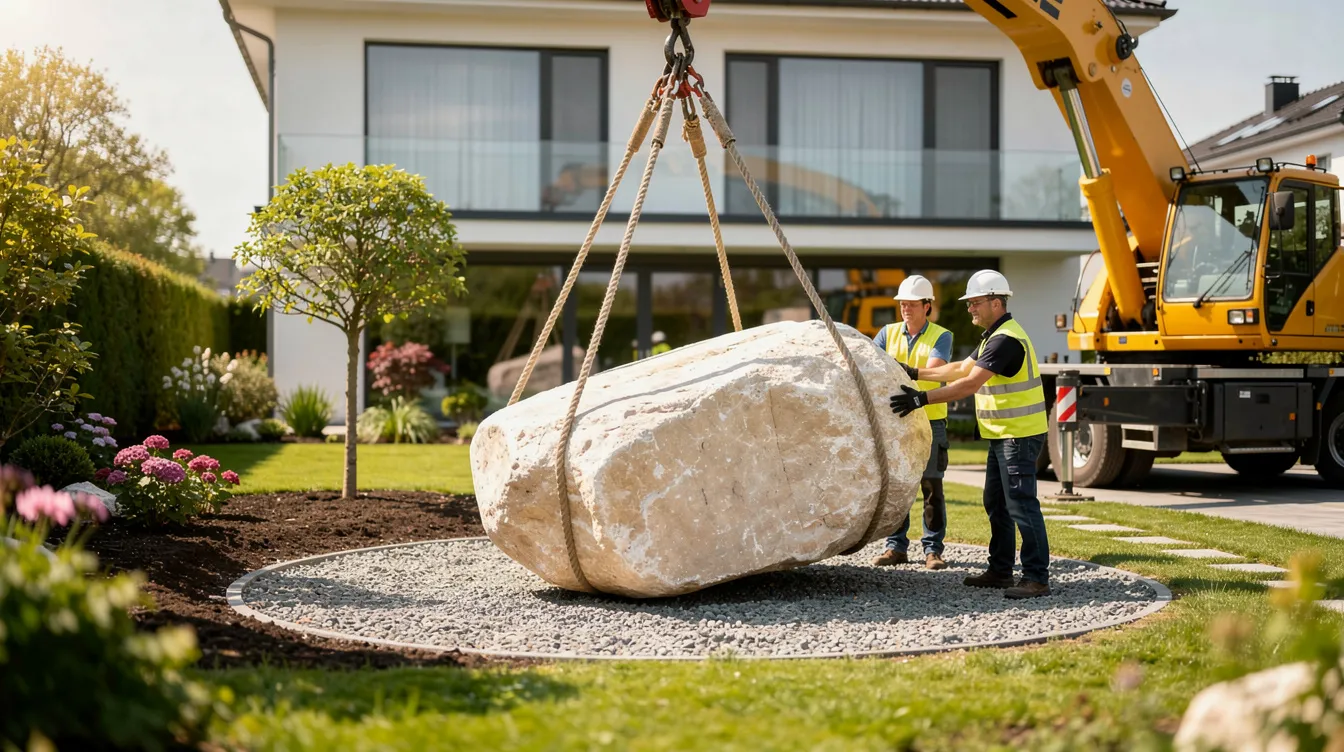
Limestone boulder for landscaping: A rounded landscape boulder measuring approximately 4 ft × 3 ft × 2.5 ft has a 30 ft³ bounding box. Treating it as an ellipsoid gives an estimated volume of about 15.7 ft³. At a planning density of 165 lb/ft³, the estimated weight is about 2,590 lbs (1.30 U.S. tons). Actual weight may differ because natural boulders do not form perfect ellipsoids and limestone density varies by source.
Crushed sandstone for a patio or base project: One cubic yard of crushed sandstone can be estimated at about 1.35 U.S. tons (2,700 lbs) as a planning value. Actual bulk weight can vary with particle size, gradation, moisture, compaction state, and supplier source. For paver base projects, knowing the estimated weight can help you plan delivery and hauling, while pricing by the ton can help you compare supplier quotes.
Slate roofing tiles for structural load: A standard slate tile at 12 in × 12 in × 0.25 in has a volume of about 0.0208 cubic feet. With slate density around 170 lb/ft³, each tile weighs approximately 3.5 lbs. Multiply by the total tile count to get a planning estimate of the slate material weight. For roof structural capacity, renovations, or additions, use verified product data and follow applicable building-code or professional structural requirements.
Who This Stone Weight Calculator Is For
This stone weight calculator is built for anyone who needs to estimate stone weight before committing to a purchase, delivery, or project:
- Homeowners planning countertop installations, landscaping features, stone veneer walls, or decorative boulder placement – and who need weight estimates before scheduling a delivery
- DIYers building retaining walls, patios, fire pits, or stone walkways who need to know whether their truck, trailer, or equipment can handle the load
- Small contractors and landscapers estimating delivery requirements, equipment capacity, and material costs for client proposals
- Property owners calculating boulder removal costs, stone monument weight for packaging and shipping, or aggregate volume for construction fill projects
If you need to calculate the weight of stone – whether it’s a single slab, a truckload of gravel, or a 3-ton landscape boulder – this tool was built for your workflow.
Calculator Accuracy and Limitations
The estimated weight can vary due to natural stone density differences based on several factors. Here’s what you should understand about the precision of any stone weight calculator:
Planning-level accuracy, not engineering-grade precision. These estimates are useful for material ordering, delivery planning, hauling, and preliminary equipment planning, but actual weight can differ because stone density, moisture, shape, gradation, and bulk void space vary by material and source. A regularly shaped stone measured accurately with supplier-tested density data can generally be estimated more closely than an irregular boulder or loose bulk aggregate. For structural design or critical lifting decisions, use verified material and load data and the appropriate qualified professional.
Natural variation is real. Granite commonly weighs around 160–175 lb/ft³ as a practical planning range, with about 168 lb/ft³ serving as a useful typical value for calculator estimates. Actual density can vary with mineral composition, porosity, quarry source, and the specific stone product, so supplier-specific density data should be used when available. Different materials can also vary substantially; for example, limestone and granite can differ significantly in density and project performance.
Moisture changes weight. Water absorption varies widely by stone type and source. Some dense granites and marbles absorb very little water, while less-dense limestones and some sandstones can absorb substantially more. If moisture is relevant to your project, use the calculator’s moisture adjustment or supplier-specific absorption data rather than assuming one percentage for every material.
Shape introduces uncertainty. A bounding box treats an irregular stone as if it completely fills its maximum length, width, and height, so it can overestimate volume. For a boulder that is reasonably close to an ellipsoid, the calculator can use the ellipsoid formula, which is π/6 × length × width × height (a factor of about 0.524). Naturally irregular, flat, fractured, hollow, or strongly asymmetrical stones may differ substantially from that approximation, so supplier scale data should be used when actual weight is critical.
Crushed stone varies by gradation and compaction. Crushed stone has a bulk density of approximately 105 lb per cubic foot, but actual density depends on particle size, gradation (e.g., #57 vs #67 stone), moisture in the stockpile, and whether the material is loose or compacted. Consider adding a waste factor of 5–10% to your order.
Recommendation: For large orders, ask your stone supplier for product-specific density or weight information when available. For dimension stone, suppliers may have tested density, bulk specific gravity, or water-absorption data; ASTM C97/C97M covers absorption and bulk specific gravity for dimension stone other than slate. For crushed stone, gravel, and other bulk materials, ask for the supplier’s typical loose or delivered weight per cubic yard and whether moisture or compaction affects that figure.
Frequently Asked Questions
How accurate is the stone weight calculator for different stone types?
The calculator provides planning-level estimates for delivery scheduling, hauling decisions, and material ordering. It uses practical density presets for common stone types—for example, about 168 lb/ft³ as a typical planning value for granite—and allows supplier-specific density when available. Actual weight can vary with quarry source, mineral composition, moisture, shape, gradation, and bulk void space, so no single accuracy percentage applies to every stone or project. For structural design or critical lifting decisions, use verified material and load data and the appropriate qualified professional.
Can I calculate weight for irregular boulders and landscape stones?
Yes. Measure the approximate bounding box around the boulder – maximum length, width, and height – using a tape measure. The boulder weight calculator applies an ellipsoid shape factor (roughly 0.524) to reduce the bounding box volume to a more realistic estimate for rounded or approximately ellipsoid-shaped boulders. Results provide reasonable weight estimates for equipment and delivery planning, though hidden shape features like undercutting or hollow pockets can still affect accuracy.
What’s the difference between calculating granite weight vs sandstone weight?
Granite density averages about 168 lbs per cubic foot, while sandstone typically ranges from 140–165 lb/ft³ depending on porosity and cementing agents. For the same volume, granite will often weigh more than a lower-density sandstone, but the exact difference depends on the specific stones and density values used. This difference matters significantly at project scale – for example, a 4 cubic foot slab in granite weighs about 672 lbs, while the same dimensions in sandstone might weigh 560–660 lbs. To calculate cost, multiply weight by price per mass from your supplier’s quote.
Does the calculator work for crushed stone and gravel?
Yes. Crushed stone calculations use bulk density – which accounts for air gaps between particles – rather than solid rock density. Crushed stone has a bulk density of about 105 lb per cubic foot, compared to 155–175 lb/ft³ for solid granite. The calculator adjusts for this difference automatically when you select crushed stone or gravel as your material type. For specific products like #57 stone or pea gravel, density can vary further based on gradation and compaction state.
How do I use weight results for truck and hauling planning?
Compare the estimated stone load with the payload rating for your specific vehicle before loading. Check the Tire and Loading Information label, usually located on the driver’s door or B-pillar, for the maximum combined weight of occupants and cargo. Passengers, tools, accessories, and other cargo all reduce the payload available for stone. If the estimated load approaches or exceeds the available payload, consider multiple trips or an appropriately rated delivery or hauling option. For wet stone, use an appropriate moisture adjustment rather than assuming one percentage for every material. If you are using a trailer, also verify the trailer, hitch, axle, tire, tongue-weight, and vehicle towing limits specified by their manufacturers.
What should I ask my stone supplier before ordering?
Ask your supplier for the material’s typical density or weight per cubic yard and make sure you know whether that value applies to solid stone, loose bulk aggregate, or compacted material. For dimension stone, ask whether product-specific density, bulk specific gravity, or water-absorption test data are available. For crushed stone and gravel, confirm the product name and gradation, typical weight per cubic yard, moisture condition if relevant, and whether the quoted figure represents loose or compacted material. Also ask whether delivery or shipping weights include pallets, crates, or other packaging. Using supplier-specific information in the calculator can give you a more project-specific estimate.
Weight equals volume multiplied by density for stone calculations – that’s the core formula behind every estimate this tool produces. The more accurate your measurements and density data, the more reliable your results will be.