Table of Contents
If you’re planning a gravel driveway, parking pad, or base layer for a building project, knowing the real crushed sandstone price before you order saves money and headaches. This guide breaks down current pricing per ton, per cubic yard, and per square foot, then walks you through exactly how much material your project demands.
Crushed Sandstone Price Overview
Crushed sandstone is usually one of the cheaper crushed stones. One Ohio quarry, Cornerstone Crushing (price list effective February 1, 2026), lists its main sandstone grades at $12.25–$22.20 per ton at the quarry, while its main limestone grades cost $36.75–$42.25 per ton. For crushed stone in general, HomeGuide’s national ranges (December 2025) run $10–$50 per ton and $15–$75 per cubic yard. No national survey prices sandstone on its own, so use these as starting points. Here’s the quick picture:
- Fill and base grades (2-inch minus and 1-inch minus): $12.25–$12.50 per ton at that Ohio quarry — ideal for rural driveways and farm roads.
- Clean driveway stone (Sandstone #57 and #4, 3/8 inch to 2 inches): $15.45–$22.20 per ton there — the sweet spot for most residential projects.
- Decorative or color-matched sandstone gravel: priced above plain base grades — attractive but commands a premium.
- Prices for crushed sandstone vary based on material type, processing requirements, and regional availability. Local market conditions and supply availability greatly affect crushed sandstone costs, so treat these as starting points and confirm with your nearest quarry.
- Crushed Stone Calculator lets homeowners enter project dimensions (length × width × depth) to instantly see how much gravel or crushed sandstone they need and estimate overall gravel cost.
What you’ll learn below: per-ton and per-yard pricing breakdowns, cost per square foot for common projects, delivery fee expectations, a step-by-step quantity calculator, comparisons to other crushed rock options, and practical tips to keep your total cost as low as possible.
What Is Crushed Sandstone & How It Compares to Other Crushed Stone
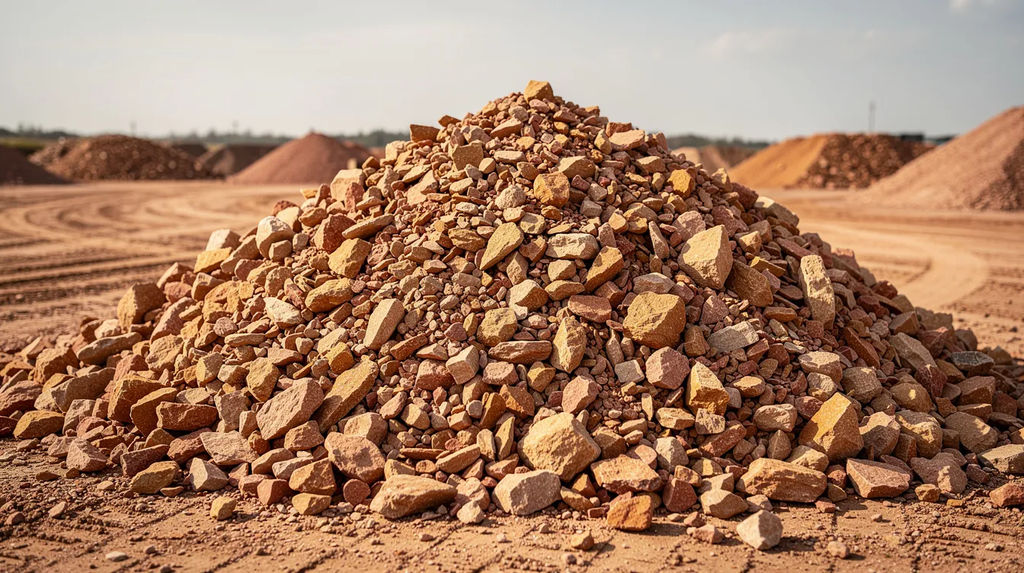
Crushed sandstone is a natural sedimentary rock — mostly quartz and feldspar cemented by silica, calcium carbonate, or iron oxide — that has been blasted or excavated and then processed through a crusher into angular aggregate. Common sizes include #57 (3/8 inch to 1 inch), #4 (1 to 2 inches), and minus grades such as 2-inch minus and 1-inch minus, which contain everything from coarse rocks down to stone dust and fines.
- Appearance: Typically tan, rust-brown, or light golden color depending on iron oxide content. It blends naturally with rural and suburban landscapes, unlike the grey of generic limestone or white of marble chips.
- Hardness & durability: Softer than crushed granite or traprock, so it wears faster under heavy wheel traffic. Crushed limestone is commonly used for driveways and paths and tends to be harder in many formations. Crushed concrete is recycled and often low-cost but less consistent.
- Drainage: A “minus” mix with fines compacts firmly and suppresses dust, though fines reduce macro-porosity. Screened sandstone drains better but may shift under traffic.
- Best uses: Light- to medium-duty driveways, garden walkways and pathways, farm tracks, building pads, and base gravel under pavers where the natural sandstone color is desired.
- When to choose harder stone: For heavy truck traffic, steep roads, or industrial construction, crushed granite or high-quality crushed limestone will outperform sandstone over time.
Crushed Sandstone Prices per Ton
Crushed sandstone is priced by the ton for bulk aggregate purchases, and crushed stone in general costs $10 to $50 per ton on average. Sandstone often sits at the lower end of that range.
- Fill and road base sandstone (1-inch or 2-inch minus): $12.25–$12.50 per ton at Cornerstone Crushing (Ohio, February 2026). Unscreened fill grades need less processing and command lower rates than decorative aggregates.
- Standard driveway-grade (Sandstone #57 or #4): $15.45–$22.20 per ton at the same quarry — the most common order for residential projects.
- Colored, screened, or decorative sandstone: priced above base grades, depending on processing and location.
- Order size matters: Per-ton delivery costs drop on bigger loads — HomeGuide notes the lowest per-ton delivery rates at about 17.5–20 tons. Small loads under a supplier’s minimum often carry an extra fee.
- Same-quarry comparison: At Cornerstone Crushing, Sandstone #57 lists at $15.45 per ton versus $39.15 for limestone #57 — less than half the price for the same size.
- Context: Crushed sandstone usually costs less than crushed granite at $25 to $50 per ton (HomeGuide), cheaper than river rocks or marble chips, and comparable to general base gravel. Online aggregate marketplaces can provide localized pricing information for your area.
Crushed Sandstone Price Table (Real Quarry List)
| Crushed Sandstone Grade | Size | Price per Ton | Approx. per Cubic Yard |
|---|---|---|---|
| Sandstone #57 | 3/8″–1″ | $15.45 | ~$21 |
| Sandstone #4 | 1″–2″ | $22.20 | ~$30 |
| Sandstone 1&2 | 2″–4″ | $19.00 | ~$26 |
| Sandstone 304 (fill) | 2″ minus | $12.25 | ~$17 |
| Sandstone 411 (fill) | 1″ minus | $12.50 | ~$17 |
| Sandstone primary fines | 3/8″ minus | $5.50 | ~$7 |
| For comparison: limestone #57 (same quarry) | 3/8″–1″ | $39.15 | ~$57 |
Crushed Sandstone Prices per Cubic Yard
Because some suppliers quote per ton while others quote per cubic yard, understanding the conversion prevents costly comparison errors. A cubic yard of gravel weighs about 1.3 to 1.55 tons; for crushed sandstone, use 1.35 tons (about 2,700 lb) as your planning average.
- Base-grade crushed sandstone: about $17 per cubic yard for 1-inch or 2-inch minus at the Ohio quarry above ($12.25–$12.50 × 1.35).
- Decorative or screened sandstone gravel: priced higher than base grades; convert any per-ton quote with the math below.
- Quick calculation: If the yard charges $25 per ton, one cubic yard at 1.35 tons costs roughly $34 (25 × 1.35). At $45 per ton for decorative stone, that cubic yard becomes about $61.
- For comparison, HomeGuide puts crushed stone in general at $15–$75 per cubic yard (December 2025) — the wide spread reflects the difference between raw road base and premium screened products.
- Small quantities warning: Bagged stone costs about $2–$6 per bag, and bags hold 2 cubic feet or less (HomeGuide). It takes 13.5 two-cubic-foot bags to fill one cubic yard, so for anything bigger than a small patch, buying in bulk is usually cheaper.
Crushed Sandstone Cost per Square Foot for Common Projects
Homeowners usually think in square feet for surfaces like a gravel driveway or patio, while suppliers quote per ton. This section bridges that gap using real numbers.
- 3–4 inch base gravel layer: roughly $0.15–$0.37 per square foot (materials only, at the Ohio quarry prices above).
- 2-inch resurfacing layer on an existing driveway: roughly $0.10–$0.19 per square foot. At a 2-inch depth, 1 ton of crushed sandstone covers about 120 square feet (80 at 3 inches, 60 at 4 inches).
- 4-inch new gravel driveway built entirely from crushed sandstone: around $0.26–$0.37 per square foot for #57 or #4 stone only. At this depth, 1 ton of crushed sandstone typically covers about 60 square feet.
- Assumptions: These estimates use a density of 1.35 tons per cubic yard and the Cornerstone Crushing prices above, before delivery. Price per ton ÷ square feet per ton = price per square foot; add delivery ($10–$25 per ton nationally) for a delivered figure.
- Comparison: Crushed concrete and generic base gravel sit at the low end of the cost spectrum; decorative gravel and crushed granite occupy the higher end.
- Labor: If you hire a crew for spreading and compacting, the cost depends on site access, soil conditions, and equipment needed. HomeGuide puts a fully installed gravel driveway at $4–$10 per square foot, so get an installed quote if you won’t do the work yourself.
Crushed Sandstone Delivery Costs & Full Truckload Pricing
Delivery often makes up a bigger share of total crushed sandstone cost than the stone itself, especially for rural jobs or small orders. Crushed sandstone pricing is influenced by delivery distance from the quarry, so always ask for delivered price, not just material price.
- Local delivery: delivery typically adds $10–$25 per ton (HomeGuide, December 2025), depending on supplier, load size and haul distance.
- Flat trip charges: Some small landscape yards charge a flat trip fee instead of a per-ton rate, so ask how delivery is priced before you compare quotes.
- Free delivery zone: Many suppliers deliver free on a 5-ton minimum within a short distance (about 5 miles in HomeGuide’s delivery section). Standard dump truck loads usually provide lower per-ton delivery pricing than smaller loads.
- Truckload example: A 10-cubic-yard load (about 13.5 tons) of 2-inch minus crushed sandstone at $12.25 per ton plus $10–$25 per ton delivery comes to about $300–$500 total (stone + haul). That works out to roughly $22–$37 per ton delivered.
- Extra mileage: Beyond the free zone, expect about $10 per extra mile (HomeGuide).
- Spreading is extra: Many haulers only dump at your delivery location. Tractor or skid-steer spreading costs extra, so clarify before you order.
What to Ask Your Supplier Before You Order
- Is the price per ton or per cubic yard, and is it the quarry price or the delivered price?
- What is the delivery charge, the minimum order, and the fee for a small load?
- How many tons does the truck carry, and will they spread the stone or only dump it?
- What is the exact product name and size (for example #57, 2-inch minus or 1-inch minus), so you compare the same stone between suppliers?
- Do they have a weight per cubic yard for this product? If so, enter it as a custom density in the calculator.
How Much Crushed Sandstone Do You Need? (Using the Crushed Stone Calculator)
The most common homeowner question is “how much gravel do I need?” The same formula applies to crushed sandstone, crushed granite, and base gravel. To estimate gravel, multiply length, width, and depth in feet — then convert.
- Step 1: Measure length × width of the area in feet.
- Step 2: Choose compacted depth — gravel driveways should be 4–6 inches deep for stability; 2–3 inches works for resurfacing or paths.
- Step 3: Convert depth to feet (divide by 12), multiply by area to get cubic feet, then divide by 27 to get cubic yards.
- Step 4: Multiply cubic yards by 1.35 (the Sandstone setting in our calculator) to estimate tons of crushed sandstone.
- Worked example: A 12 ft × 50 ft driveway resurfaced with 3 inches of crushed sandstone: area = 600 sq ft, volume = 600 × 0.25 = 150 cu ft = 5.56 cubic yards, tons = 5.56 × 1.35 ≈ 7.5 tons. At $25 per ton, that’s roughly $188 for materials. With a 10% order allowance, you’d order about 8.25 tons. For a 1,000 sq ft area at similar depth, you’d need about 12.5 tons of gravel (about 13.75 with 10% allowance).
- Use the tool: Crushed Stone Calculator lets you select crushed sandstone, enter your dimensions and depth, and instantly see cubic yards, tons, and an optional cost estimate based on your local price per ton.
- Waste factor: Always order extra gravel to avoid running out during installation. Add about 10% for spillage, uneven ground, irregular edges and measuring error. This order allowance does not cover compaction — for a compacted base, ask your supplier how much loose stone to order for the finished depth.
Crushed Sandstone vs Other Gravels: Cost & Best Uses
Choosing the right material means weighing price against performance. Here’s how crushed sandstone stacks up against common alternatives you can explore in our best gravel for driveways guide.
- Crushed concrete: Often $11–$53 per ton (HomeGuide) — a low-cost option for deep base layers and eco-friendly, though it can contain inconsistent pieces.
- Crushed granite: $25 to $50 per ton, very durable and attractive, excellent for top-course gravel layer applications.
- Crush and run gravel (crusher run): $24 to $34 per ton — a mixture of crushed rock and fines that compacts well for roads and driveways.
- Pea gravel: $28 to $45 per ton, smooth and attractive for landscaping, and 1 ton of pea gravel covers about 62 square feet at 4 inches deep. River rock is ideal for landscaping and water features but even pricier: about $33–$49 per ton in HomeGuide’s price table, and $45–$130 per ton depending on size and color.
- Where sandstone excels: Rural driveways and farm tracks where tan or golden color is preferred; compacted road base under a bigger gravel driveway or parking pad; backfill and sub-base where fines help bind and create a firm surface.
- Limitations: Softer than granite, so not ideal for heavy truck traffic or steep grades. May break down faster in freeze-thaw cycles. Decorative screening adds cost.
- Mix strategy: Use a thick sandstone base layer topped with a thinner gravel layer of crushed granite or pea gravel for a longer-lasting, more attractive surface at moderate cost.
Project Examples: Realistic Crushed Sandstone Cost Scenarios
These scenarios use 2026 prices from the sources above and the Crushed Stone Calculator steps so you can mirror the process for your own project.
- Example 1 — Small 10′ × 20′ parking pad, 4″ deep: Area = 200 sq ft. Volume = 200 × 0.333 = 66.7 cu ft ≈ 2.47 yd³. Tons = 2.47 × 1.35 ≈ 3.3 tons. At $22/ton material + $15/ton delivery = $37/ton delivered, total estimates come to about $123 for stone and haul (a load this small may carry a minimum delivery fee).
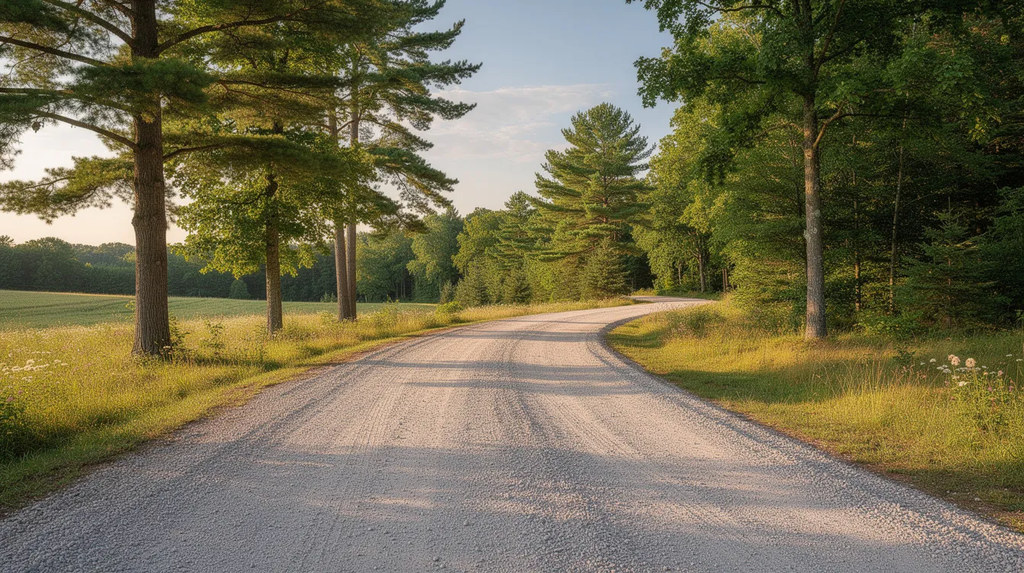
- Example 2 — 12′ × 60′ rural driveway, 6″ of 1-inch minus crushed sandstone in two lifts: Area = 720 sq ft. Volume = 720 × 0.5 = 360 cu ft ≈ 13.3 yd³. Tons = 13.3 × 1.35 ≈ 18.0 tons. At $12.50/ton material + $12/ton delivery = $24.50/ton delivered, material + delivery ≈ $440. Spreading and compaction with equipment would be additional.
- Example 3 — 200 sq ft garden path, 2.5″ crushed sandstone base under decorative top: Volume = 200 × 0.208 = 41.7 cu ft ≈ 1.54 yd³. Tons = 1.54 × 1.35 ≈ 2.08 tons. At $40/ton delivered, base stone costs about $83. Switching to crushed granite for the base would cost roughly $35–$75 per ton delivered (HomeGuide granite $25–$50 plus $10–$25 delivery) — a bigger expense, and about 10% more tons for the same depth because granite is denser. The decorative mulch or pea gravel top layer adds separately.
Tips to Save on Crushed Sandstone Without Sacrificing Quality
Seasonal demand influences prices, typically peaking during spring and summer, so timing your buy matters. Here’s how to keep your crushed sandstone cost as low as possible.
- Buy full truckloads: Ordering a full truckload at once typically unlocks lower prices per ton and reduced delivery charges. Larger project purchases often receive better pricing per ton than smaller retail purchases, and bulk commercial purchases generally qualify for discounts compared to retail rates.
- Layer strategically: Use crushed sandstone for the deep base layer (where nobody sees it) and finish the visible surface with a thinner, more attractive gravel like bark-colored pea gravel or screened granite.
- Shop local: Check quarries, landscape yards, and recycled material suppliers near your delivery location. Crushed concrete or mixed base gravel may be a cheaper substitute for the deepest layers beneath your driveway.
- Share delivery: Combine orders with neighbors to split haul fees, or schedule weekday deliveries when demand is lighter.
- Test scenarios: Use the Crushed Stone Calculator to compare “what if” depth changes — switching from 6 inches to 4 inches of crushed sandstone, or swapping part of the area to cheaper base gravel — before you buy.
Using Crushed Sandstone Safely & Effectively in Your Project
Proper installation protects your investment and prevents the kind of ruts and washouts that force expensive do-overs. Follow these steps from our gravel driveway installation guide.
- Prep the subgrade: Strip topsoil, dirt, and organic soil. Use landscape fabric beneath gravel to block weeds from pushing through over time.
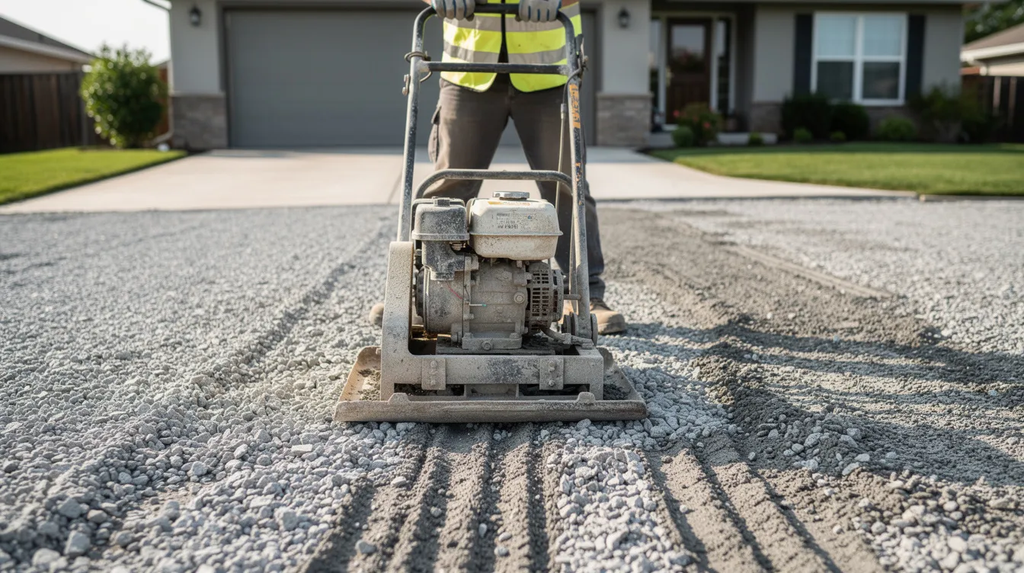
- Install in lifts: Place crushed sandstone in 2–3 inch layers and compact each lift with a plate compactor or roller before adding the next. Skipping compaction is the most common mistake — it leads to settlement, ruts, and wasted materials.
- Crown for drainage: Build the center of a gravel driveway slightly higher (about ¼ inch per foot of width) so water sheds to the edges instead of pooling. Ignoring moisture management is what turns driveways into mud in wet weather.
- Fines as binding base: Crushed sandstone with sand-sized fines and stone dust compacts very firmly, making it excellent base gravel below pavers, concrete pads, patios, and small outbuildings.
- Plan for maintenance: Top up your driveway surface with 1–2 inches of fresh crushed stone every 1–3 years depending on traffic. Use the calculator each time to see how much gravel you need for the refresh — it’s usually far less than the original order.
Crushed Sandstone Price FAQ
How much is a ton of crushed sandstone?
It depends on the grade and your location. Cornerstone Crushing in Walhonding, Ohio lists its main sandstone grades at $12.25–$22.20 per ton (fines $5.50) on its February 2026 price list, and HomeGuide puts crushed stone in general at $10–$50 per ton (December 2025). Delivery usually adds $10–$25 per ton.
How much does a cubic yard of crushed sandstone weigh?
About 1.35 US tons (roughly 2,700 lb) as a planning value. One cubic yard of crushed stone typically weighs about 1.3 to 1.55 US tons. Actual weight varies about ±10% by source, gradation and moisture, so use your supplier’s number if they give one.
Is crushed sandstone cheaper than limestone?
Often, yes. At the same Ohio quarry, Sandstone #57 lists at $15.45 per ton versus $39.15 for limestone #57. Sandstone is softer, though, so limestone or granite is usually the better choice for heavy traffic.
How much area does a ton of crushed sandstone cover?
At 1.35 tons per cubic yard, one ton covers about 120 square feet at 2 inches deep, 80 square feet at 3 inches, and 60 square feet at 4 inches.
Ready to get started? Measure your project area, open the Crushed Stone Calculator, and compare crushed sandstone products against other aggregates for both cost and performance before you place your order. Getting the right quantity on your first delivery saves both money and hassle.
Last reviewed: October 2026