Table of Contents
No. 57 stone is one of the most widely used crushed stone grades in the United States, valued for its clean, open-graded structure and strong drainage. If you are standing at a local yard trying to figure out whether it is the right material for a driveway, a French drain, or a concrete base, this guide walks through exactly what No 57 stone is, how it is sized, where it works best, and how it compares with other common aggregates like #67 stone and crusher run.
What Is No 57 Stone?
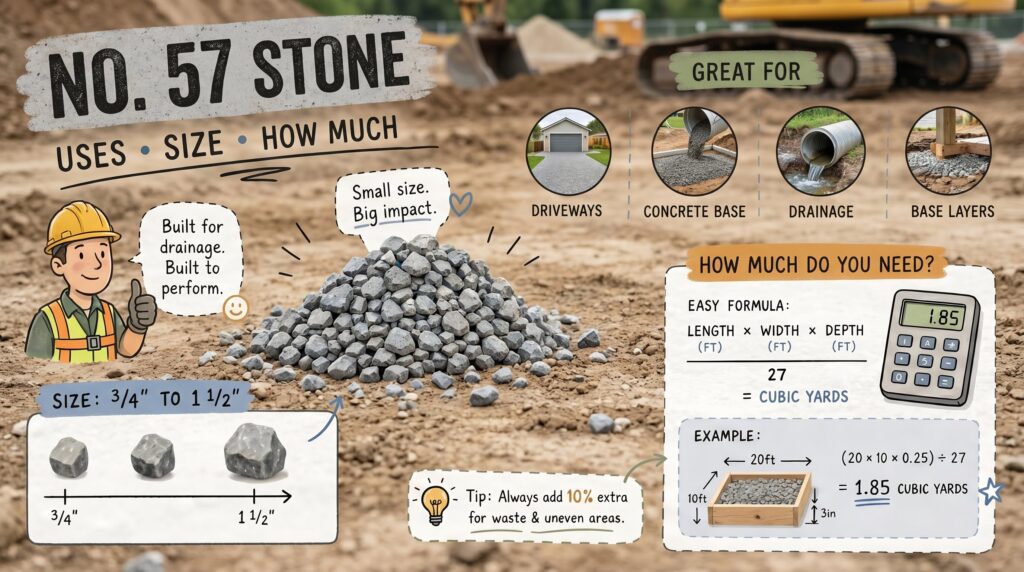
No 57 stone is a crushed stone aggregate whose individual stones typically range from about 3/4 inch to 1 inch, with very little fine material. The “57” is not a measurement — it is a size number from a standard specification (the AASHTO M43 system) that defines the aggregate size by how the material passes through a series of sieves. In other words, “57 stone” tells a supplier the gradation you want, not the rock type.
Because it contains minimal fines, No 57 stone is described as an open graded aggregate: the uniform, larger stones leave open voids between individual stones, so water can drain naturally through the layer. That single property — free drainage — is why this stone size shows up in so many construction and landscaping projects.
The stone itself is usually crushed from natural rock deposits such as limestone or granite, so it has angular, individual stone facets rather than the smooth texture of rounded river gravel. Those angular edges help the material lock together and hold heavy loads better than same-size rounded gravel.
What Does #57 Stone Look Like and What Size Is It?
If you pour a pile of No 57 stone, you will see mostly 3/4-inch to 1-inch angular pieces of a fairly consistent stone size, with almost no sand or dust. The pieces are not all the exact same size — a proper gradation includes a controlled range of smaller pieces down to about a #4 sieve — but there is far less variation than you would see in a dense-graded product like crusher run.
Under a formal sieve analysis, No 57 stone passes a 1-1/2 inch sieve completely, is mostly retained above a #4 sieve, and carries only minimal fines below that. This is what gives the material its clean, free-draining character and its familiar look at the aggregate yard.
No 57 Stone Gradation and Standard Specification
The gradation is defined by the AASHTO M43 standard specification, which many state agencies and quarries follow. The specification sets the percentage of material that should pass each sieve size, which is why a #57 product from one yard behaves much like a #57 product from another, even when the parent rock differs.
Knowing the specification matters when you order. Buying by the size number (“give me #57”) rather than by a vague description (“some 3/4 gravel”) is the reliable way to get consistent aggregate size, because the number ties directly to a defined gradation rather than a local nickname.
Common Uses for No 57 Stone
No 57 stone is genuinely versatile, and most of its applications trace back to the same two strengths: strong drainage and good load support. Here are the jobs it does best.
French Drains and Drainage Solutions
For a French drain, dry well, or any trench that has to move water, clean No 57 stone is a go-to drainage layer. The open voids let water flow to the perforated pipe instead of pooling in the soil. A best-practice install wraps the trench and pipe in a non woven geotextile fabric so surrounding soil cannot wash into the stone and clog the drainage over time. For areas that require drainage after heavy storms, this combination of washed stone and fabric is hard to beat.
Driveways and Driveway Projects
On a gravel driveway, No 57 stone is often used as a top or surface layer, or as a free-draining layer over a compacted base of dense material. Because it is open graded, it does not pack into a hard, sealed surface the way crusher run does — the same voids that make it drain well also mean it stays looser underfoot. Many driveway projects therefore use a dense base material first (for a solid base) and finish with #57 for drainage and a clean surface.
Concrete Mixes and Concrete Aggregates
No 57 stone is a standard coarse aggregate for concrete mixes. Its size and clean gradation make it a common choice among concrete aggregates for slabs, footings, and general structural concrete, where a uniform, angular stone helps the mix perform predictably.
Base and Backfill Applications
Beyond drainage, No 57 stone works as a base layer under slabs and pavers, as a slab base, as pipe bedding, and as structural backfill. It is a frequent pick for retaining wall backfill and general wall backfill, where its free-draining nature relieves water pressure behind the wall. It also appears in road base and road shoulders work, and even in railroad projects, wherever a clean, load-bearing, draining aggregate is needed. For a paver base, it is typically used within a properly designed open graded base rather than as the final leveling course.
No 57 Stone vs Other Crushed Stone Grades
One of the most common questions is how No 57 stone compares with the grades sitting right next to it. Understanding these different grades helps you match the right material to the project.
| Grade | Typical size | Fines? | Best for |
|---|---|---|---|
| No 57 stone | ~3/4″–1″, open graded | Minimal | Drainage, concrete, base, backfill |
| #67 stone | ~3/4″ nominal, slightly smaller top size | Minimal | Concrete, drainage in tighter sections |
| Crusher run | Mixed sizes plus stone dust and fine material | Heavy fines | Compacted base that needs a solid, firm surface |
| #411 | #57 blended with fines | Some fines | Compactable base and driveway top |
No 57 vs #67 stone: Both are clean, open-graded aggregates, and they overlap heavily. The practical difference is top size — #57 runs a touch larger at the top of its range, while #67 tops out slightly smaller. If your project requires the material to fit a tighter section or screen, #67 may be specified; for general drainage and concrete, they are often interchangeable, but always confirm which your plan calls for. Between the two, #57 is usually the marginally larger aggregate size.
No 57 vs crusher run: This is a difference of purpose, not just size. Crusher run is a dense-graded material full of fine material and stone dust, so it compacts with a plate compactor into a hard, solid base. No 57 stone, being open graded with minimal fines, does not compact the same way — it stays free-draining. Choose crusher run when you need a firm compacted surface, and #57 when you need water to move through the layer.
No 57 vs 3/4 stone and 2B: In many regions “3/4 clean stone” and “2B” are close cousins to #57, but the exact gradations vary by area. Confirm the local equivalent with your yard rather than assuming the names match exactly.
Washed vs Unwashed No 57 Stone
Washed No 57 stone has been rinsed to remove the last of the fine material and stone dust, leaving an especially clean product ideal for drainage applications, exposed decorative use, and concrete. Unwashed stone can cost a little less and is fine where a small amount of dust is not a problem, such as some base and backfill uses. For drainage-critical work, spend the small premium on washed, clean stone.
Compaction and Installation Tips
Because No 57 stone is open graded, it behaves differently from base products during installation. It will settle and the angular faces will interlock somewhat, but it will not tighten into a sealed surface the way a dense-graded material does. When you do place it as part of a base, work in a thin layer and level it so the stones are properly oriented and evenly supported. Where the design calls for compaction under a slab or paver base, follow the project’s specification and lay geotextile below the drainage layer to keep soil and stone separated for the long term.
How Much No 57 Stone Do You Need?
To estimate quantity, you need the length, width, and depth of your area. Multiply length x width x depth (all in feet) and divide by 27 to get cubic yards, then convert to tons using the stone’s density. No 57 stone has a density of roughly 1.3 to 1.5 tons per cubic yard, and many estimates use about 1.4 tons per cubic yard as a practical planning value.
Rather than doing this by hand, enter your dimensions into the Crushed Stone Calculator — pick your material, set your depth, and it returns cubic yards, tons, and an optional cost estimate, with a built-in waste factor you can adjust for irregular shape areas or uneven ground.
What Does No 57 Stone Cost?
Pricing depends on rock type, whether the stone is washed, your region, and order size, and No 57 is typically priced per ton because it is sold by weight. For current pricing ranges and how truckload size affects the per-ton rate, see our detailed guide on the cost of 57 stone. As a quick planning note, buying a full truck load usually lowers the price per ton compared with a small order, and delivery is often quoted separately.
Frequently Asked Questions
Why do they call it 57 stone? The name comes from the size number in the AASHTO M43 standard specification. Each number defines a specific gradation, so “57” identifies the sieve profile of the aggregate, not a rock type or an exact dimension.
What size is #57 stone? Individual stones generally range from about 3/4 inch to 1 inch, with a controlled amount of smaller pieces and minimal fines.
Is 57 stone the same as gravel? Not exactly. “Gravel” often refers to naturally rounded stone, while No 57 stone is crushed and angular. They can be used for similar jobs, but the angular shape of #57 helps it lock together and support heavy loads better.
Is 57 or 67 stone bigger? No 57 stone is usually the slightly larger of the two at the top of its size range; #67 tops out a bit smaller. Otherwise they are close and often interchangeable for drainage and concrete.
Are 3/4 and 57 stone the same? They are close in many areas, and #57 is frequently sold as “3/4 clean stone,” but local gradations vary — confirm with your supplier.
Is #57 stone the same as 2B? In some regions they are treated as equivalents, but the exact specifications differ by area, so check the local definition before ordering.
What is the difference between #57 and #411 stone? No 57 is clean and open graded, while #411 is essentially #57 blended with fines so it can compact into a firmer base. Use #411 or crusher run when you need a solid, compacted surface, and #57 when you need drainage.
How many tons of #57 stone are in a dump truck? It depends on the truck, but a standard tandem dump truck commonly carries in the range of a dozen to twenty-plus tons. Confirm the exact load size and any delivery minimums with your local yard.
What is #57 gravel good for? Its most common uses are French drains and other drainage solutions, driveways, concrete mixes, and base or backfill applications behind retaining walls and under slabs.
Pingback: How Much is a Ton of Gravel? Cost Breakdown and Options Explained
Pingback: The Best Uses for Crushed Limestone in Construction and Landscaping
Pingback: Understanding Crusher Stone Price: A Guide for Buyers and Contractors
Pingback: Understanding Crushed Rock Price: Factors and Trends You Need to Know
Pingback: Understanding 3/4 crushed stone price : What to Expect and Consider
Pingback: Understanding Type A Gravel: Uses, Benefits, and Characteristics
Pingback: Understanding 2 Gravel: Types, Uses, and Key Properties
Pingback: Understanding Gravel 1: Uses, Benefits, and Characteristics
Pingback: Clean Stone Guide: Uses, Sizes, Drainage, Driveways & Cost
Pingback: Gravel Sizes Guide: Choose the Right Stone for Any Project
Pingback: Understanding 67 Stone: Uses, Benefits, and Key Characteristics
Pingback: Essential Guide to Rock Sizing for Landscaping and Construction
Pingback: Gravel or Crushed Stone: Choosing the Right Aggregate for Your Project
Pingback: The Best Uses and Benefits of 5/8 Minus Gravel for Your Projects
Pingback: Understanding the Price for Gravel: What to Expect and Consider
Pingback: Understanding the Benefits of SB2 Gravel for Your Landscaping Needs
Pingback: Top Benefits of Using Washed Gravel in Construction and Landscaping
Pingback: 1 Inch Minus Gravel: Uses, Benefits, Installation Tips, and How Much You Need
Pingback: 57 Stone Rock: Uses, Sizes, Coverage & How Much You Need
Pingback: How Much Does a Yard of Gravel Weigh? Essential Facts and Calculations
Pingback: Essential Aggregate Gravel Size Chart for Your Construction Needs